
Home / Research / Beyond trade? Chinese private capital under the African Continental Free Trade Area
Beyond trade? Chinese private capital under the African Continental Free Trade Area
Published: November 6, 2025
•
International Affairs, Volume 101, Issue 6, November 2025, Pages 2253–2264
Abstract
Since the early 2000s, imports from China have largely substituted imports from Europe; since the 2010s, Chinese firms are also localizing production activities in African economies. Increasing Chinese investment raises the question of whether the localization of Chinese private capital supports Africa's structural transformation and development objectives, especially as the African Continental Free Trade Area (AfCFTA) is implemented. The policy paper details the evolution in the presence of Chinese private capital in Ghana, where Chinese traders have considerable market presence and where more than 400 Chinese-owned manufacturers registered operations between 2004 and 2024. The shift from trade to manufacturing creates opportunities for employment and regional value chain development, but challenges remain around uneven value capture and uncoordinated regulatory frameworks. To harness Chinese private capital, policy should prioritize the embeddedness of investment to support industrialization and broader socio-economic development. The paper offers two sets of recommendations: Ghana: forming a dedicated trade regulatory body to clearly define trading activities and developing a milestone-based incentive regime to link foreign investment to local business development and capacity-building. AfCFTA: harmonizing trade and investment policies to prevent regulatory competition, and ensuring growing labour and environmental standards to avoid a ‘race to the bottom’ and capital flight.
Regions
Themes
Cite This
Gambino, E. (2025). Beyond trade? Chinese private capital under the African Continental Free Trade Area. International Affairs, Volume 101, Issue 6, November 2025, Pages 2253–2264. https://doi.org/10.1093/ia/iiaf177
Full Text
In the twenty-first century, economic globalization has been marked by a major shift in the direction of global trade, which is now increasingly concentrated around South–South exchanges. This has mostly been a ‘China story’, as China's share of global trade jumped in US dollar terms from just over 2 per cent in 1997 to 12 per cent in 2022. China-led global value chains and production networks have thus become central to global economic flows. This is most evident in African markets where, since the early 2000s, imports from China have largely substituted for those from Europe; China has thus become the largest trading partner for most African nations. The total value of China–Africa trade grew from just under US$10 billion in 2000 to $262 billion in 2023.
Chinese imports into African markets are often considered to be a threat to nascent industry and part of Africa's consumption dependency, thereby undermining African development agendas. However, Chinese-made finished goods enter Africa and travel across national borders—formally and informally—with seemingly little regulation or intervention by African governments. Across African markets, rapidly growing Chinese imports have had varying impacts on local production and consumption. On the one hand, Chinese machinery and parts have provided some local producers with upgrading opportunities, and the availability of cheap products has supported small-scale traders in accessing affordable goods that are particularly popular among consumers with little purchasing power. On the other hand, the increase in imports of Chinese-made finished goods has been connected to decreasing local manufacturing outputs and has caused grievances among local importers and distributors, particularly when Chinese products are imported and sold by Chinese traders operating locally.
A transition is now under way. Privately-owned Chinese companies that were previously engaged solely in importing finished goods are increasingly assembling and producing goods—although, for the most part, partially producing—in Africa. For instance, for the last 20 years one Chinese-owned company has been producing PVC tubes in Ghana using a mix of imported and recycled materials sourced locally. Its two factories employ around 300 workers, and the factory located in Greater Accra recently expanded into assembling light bulbs that are now on sale in nearby China Malls. Most notably, the ceramic tile manufacturer Twyford Ghana—a joint venture between the privately-owned Chinese companies Keda Industrial Group and Sunda International—was the first Ghana-based Chinese company to export locally-manufactured products under the African Continental Free Trade Area (AfCFTA) agreement of 2018.
African countries have long been striving to lower barriers to intercontinental trade, which currently accounts for 15 per cent of total trade. Tariff reduction initiatives within African regional economic communities—such as ECOWAS, the Economic Community of West African States—have had varying degrees of success, with the result that these communities became the building blocks of a much broader trade integration initiative, the AfCFTA. The AfCFTA seeks to create the world's largest free trade area, with a combined GDP of about US$3.1 trillion and a market of 1.5 billion people. The AfCFTA carries significant potential for the localization of Chinese private capital—this refers to the processes by which Chinese companies anchor their operations in African markets, through setting up manufacturing plants, sourcing inputs locally and responding to local economic and regulatory conditions. This trend is particularly visible as companies move from importing finished goods towards value-adding activities, in what Tang refers to as a shift ‘from trade to investment’. While this shift implies employment creation and the broadening of industrial production, questions remain around the extent to which value is captured by Chinese actors alone and, consequently, whether this shift supports industrialization efforts in Africa. Can the localization of Chinese private companies support structural transformation in African economies?
This policy paper draws on the case of Ghana to explore avenues to harness the transformative potential of Chinese capital under the AfCFTA. Ghana was one of the first countries to embrace the AfCFTA agenda and the AfCFTA Secretariat is hosted in Accra. The previously mentioned example of Twyford, the first Chinese company to trade its Ghana-manufactured products under the AfCFTA, is only one of more than 400 Chinese-owned manufacturing companies registered in Ghana between 2004 and 2024. Ghana's experience with the localization of Chinese capital can offer valuable insights into how increasing flows of Chinese foreign direct investment (FDI) can support the structural transformation of African economies. The policy paper contributes to current work on the potentialities and challenges associated with the AfCFTA by extending and developing existing understandings of the ways in which Chinese private capital is increasingly anchored in African economies.
This paper is based on extensive mixed-methods fieldwork research conducted in Ghana between 2022 and 2025; this research involved
1) more than 50 semi-structured interviews with West African traders involved in the trading of Chinese goods, Chinese business owners and managers of Chinese import–export and manufacturing companies, and Ghanaian government officials;
2) ethnographic observations among Chinese entrepreneurs and in Ghana's largest market, Makola;
3) a geolocation exercise based on field observations to capture the presence of Chinese retail and wholesale shops in Greater Accra, conducted between June and July 2024; and
4) site visits to Chinese companies in Greater Accra.
The paper proceeds as follows. First, it explores the evolution of the presence of Chinese private businesses in Ghana, focusing on trade and manufacturing in the twenty-first century. Second, it focuses on Chinese private capital localization to explore the varying impacts of these businesses on the local economy. Finally, the paper offers recommendations for the harnessing of Chinese private capital under the AfCFTA to support structural transformation.
The evolution of the presence of Chinese private businesses in Ghana
In the first two and a half decades of the twenty-first century, the number of Chinese migrants in Ghana is estimated to have grown significantly from around 2,000 in the late 1990s to more than 100,000 in early 2025. This increase is mostly related to
1) the intensification in the state-backed internationalization activities of Chinese state-owned enterprises (SOEs);
2) the opportunities emerging from the informal gold mining sector;
3) increased demand for Chinese goods and services in light of increased migration; and
4) the centrality of Chinese imports in Ghana's economy.
First, the increase in Chinese-funded projects in sectors such as infrastructure boosted the numbers of short-term migrant workers in Ghana. Between 2000 and 2008 alone, Chinese state-owned policy banks committed a total of US$1 billion in loans to Ghana's power and transport sectors. As highlighted by previous studies, sometimes short-term migrant workers employed by Chinese SOEs decide to remain in the African country where they have been working, in order to pursue entrepreneurship ventures. Such has been the case in Ghana, where many of the businesspeople interviewed had previously worked in subsidiaries of large Chinese SOEs.
Second, the economic potential of the rapidly expanding small-scale gold mining sector in the aftermath of the 2007–2009 financial crisis (and the consequent increase in global gold prices) attracted Chinese miners to Ghana. An estimated total of 50,000 Chinese miners operated in Ghana's Ashanti Region—which is thought to host Africa's second largest gold reserve—between 2008 and 2013. According to Botchwey et al., the Ghanaian Immigration Service recorded an official total of 20,300 arrivals of Chinese citizens in 2013 alone. Nevertheless, the Chinese ‘gold rush’ in Ashanti Region soon faced a backlash, as the Minerals and Mining Act of 2006 reserved small-scale (artisanal) gold mining for Ghanaian citizens. In 2013, following an outcry around the growth of Chinese small-scale mining, the Ghanaian government launched a crackdown on illegal mining activity, leading to the departure of almost 4,600 Chinese citizens. Afraid of further repercussions, many Chinese miners left Ghana, moving to other countries in the region such as Burkina Faso, Mali or Côte d'Ivoire, or entered other sectors such as trade or real estate. Further crackdowns during the first presidential term of Nana Akufo-Addo (2017–2021) prompted many other Chinese migrants to either leave the country or shift to other sectors.
Third, as the numbers of Chinese migrants in Ghana grew, a steady increase in demand for Chinese goods and services contributed to the unfolding of a new wave of entrepreneurial migration. The total number of registered Chinese companies—both state-owned and privately owned—reached 560 in 2014. The Ghana Investment Promotion Centre (GIPC) Act of 2013, discussed below in more detail, reserves certain business activities—such as retail activity in market spaces—for Ghanaian citizens, except in cases where a minimum foreign capital requirement is met.
Fourth, Chinese imports have gained considerably in importance within the Ghanaian economy in the past two decades. The value of total trade between China and Ghana rose sharply from US$0.3 billion in 2003 to over $11 billion in 2023. Chinese importers also gained rapidly in visibility as they began opening representative offices and shops, particularly in the Makola market in Accra, the country's largest. Before the GIPC Act of 2013, 80 per cent of a total of 157 trading businesses were registered in Ghana as franchises of Chinese companies (although, at times, these are companies in name only), while 20 per cent were registered as joint ventures. After the minimum investment requirement for non-citizens was raised to US$1 million and the presence of foreign traders limited to wholesale in 2013, many of these shops closed. Overall, the proportion of Chinese companies registered as joint ventures with the GIPC between 2014 and 2021 fell to 15 per cent, half the proportion of companies registered as joint ventures between 2000 and 2014.
As shown in figure 1—the result of a mapping exercise undertaken through field-based geolocation in June and July 2024—close to 200 retail and wholesale shops were located in Greater Accra. The map highlights the higher concentration of Chinese shops (in white on the heat map below) in the area of Greater Accra hosting the Makola Market, as well as in Tema, which hosts a large number of Chinese companies and migrants working in industries requiring continuous and easy access to Ghana's largest port of Tema. The types of Chinese shops range from Chinese private companies or family businesses, with both retail and wholesale operations, to franchises of large Chinese firms and China Malls, the latter of which are mainly focused on retail. Businesses are opened by Chinese representatives directly connected to producers, by staff of Chinese companies that have reached commercial agreements with Ghanaian traders, or they can be franchises of larger companies often present in multiple African countries. As such, the majority of these firms purchase directly from Chinese producers and distributors. This not only lowers costs but can also enable targeted marketing—for instance by launching French brand names to make products appealing to francophone African markets—and the inclusion of consumer feedback in light of growing provision of aftersales services.
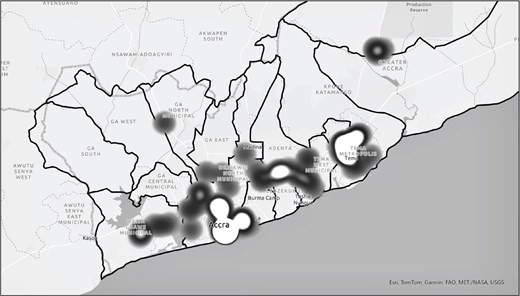
Figure 1:Heat map of Chinese wholesalers and retailers in Greater Accra
Note: This heat map shows the concentration of Chinese wholesalers and retailers in the Greater Accra region as of July 2024. Color intensity represents the presence of said businesses, with areas in white showing higher concentration and those in grey lower concentration.
Source: Field-based geolocation dataset of Chinese traders in Accra (2024); author's own compilation.
The localization of Chinese private capital in Ghana
Since the promulgation of the first GIPC Act (Act 478) in 1994, which established a minimum investment of US$200,000, and its subsequent amendment in 2013, a lively debate has ensued around foreign participation in restricted sectors. In 2012 Ghanaian traders represented by the Ghana Union of Traders Association (GUTA) put intense pressure on the government to enforce the laws regulating trade in Ghanaian markets.34 In response, a task force was created to ensure that only certified foreign retailers were operating in Ghanaian markets, which resulted in the locking up of certain shops and the amendment of the GIPC Act in 2013.
The GIPC Act of 2013 sets the conditions for foreign businesses wishing to begin operating in Ghana. Section 27 of the 2013 Act states:
A person who is not a citizen or an enterprise which is not wholly owned by [a] citizen shall not invest or participate in … the sale of goods or provision of services in a market, petty trading or hawking or selling of goods in a stall at any place.
This provision aims to protect the market sector, which contributes significantly to employment creation and the broader economy. Although the GIPC Act of 2013 restricts foreigners from operating in markets, it does not ban them outright from trading, which suggests that most controversies emerge around the definition of what constitutes a market. Some stakeholders interpret the GIPC Act of 2013 as stating that foreigners are not permitted to trade in retail per se, rather than in retail within market spaces.
At times, however, the GIPC has struggled to negotiate its mandates to promote/incentivize trade and to enforce the country's investment policy. As one Ghanaian official stated, the GIPC effectively ‘holds both the carrot and the stick’. The lack of a streamlined and coherent investment policy has the potential to increase the risk of capital flight, as foreign investors may lose confidence in the stability of the Ghanaian economy. During the field research for this study, several foreign investors spoke of the high costs associated with doing business in Ghana: evidence provided by private-sector organizations suggests that some businesses have already began relocating to neighbouring countries, such as Côte d'Ivoire.
Over the past decade, the GUTA has continued to advocate for the strict implementation of the GIPC Act of 2013, initiating recurring protests including a four-day shop lockup in 2014, threatening legal action against foreign-operated shops in 2021 and organizing an operation targeting mobile phones operated by foreigners in Koforidua in the Eastern Region in 2023. In July 2024, the GUTA formally submitted inputs to parliament as an amendment to the GIPC Act of 2013 was being discussed. These inputs advocate for the minimum investment requirement in the trade sector to be raised to US$2 million, but exclude Ghanaian goods and companies operating under the AfCFTA. They also underscore the need for ‘trading’ to be defined more clearly. According to GUTA, ‘[t]rading simply means buying and selling of imported goods’.
As shown in figure 1, Chinese retail and wholesale shops are currently present within and outside market spaces, which has varying impacts. While Chinese traders have long been operating in Ghana, the composition of local participation in the trade sector is evolving. Chinese companies are increasingly capturing the market roles previously only undertaken by Ghanaian traders, who have long been travelling to China to inspect and order goods for distribution in the Ghanaian and wider regional market. Many market traders in Ghana still often travel to China, but the costs involved with these journeys have increased, leading many to exit the trading business or rely on intermediaries, online platforms or buying from Chinese traders physically present in Ghana.
Additionally, competition among Ghanaian and Chinese traders unfolds differently depending on business size, type of goods, sale modality and collective agency. First, the size of a local business shapes the extent to which it is affected by the growing presence of Chinese traders. Small- and mid-sized businesses selling Chinese products are often the first to be affected. Second, the type of goods being traded determines the degree of Chinese involvement in the downstream of different value chains. For example, Chinese footwear wholesalers dominate the streets of Makola market, which reflects the significant share (4 per cent) of all Ghanaian imports from China accounted for by footwear. At the same time, the availability of cheap Chinese imports can support small-scale traders and widen access to everyday necessities for consumer with low purchasing power.
Third, Chinese retailers are shaping how consumers expect products to be presented and sold, which in turn affects Ghanaian retail businesses. For example, market traders selling curtains reported sharp decreases in retail sales, while wholesale trade in the sector remained constant. Mirroring Obeng's findings, they traced the evolution of consumer preference to the fact that China Malls sell ready-made curtains, whereas market traders require clients to collect made-to-order curtains after a few days. The China Malls are grounded manifestations of the shift in the import composition of Ghana. These large retail stores, selling China-made products ranging from household appliances and furniture to make-up and children's toys, have been opening across all major cities in Ghana since the mid-2010s. They mainly target local consumers and have become popular shopping destinations, albeit not without controversies. For instance, the Spintex Road China Mall in Accra was closed by the Ghana Revenue Authority in October 2022 due to poor compliance with new e-VAT regulations. In another example, after a branch of EU Chinatown—a competitor of the China Mall group—opened in the northern Ghanaian city of Tamale in early 2024, workers staged protests against their employers over their remuneration. While the promised base salary was 700 Ghanaian cedis (then US$45) per month, deductions were imposed for uniforms and national insurance, thus lowering the salary paid to 400 cedis per month (then $25).
Finally, collective agency influences the degree to which Chinese traders expand and localize their activities. For instance, the Ghana Electronics and Musical Instrument Dealers' Association (GEMIDA), a branch of GUTA, placed particular emphasis on building trust-based relations among a network of local traders in Makola who share information and support each other in retaining market share. Members of GEMIDA reported two attempts by Chinese traders to open shops selling similar products in Makola, both of which were halted by engagement with fellow traders and the owners of commercial property in the market space. GEMIDA's relative success is also partially attributable to the type of products sold by its members, as churches, schools and large event organizers (such as political rallies or festivals) make up most of their customers. These consumer groups require high levels of market insights, cultural embeddedness and personal connections, which Chinese traders have not yet sought or achieved.
As regards production, between 2014 and 2021 Chinese firms in the manufacturing sector accounted for more than half of all the Chinese companies that registered with the GIPC, contributing US$2.3 billion in FDI into this sector. According to GIPC databases, a total of 448 Chinese manufacturing companies registered between 2004 and 202448—although this number might not be accurate in terms of the number of active companies. It should be noted that trade businesses are often fronted by Ghanaian individuals to avoid the minimum investment requirement set by the GIPC Act of 2013: rumours of Chinese traders operating informally from residential properties are widespread, thus potentially significantly reducing the number of businesses captured by the registration system. Nevertheless, total Chinese FDI grew from US$6.6 million in 2003 to slightly more than $1 billion in 2022. Tang's study shows that most of the private Chinese manufacturing plants in Ghana have emerged after traders made significant returns importing the same products those Chinese plants now (partially) produce. This suggests that market competition and pressures engendered by restrictions imposed on trading activities have contributed to a shift from trading to manufacturing.
The increasing role of Chinese private businesses in Ghana's economy can therefore be broadly described as ranging from complementary to competitive. Employment creation, increasing product availability and extension of market spaces have brought benefits to some. However, the growing presence of Chinese traders has had varying impacts on local traders and could raise challenges to the implementation of the AfCFTA. Since most Chinese traders focus on importing finished goods, without adequate policies aimed at stimulating the establishment of manufacturing plants in Ghana, Chinese goods might continue to be readily and conveniently available, stifling the country's shift towards industrialization. Additionally, overlapping efforts and diverging policies within and among African countries hinder regional integration efforts and foster intrastate competition, similarly to what happens in the context of infrastructure development and connectivity initiatives.
Lastly, the opportunities associated with trading in Ghana have led many Chinese-owned firms to transition and/or expand their economic activities into local production. Increasingly, Chinese companies are producing what might eventually be classed as ‘Africa-made products’, but recurring issues remain around their labour relations and their health and safety practices, as well as their contributions to broader socio-economic development through skills transfer initiatives and their compliance with taxation regimes. It is therefore crucial to design evidence-based policies to foster a conducive environment for the harnessing of Chinese private capital, in ways that support structural transformation as envisioned by the AfCFTA's objectives and the broader continental development agenda.
Conclusion
Against the background of increasing Chinese FDI and the proliferation of Chinese-owned factories, the potentialities associated with the AfCFTA cannot be underestimated. The reduction of barriers to intra-African trade represents an unprecedented opportunity for regional/continental integration. In particular, by focusing on promoting African products to be traded under the AfCFTA, this initiative could significantly contribute to industrialization and to the emergence of African regional value chains closely interconnected to their global counterparts. The prospect of eliminating tariffs for Africa-made products fulfilling the agreed rules of origin could have a positive impact on the localization efforts of Chinese investors. Negotiations around rules of origin are yet to be completed for some products, but local content requirements are expected to average at around 40 per cent,52 pointing to Chinese-owned factories in Ghana and beyond as a potential source for the manufacturing of products to be traded without tariffs.
The movement towards the elimination of tariff barriers has the potential to foster more Chinese investment in local or partial production, thus supporting employment creation, industrialization and technology and skills transfer. It is, however, crucial to ensure the firm establishment of a domestic business environment that is attractive to foreign investors and that leverages FDI for broader socio-economic development and structural transformation. The case of Ghana discussed in this paper highlights how the country has become a hub for Chinese firms seeking to integrate in regional markets and serve West African consumers. As such, it offers insights into which policy spheres have supported or hindered the channelling of Chinese capital towards industrialization, effectively supporting or undermining its broader development agenda. Below, recommendations are offered to enhance the harnessing of Chinese and foreign capital more broadly in Ghana, as well as within the process of the implementation of the AfCFTA.
Recommendations on harnessing Chinese private capital under the AfCFTA
This paper identifies the following key areas of action for policy-makers, including those within international organizations and European governments seeking to support the implementation of the AfCFTA.
Recommendations specific to Ghana's policy context:
-
Harmonizing efforts of the different Ghanaian institutions involved in the regulation of trade would ensure stronger regulatory capacity. In particular, the establishment of a trade regulatory commission, similar to those which exist in other sectors (such as mining), is crucial to the coordination and enforcement of trade policies.
-
Further efforts should be devoted to defining the trading sector and clarifying existing confusion on what constitute market spaces under the GIPC Act of 2013. Doing so in consultation with different trading communities (including Chinese traders) would help ensure that regulations are transparent and inclusive. Such consultations could also foster trust-building and cooperation between different communities of traders, mitigating potential tensions while promoting fair competition practices.
-
Current Ghanaian investment policy appears focused on attracting rather than embedding FDI. It is crucial to devise policy instruments that balance FDI attraction policies with industrialization policies aimed at capturing value domestically. These should be focused on the development of a milestone-based incentive regime which encourages the strengthening of backward and forward linkages between Chinese-owned factories and local industry. Encouraging partnerships, joint ventures and subcontracting arrangements could support the integration of Ghanaian businesses into existing and emerging value chains.
-
Capacity-building for Ghanaian workers and entrepreneurs should be prioritized. Skills transfer programmes, particularly in technical and managerial areas, would ensure that labour benefits from the presence of Chinese investors, effectively supporting social upgrading. Skills transfer and professional development initiatives within Chinese businesses should be encouraged through partnerships with local non-governmental organizations, civil society actors and universities. These could be gradually integrated through a milestone-based system within tax relief incentive schemes for attracting FDI.
Recommendations on the implementation of the AfCFTA:
-
Fostering coordination among AfCFTA member states is crucial to limiting intra-state competition for FDI and value capture, as was the case for transport corridor development in West Africa. Instruments such as the bonds being devised to absorb tariff loss in the first phases of implementation of the AfCFTA protocol can support the loss of taxation revenues (although they might not be enough for entrepôt states such as Togo), but other areas could foster competition. For instance, environmental and labour standards, costs associated with doing business and competing incentive regimes should be carefully assessed with the goal of preventing a ‘race to the bottom’ and capital flight.
-
To reap the benefits of Chinese investment in the context of the AfCFTA, a high degree of coordination has to materialize among its member states on trade regulations and investment promotion laws. This is critical for fostering industrialization and regional value chain development without undermining the competitiveness of local firms. Addressing these implications requires careful policy planning and regulatory oversight to ensure that the benefits of the AfCFTA are fully realized for all member states.
More Research
1/2