
Home / Research / Market Opportunities and Political Responsibilities: The Difficult Development of Chinese Private Security Companies Abroad
Market Opportunities and Political Responsibilities: The Difficult Development of Chinese Private Security Companies Abroad
Published: November 5, 2018
•
Armed Forces & Society, Volume 46, Issue 1
Abstract
Building upon the conceptual work of Krahmann and Habermas, this study explains how political power and market forces in China combined to create an enormous domestic market for overseas security services and, at the same time, undermined the full development of domestic private security companies (PSCs). The growing responsiveness of the state to the request for protection of Chinese citizens and assets abroad made room for the initial development of Chinese PSCs’ overseas operations. However, the policy makers’ focus on political loyalty has inhibited the full-fledged maturation of China’s private security industry. So far, large foreign PSCs have been the main beneficiaries of this situation. The future development of Chinese PSCs remains possible in a gradual and pragmatic way, but Chinese policy makers will have to deal with important diplomatic and political questions before the development of any “Chinese Blackwater” will be imaginable. During a speech in August 1927, the late Chinese leader Mao Zedong declared that “political power grows out of the barrel of a gun” (G. C. Li, 1995, pp. 325, 326). Although the original symbiotic relationship between the Chinese Communist Party and the People’s Liberation Army (PLA) has been replaced with a more traditional, Huntington-style objective control of the civilian leadership over the armed forces since the 1990s (Kiselycznyk & Saunders, 2010, pp. 13, 14; Miller, 2015), the key principle at the core of Mao’s statement is still valid today.1 Indeed, while the PLA has always reported solely to the Chinese Communist Party, the paramilitary People’s Armed Police was under the control of both the State Council and the Party up until January 1, 2018. That day, its complete command was transferred to the Party’s Central Military Commission. This move sends a clear signal about the exclusivity of the relationship between political power and “the gun” and about who is in charge of protecting the country and its people. Yet, in a context where it seems there is no space for actors not directly and explicitly controlled by the Party, private security companies (PSCs) have become increasingly active actors in Chinese foreign policy. Indeed, China’s market for overseas security services is booming (growing from US$2.4 billion in 2005 to US$11.5 billion in 2015), fueled by the rich contracts offered by Chinese state-owned enterprises (SOEs) that both local and foreign PSCs ruthlessly compete to win. The launch of the Belt and Road Initiative in 2013, a multibillion-dollar plan aimed at integrating the Eurasian continent with new railways and ports, has further intensified the competition by making unstable regions like the Middle East and Central Asia targets for large-scale investments. Hence, how is the combination of abundant economic opportunities and heavy politicization influencing the development of Chinese PSCs and their role in Chinese foreign policy? Given the global scale of China’s diplomacy and the massive size of its market for security, its approach to the use of PSCs can have important consequences for world affairs. This includes setting the standards of an extremely lucrative and sensitive industry to, eventually, the evolution of conflicts and crises through the deployment of private proxies. Unfortunately, similarly to studies on the private security industry in other non-Western countries (Barak & David, 2010), the literature relating to China is largely composed of journalistic articles, which often use sensationalistic tones to narrate stories and are mostly based on speculations. There are very few detailed, but largely descriptive, academic studies on this topic (Arduino, 2018; Zi, 2015). Within the Western debate on Chinese PSCs, there is a general tendency to view their development into something similar to their Western counterparts as inevitable. At least partially, this is because there has been no substantial attempt so far to study them in a theoretically informed way. This article aims at being among the first to do so.
Regions
Themes
Cite This
Ghiselli, A. (2018). Market Opportunities and Political Responsibilities: The Difficult Development of Chinese Private Security Companies Abroad. Armed Forces & Society, Volume 46, Issue 1. https://doi.org/10.1177/0095327X18806517
Full Text
A Framework to Understand the Development of Chinese PSCs
The issue of political control over the means of violence lies at the core of this article’s research question. Thus, it is necessary to move beyond studies that take for granted an American/liberal-style approach to the privatization of security in foreign policy (Carafano, 2008; Kinsey, 2006; Singer, 2003) and look at Krahmann’s (2010) Republican and Liberal models of civil–military relations. Republicanism advocates for the centralization of the provision of security within the state and, if possible, envisions large national armed forces composed of conscripted citizen-soldiers. This is to preserve the strong democratic, and thus political, control over the armed forces. Consequently, the scope of private actors’ activities is extremely limited and meant to support the regular armed forces, not substitute them. A defensive/noninterventionist military strategy is usually the external result of this structure. Liberalism, on the contrary, takes cost-efficiency as the cardinal principle behind the organization and use of the armed forces. In certain contexts where the state is seen as inefficient and an obstacle to individual freedom, the state’s control over the armed forces must be limited and soldiers must be apolitical professionals. Given these more capable armies and weaker democratic control over them, Liberal-leaning countries tend to adopt much more interventionist foreign policies. This usually means going beyond traditional territorial defense and engaging in conflicts where the intensity of violence is rarely high and massive firepower is not enough to win. In these situations, private actors can support and, importantly, substitute regular troops by supplying capabilities that the state cannot and/or does not want to develop, and/or maintain beyond what is immediately necessary.
Krahmann admitted that her models are ideal types and that the distinction between them “has never been clear-cut. Both ideologies are best understood as the end points of a continuum with a variety of positions in between.” However, given China’s specific political system, Krahmann’s framework cannot be simply applied as it is. This is because she takes for granted a degree of separation between the public (understood as the state and political power) and private spheres that the reforms of Deng Xiaoping between the 1970s and 1980s never achieved, despite the significant decrease of state interference in the citizens’ private affairs. PSCs in China are currently developing in an environment where the full separation between the public and private spheres has yet to be carried out. It is important to point out that this is not a problem only for the study of the Chinese case. Indeed, as already claimed by other scholars (Haldén, 2013), the failure to fully take into consideration the fact that non-Western countries do not always feature the same high degree of separation between public and private spheres typical of their Western counterparts can significantly undermine both academic observations and policy-making. Thus, while Krahmann’s models are potentially useful in making comparisons between China and other countries, it is also necessary to look at German sociologist and philosopher Jürgen Habermas’s work on the concepts of public and private to further develop them.
There are two good and interrelated reasons to choose Habermas over other thinkers. The first is that previous studies showed that Habermas’s ideas about the distinction between public and private spheres are particularly effective in explaining the interaction between state and society in China during the revolutionary era as well as after the already-mentioned reforms launched by Deng (Huang, 1993; Rocca, 2003). Hence, it is likely that the same approach can be replicated, or at least can offer insights, for the analysis of more contemporary aspects of China’s specific case. The second reason is that the issue of how to understand the division between public and private spheres is problematic when it comes to Western countries too, like those that Krahmann chose as case studies. This division can be traced back to thinkers like Locke (1988) who created a picture of social relations in which the domestic realm is defined as paradigmatically private and the political realm of state power is defined as public. Over time, as liberal democracy matured and the society composed of private individuals became one of the main actors in the public sphere together with the state, scholars like Lippmann (1922) and Dewey (1927) continued the discussion about the public sphere and how the state and the individual interact in it through democratic institutions. However, as well summarized by Koopman (2007), the compromise that liberal scholars of the past envisioned between a unified public sphere organized by the state and a highly differentiated private sphere insulated from state organization quickly lost its intelligibility. In a context of cynicism about democratic institutions, Habermas (1991) claimed in The Structural Transformation of the Public Sphere that the public sphere, understood as a place that kept the society and the state separated while allowing them to interact in a rational way for the public good, has been under attack by both state interventionism and private interests since the advent of the welfare state and mass society. Consequently, the separation between what is private and what is public and between state and society has been constantly weakening. The first step of this process is the “societalization” of the state, which is the growing responsiveness of policy-making to the needs of the society. The second step is the “stateification” and repoliticization of the society as a product of the “extension of public authority over sectors of the private realm” (Habermas, 1991, p. 142). This process inevitably results in the accumulation of power by state bureaucracies tasked with “stateificating” the society and/or by larger private actors in the market that can influence, that is, “societalizate,” the state (Habermas, 1991, pp. 143–145). It is thus clear that, while the rigid separations between public and private spheres that Krahmann’s Republican and Liberal ideal types imply is hardly defensible when it comes to the study of the private security industry in Western countries (and thus even less in the case of non-Western ones), Habermas’s ideas about the mutual infiltration of public and private spheres can be highly effective in the exploration of the continuum existing between Krahmann’s models.
“Societalization” and “stateification” can, therefore, be viewed as natural trends occurring within the space between Krahmann’s ideal types (Table 1) in Western as well as non-Western countries like China. One the one hand, “societalization” of the state’s provision of security goods can push a country to adopt certain measures typical of the Liberal ideal type, such as the creation of a market for private security. This is because growing responsiveness to nontraditional security threats, like terrorism and instability in other countries, creates the demand for capabilities that militaries usually do not prioritize in their planning for high-intensity warfighting (Kinsey, 2006, pp. 95, 96). Krahmann’s (2010, pp. 156–193) study demonstrates clearly how changes in the external security environment forced the otherwise Republican-oriented German government to change its approach and reluctantly expand the role of contractors. On the other hand, the “stateification” of the private security industry is the precondition for the eventual emergence of a Republican-inspired system. Even in the United Kingdom and the United States, two classic examples of the liberal model (Krahmann, 2010, pp. 219–222), the bureaucracies tasked to regulate the private sector spontaneously encouraged and pressured the PSCs to act as though they were part of the military; they expected the loyalty of the private actors and assessed their performance depending on how their service contributed to the achievement of the state’s goals. Thus, the degree of “stateification” and “societalization,” observable by looking at the actual and intended level of state control on the operations of the PSCs, can be used to assess the direction and the stage of development of the private security industry toward either the Liberal model or the Republican model. This depends on the type of relationship forged between the state and the PSCs. It is thus not only possible to understand the trajectory of the Chinese private security industry but also the problems it faced during the process of adjustment between public and private interests.
Table 1. A Framework to Study the Development of the Chinese Private Overseas Security Industry.
|
|
Republican Model |
|
Liberal Model |
|
Private and public sphere |
Overlapping |
|
Completely separated |
|
Ideal type of soldiers |
Citizen–soldier |
|
Private contractor |
|
Relationship between the state and the arm-bearing citizen |
Duty |
|
A contract |
|
Role of the contractor |
A support to the regular armed forces. |
|
A substitute of the regular armed forces. |
|
Nature of the primary threat |
Traditional, long-term security threats (interstate, high-intensity conflicts) |
|
Nontraditional, short-term security threats (terrorism, pirates, etc.) |



Note. Prepared by the author.
In its first part, this study considers the policy and economic contexts surrounding the development and operations of Chinese PSCs to illustrate the “societalization” of the state provision of security goods abroad. It discusses how the market has developed and who the main actors are. The second part focuses on the level of “stateification” of the Chinese security industry by looking at the media, scholarly, and policy debate on the development of Chinese PSCs. Here, it appears that pro-“stateification” forces have, at least, matched the pro-“societalization” ones. The third part, consistent with Habermas’s work, discusses how Chinese PSCs and their relationship with political power, through the state bureaucracies tasked to deal with them, have developed under the pressures of “stateification” and “societalization” forces.2 Great attention is paid to the legal arrangements concerning the operations of Chinese PSCs abroad. The final part of this study discusses the findings and implications of the analysis.
It is difficult to study Chinese PSCs. As illustrated below, the Chinese private industry for overseas security services is very young and is composed only of a handful of capable actors. Moreover, there are no available databases or other official sources on Chinese PSCs. Therefore, the analysis must rely on connecting information dispersed throughout the most influential Chinese media, academic, and policy publications. Special attention is paid to the voices of entrepreneurs and legal experts, both from universities and government institutions. Relevant Chinese legislation is also taken into consideration. It is thus important to keep in mind that the findings of this study must be taken with a grain of salt. Nonetheless, clear trends emerge from the analysis. Moreover, as argued below, the scarcity of official documents on Chinese PSCs is in itself an important element that reveals much about China’s case.
The “Societalization” of the State and the Chinese Overseas Security Market
During the early 2000s, the protection of the lives and assets of Chinese citizens abroad, often referred to as “overseas interests” in Chinese publications, did not rank high on the policy agenda. Instead, the Chinese state focused on the prevention of incidents abroad. However, these overseas interests became a priority in the early 2010s. The Chinese state then tentatively relaxed its approach to the use of the military during this time as an attempt to address incidents abroad.
Year 2004 was an important year. Shortly after the former Party General Secretary Hu Jintao introduced the principle of “governing for the people,” which was meant to water down the highly state-centric approach of Chinese policy-making, various Chinese workers in Sudan, Pakistan, and Afghanistan were kidnapped and/or killed. Consistent with the logic of “societalization,” the state reacted immediately in two ways. First, the Ministry of Foreign Affairs established the Department of External Security to support the work of the Department of Consular Affairs, which was already tasked with providing assistance to Chinese citizens abroad. Several months later, the State Council created the ministerial-level Small Group for Coordination on External Emergencies, led by the Minister of Foreign Affairs Li Zhaoxing, to play a coordinating role in protecting China’s overseas interests (Zhang, 2007, p. 258). Second, with the support of the Ministry of Foreign Affairs, the Ministry of Commerce and the State-Owned Assets Supervision and Administration Commission issued new regulations calling for companies operating abroad to improve their risk-assessment capabilities (Ministry of Foreign Affairs [MFA], Ministry of Commerce [MOFCOM], State-Owned Assets Supervision and Administration Commission [SASAC], 2005). In 2010, those regulations were further strengthened by the contribution of other state agencies in response to the fact that the “external security environment worsened” (MFA, MOFCOM, National Development and Reform Commission, SASAC, Ministry of Public Security, State Administration of Work Safety, All-China Federation of Industry and Commerce, 2010). Importantly, among these agencies is the Ministry of Public Security, which is also responsible for monitoring the activities of all Chinese PSCs. The provisions in this new document are binding and they further require companies to provide security training to their employees before sending them abroad.
The hasty evacuation of 36,000 Chinese nationals from Libya in 2011 made the protection of Chinese citizens abroad a priority (Zerba, 2014). In early 2013, Premier Wen Jiabao (2013) declared for the first time that protecting the country’s overseas interests is one of the top priorities of the Chinese leadership. The Chinese government responded to the crisis in Libya in two ways. First, it strengthened the requirements relating to risk assessment and training for the employees of companies investing abroad by updating regulations first introduced in 2010 (MOFCOM, 2012). The training for those sent abroad has subsequently includes basic self-defense, crisis response techniques, first-aid procedures (even for gunshot wounds), and body search for weapons. Second, it changed its attitude toward the role of military instruments vis-à-vis threats to its interests abroad by both adopting a more relaxed approach to the use of force by the United Nations (UN) and pushing the PLA to develop the necessary capabilities for deployments abroad. Yet, while these changes mark a significant turn in China’s traditionally cautious approach to foreign policy, it seems that China remains focused on improving stability at a regional level rather than direct intervention in a country following a sudden crisis (Ghiselli, 2018).
The deployment of Chinese peacekeepers nearby the porous Algeria–Mali border is a good example of this. The presence of Chinese combat troops in northern Mali to aid the UN peacekeeping mission supports the stability of both Mali and Algeria, where more than 90,000 Chinese citizens lived and worked in 2016, by operating in an area that has become a refuge for terrorists and smugglers. However, due to the distance from their deployment area and the limitations of being under UN command, the Chinese soldiers were unable to respond to a terrorist attack at the Radisson Blu Hotel in Bamako that killed three Chinese senior managers (Ghiselli, 2016). Something similar happened earlier in 2012 too, in the aftermath of the kidnapping of 29 Sinohydro employees by local insurgents. Soldiers of the Chinese peacekeeping contingent deployed to Sudan requested permission to leave their posts and join the search. Much like the incident in Mali, however, they could not go. The leadership of the contingent denied their request and the legal expert deployed with them was called to calm the soldiers down and to explain the rules of the UN chain of command (“Zhongguo Zhu Su,” 2012).
At least when it comes to low-intensity, nontraditional security threats, the gap between demand and what the state can/wants to offer in terms of security overseas resulted in the massive expansion of the Chinese market for private services. As Figure 1 shows, the market has been rapidly growing since 2011, thereby indicating that the disparity between demand and supply has subsequently widened. To be sure, the state itself, through the implementation of previously mentioned regulations, pushed SOEs to look elsewhere for necessary protection.
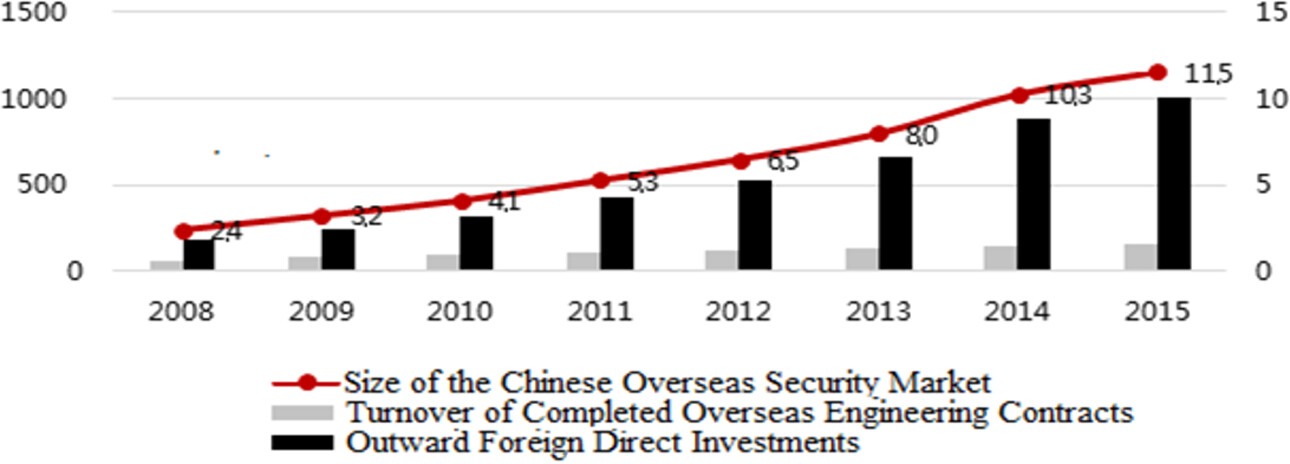
Figure 1. Chinese economic presence abroad and the overseas security market 2008–2015. Source. Phoenix International Think Tank. Translated by the author of the paper.
Due to these regulations, and in part because of the large sums of money that they can spend, large Chinese SOEs are the most important consumers for overseas forces within the Chinese market. For example, in the case of the energy giant China National Petroleum Company, security-related activities accounted for 3–5% of its budget earmarked for investments in risky countries. In places where security conditions are extremely precarious, such as in Iraq, costs can rise to nearly 20%. According to estimates published by the China Economic Weekly, China National Petroleum Company has spent at least US$3.3 billion on security since 1993 (Jia, 2017). China National Petroleum Company, Sinopec, and China National Offshore Oil Corporation each spent more than US$2 billion on security in 2015. It is common practice for Chinese SOEs operating in dangerous areas to defend themselves by asking for protection from local governments, developing in-house risk-assessment capabilities, and outsourcing tasks that require additional resources, such as armed guards or private contractors. China National Petroleum Company established an anti-terrorism and overseas emergency center staffed with 160 analysts in 2007. As of 2013, it employed roughly 1,300 security guards to protect its projects overseas (“Zhongguo Baoan Qiye,” 2013). A secondary consumer group consists of smaller, usually private, businesses. Although there are far more of these types of businesses than SOEs, their impact on the market is much less significant. As lamented by a Chinese consultant, these small businesses often underestimate the risks abroad and prioritize cutting costs. Consistently, they typically dedicate only 1% of their budget to security (Yuan, 2012). Various Chinese ministries and diplomatic representatives also purchase private security products to some extent. State administrations, especially local governments, also offer economic support for the purchase of insurances and security products to businesses investing in dangerous countries (Ke, Li, Zhao, Yu, & Li, 2015).
Chinese consumers can choose from three different kinds of PSCs: Chinese PSCs, large international PSCs, and PSCs based in the countries where they invest. The first Chinese PSC to offer services targeting companies investing abroad (in particular, Iraq), only started doing so in 2010 (“Zhongguo Baoan Jiang,” 2010). Consistent with the logic of supply and demand, Chinese PSCs offering overseas services took notice of the growing security threats faced by rich SOEs operating in the Middle East and Africa and decided to establish local branches within these regions (Phoenix International Think Tank, 2016). Recently, Chinese PSCs and international insurance companies have also started to explore cooperation with foreign PSCs (Arduino, 2018, p. 136). In 2016, the number of employees from Chinese PSCs sent abroad totaled around 3,200, which is more than the 2,600 Chinese troops deployed as part of UN peacekeeping missions (Bi, 2017). Chinese PSCs that attempt to globalize are, like their foreign counterparts, usually formed by and focus on hiring former soldiers. The majority of these soldiers were previously officers with some operational experience in the special operation forces of the army and, in particular, armed police (Qiu, 2014). The Chinese armed forces have between 20,000 and 30,000 of these operators (Blasko, 2015), and Chinese PSCs can draw from this large pool to fill their rank and file. Furthermore, there are many former troops that return to civilian life every year after ending their contracts as conscripts.
Yet, in such a vast and highly competitive market, Chinese PSCs are neither alone nor in a strong position. They face very strong foreign competition. Companies like Control Risk and G4S dominate the Chinese market due to their global presence, highly trained personnel, and wide range of services offered. At the same time, local security contractors in countries where Chinese companies invest offer cheap services and the advantage of reducing the friction between foreign investors and local communities. More recently, Chinese PSCs also started competing with foreign companies based in China, such as Frontier Services Group which was founded in Hong Kong by Erik Prince. While big foreign firms are usually contracted by Chinese SOEs, local PSCs attract smaller clients because of their low prices. Chinese PSCs suffer seriously from both high-end and low-end competition, not only because they are outnumbered but also because of the limited range and quality of the services that they offer. On the one hand, Chinese citizens cannot use firearms abroad (the reason for this is discussed below), thereby undermining the attractiveness of Chinese PSCs for consumers with interests in dangerous parts of the world. On the other hand, although most employees at Chinese PSCs are former soldiers, their limited knowledge of foreign languages and cultures, coupled with far less operational experience than their foreign counterparts, further affects the competitiveness of China’s domestic security industry even for nonarmed services (Chen, 2016).
In sum, the “societalization” process of the state had a deep impact on Chinese foreign and defense policy, and the role of private actors within it, by pushing China clearly toward the Liberal ideal type. This is well exemplified by the fact that SOEs mainly hire international PSCs to protect projects that are usually guided by political and diplomatic goals set by the state and are thus politically sensitive. By comparison, Italy, which bears more resemblance to the Republican model, opted to send its own troops to protect a private company working on the construction of a dam in Mosul, Iraq. While this section explored the impacts of the Chinese state’s “societalization,” the next section focuses on the “stateification” of the Chinese private security industry.
To Protect Is to Serve
While the “societalization” of the state in China created clear opportunities for private security actors in general, the state has also been strongly focused on “stateificating” domestic PSCs. Specifically, this process has focused on making Chinese PSCs equally as capable as their foreign competitors, while also keeping them firmly within the state’s orbit. Figure 2 shows that, consistent with the idea of “stateification,” the debate about the development of domestic PSCs within the Chinese media and scholarly publications gained real traction in 2010, when the first domestic PSC began to offer services overseas. Subsequently, this created demand for a better definition of the relationship between the state and private actors.
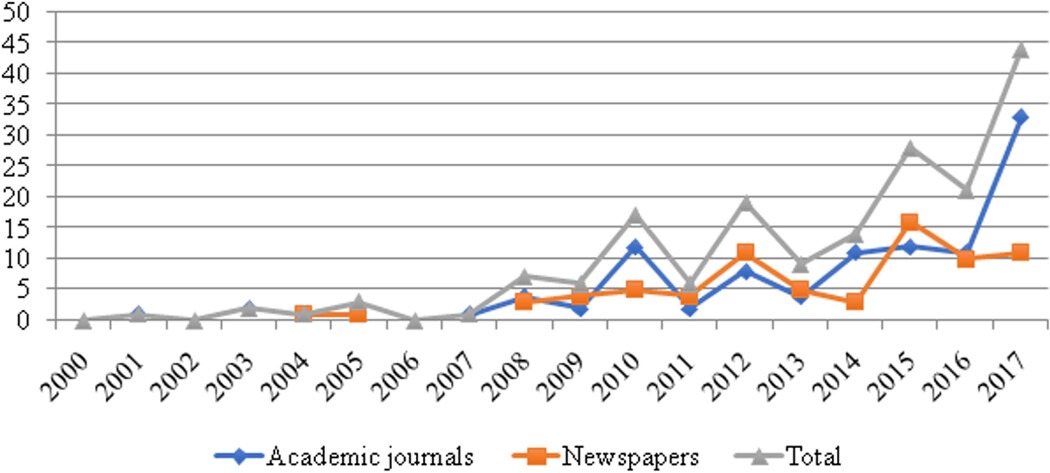
Figure 2. Articles published in Chinese academic journals and newspapers on the use of private security in foreign policy. Source. CNKI. Compiled by the author.
Both reports and remarks from experts belonging to the armed forces and the Ministry of Public Security are extremely limited, but it is within these sources that the idea of “stateification” is best articulated. It is important to note that all PLA officers who have commented on the development of domestic PSCs belong to research centers that focus on nontraditional security and Military Operations Other Than War, two key terms associated with the issue of protecting China’s overseas interests. Therefore, these officers represent the part of the foreign policy apparatus tasked with responding to society’s demand for security abroad.
These scholars see no problem in supporting the development and use of Chinese PSCs for tasks that the army is not capable of, or necessarily interested in, carrying out. After all, as one wrote, “the state is capable of protecting the citizens abroad only to some extent” (Wang, 2016). Given the widespread use of PSCs by other countries to carry out important foreign policy tasks, it would make sense for China to adopt the same practice. Thus, Chinese PSCs must drastically improve their capabilities and become “the fourth service of the armed forces” because the growing demand from the state and the market for security products “is not just an opportunity, but also a responsibility” (He, Wan, & Tan, 2016; Yu, 2017).
These experts encourage the state to promote the development of PSCs to ensure that they can fulfill their political missions. For example, while PLA and Police instructors can provide special training to PSC employees who will go abroad, SOEs should leverage their influence on the market to promote the creation of a “production chain” of security services (Pei & Song, 2017). A scholar affiliated with the Ministry of Public Security suggests that the operations of all PSCs, not only Chinese ones, working for Chinese entities could be brought within the framework of China’s relations with other countries through, for example, the Shanghai Cooperation Organization. This would ensure that both diplomatic priorities and the protection of overseas interests would not conflict with each other (Zhang, 2017).
Chinese PSCs can grow by dedicating themselves to the achievement of the state’s goals, not simply by seeking profits in international markets. Both of these agendas are not mutually exclusive, of course, but the former is more important than the latter. This is not surprising and is rooted in history, when money/power-seeking warlords consistently undermined the authority the modern Chinese state since the fall of the Qing dynasty. While some doubt the capability of domestic companies to successfully compete against foreign companies in terms of variety and quality of services, their political loyalty is not only taken for granted but is also expected. This belief is so deeply engrained that among the publications referenced for this study, none discuss the possibility of Chinese PSCs being hired by foreign clients. This lends itself to the fact that Chinese PSCs are not described as companies whose aim it is to make profits, but instead are viewed as actors that have two special responsibilities. First, they must contribute to the protection of Chinese citizens and assets abroad. Their main responsibility is to the society and, therefore, to the state and the country’s political leadership. Second, they are also responsible for ensuring that no diplomatic incident between China and the countries in which they operate occurs. After all, the unruly behavior of small companies operating abroad has already created many problems for the Chinese government (Gill & Reilly, 2007).
Experts at various universities and think tanks have put forward similar, yet more sophisticated, opinions. Essentially, they argue, PSCs can and must contribute substantially to the protection of China’s overseas interests. They support not only the marketization of this aspect of Chinese foreign policy, but also the making of a political and moral, explicit and clear, connection between private actors, society, and the state (Xin, 2016). According to Qinghua University’s Zhao and Li (2015), it is important that Chinese PSCs do not become like their foreign counterparts, that is, mercenaries looking for the highest paying client. Protecting small businesses that cannot afford the service of large foreign PSCs is a significant issue that would be hard to solve if Chinese PSCs simply adopted the practices of their counterparts. Ensuring the protection of virtually all citizens abroad, including small entrepreneurs, is the priority of the government. Thus, as Zhao and Li argue, the development of Chinese PSCs must aim to achieve this goal, otherwise their work would be counterproductive.
Compared to their counterparts working for the armed forces and the security services, university and think tank experts spend more time discussing issues that arise from pushing for the stateitization of domestic PSCs and the risk of being viewed as state actors in disguise. In order to ensure political loyalty and preserve diplomatic deniability, they propose a two-pronged strategy (Bi, 2017; Dai & Wang, 2017). On the one hand, the operations of the PSCs should be regulated through agreements between China and other countries, so that legal issues can be avoided. Moreover, China should be more active in shaping and enforcing international norms and laws, like the Montreux Document, that regulate the activities of PSCs. On the other hand, the Ministry of Public Security should expand its supervision of domestic PSCs that intend to offer services overseas, especially if they send their own employees abroad rather than hiring locally. The first step would be to verify that there are no hidden ties between a certain PSC and state/party officials in order to avoid potential corruption and eliminate the issue of PSCs being viewed as proxies of the state. The second step would be to strengthen the cooperation between the Ministry of Public Security and Chinese diplomatic representatives abroad to monitor the actions of PSCs, and eventually punish them according to Chinese law (the role of Chinese domestic laws is further discussed below). Regulatory development, therefore, can proceed only if state supervision follows suit.
Finally, commentary and publications both of and about Chinese security entrepreneurs appear frequently in Chinese media. These publications often favorably depict the development of the domestic industry vis-à-vis its contribution to the protection of Chinese interests abroad (“Meiguo Yongbing Zhi,” 2015). However, economic success is rarely mentioned. Owners of Chinese PSCs often present themselves as reliable partners that can loyally liaise with greedy foreign subcontractors and authorities to protect the secrets of Chinese (state-owned) investors (Huang, 2015). This is, they argue, their important contribution to both the society and the state. Yet, to be sure, this is also the only way in which they can frame their activities. As the much-studied nationalist discourse in China shows (Greis, 2004, pp. 125–128), one must be careful not to criticize either the goals decided by the government or the ways in which to achieve them. Even indirect criticisms can lead to marginalization and suppression by the state media in the public debate. At the same time, being mostly former soldiers, the identity of Chinese security entrepreneurs does not differ significantly from that of their foreign colleagues. They all entered the security industry to earn a comfortable living, but many have also retained a strong sense of duty toward their country (Franke & von Boemcken, 2011).
While rarely emphasizing the lack of support from the state (further discussed below), Chinese security entrepreneurs point to malpractices in the market and widespread unprofessionalism as the cause of the low competitiveness of Chinese PSCs. For example, complaints about the unwillingness of many Chinese companies with investments in Africa or the Middle East to spend on security are relatively common (Luo, 2014). Some have also noted that many security companies, both Chinese and foreign alike, attempt to out-price one another, thereby making business difficult for those that could otherwise provide better services if the clients would be willing to spend more. Moreover, this race to the bottom of prices also dissuades former soldiers from joining the industry. Instead, many prefer a more comfortable, albeit equally low paying, career within the public bureaucracy (Chen, 2016). These factors contribute to the survival of many PSCs that employ unskilled and unprofessional personnel. That said, some have also admitted that Chinese PSCs are actively discouraged from operating in high-risk environments. This is both to protect their employees against potential dangers and also to eliminate the risks of being caught up in situations that could create diplomatic problems (Qiu, 2014). Furthermore, many also note the issue of an unclear legal framework for overseas operations, especially concerning the use of firearms.
In sum, the analysis shows heavy pressure to “stateificate” the nascent domestic security industry and ensure its contribution to the achievement of the state’s goals, thereby moving closer to the Republican model. However, how to do so is far from certain. Indeed, it is clear that underregulation, rather than overregulation, is the main obstacle for the development of Chinese PSCs. The next section discusses this issue as the product of opposing “stateification” and “societalization” forces that exist in China.
Legal Uncertainties and Mixed Results
As a Chinese scholar well summarized, the fact that domestic PSCs offering overseas services are regulated by domestic laws under the supervision of an institution, the Ministry of Public Security, that is highly focused on domestic law enforcement, is a source of great uncertainty (Cao, 2017). Indeed, although that Ministry is a powerful institution domestically within China, it has neither the capabilities nor the man power to supervise Chinese PSCs abroad. Moreover, those PSCs operate within a gray area of Chinese law. The current law on private security was implemented in 2010. It allows the existence of two distinct types of PSCs—“security companies” and “security companies that provide armed escorting services”—but makes no specific reference to their activities in other countries (State Council, 2009). Chinese law on gun control too is ambiguous in this regard (National People’s Congress, 1997). The punishment for illegally owning firearms in China ranges from a minimum of 3-year imprisonment to the death penalty under certain circumstances. Moreover, the seventh article of the Chinese Criminal Code states that
this Law shall be applicable to any citizen of the People’s Republic of China who commits a crime prescribed in this Law outside the territory and territorial waters and space of the People’s Republic of China; however, if the maximum punishment to be imposed is fixed-term imprisonment of not more than three years as stipulated in this Law, he may be exempted from the investigation for his criminal responsibility.
In contrast to this legal vacuum, a series of ad hoc agreements between Chinese PSCs and SOEs have guaranteed domestic security contractors a limited, but important space to operate abroad. Yet the results of this cooperation have been mixed, with positive developments only in certain areas.
A clear example of successful cooperation between PSCs and policy implementers is armed protection for shipping companies. According to the Law of the Sea (UN, 1982), the laws of a nation’s flag displayed onboard apply to vessels in the high seas. Thus, Chinese contractors are permitted to both carry and use guns for defensive purposes in international waters if they are onboard non-Chinese flagged vessels. However, it seems that ad hoc agreements have allowed Chinese PSCs to deploy armed guards onboard Chinese-flagged ships. Indeed, the first time a Chinese PSC provided this kind of service was through a partnership with the giant Chinese shipping company COSCO in 2012. Similarly, the Macao-registered Hua Wei Security Group’s website suggests that its guards can carry guns at least onboard Macao-flagged vessels as a part of an agreement with Macao authorities (Hua Wei Security Group).
Nonetheless, Han Fangming’s role in the previously mentioned kidnapping of Sinohydro workers in Sudan shows that broader attempts to reform the industry have generally failed. It is important to emphasize that this is the most direct and formal known attempt to regulate the overseas operations of domestic PSCs so far. Han has been serving as a Deputy Chairman of the Foreign Affairs Committee of the Chinese People’s Political Consultative Conference (CPPCC), and advisory body of the Chinese government since 2008. He also founded the Charhar Institute, a Chinese think tank which has written the most detailed report on China’s private security market thus far (Ke et al., 2015), in 2009. At the same time, he has also held top managerial positions in several SOEs, including Sinohydro when the attack against the workers occurred in 2012. During that time, he declared to the media that China needed its own firms similar to Blackwater (Yuan, 2012). Also, he drafted a law proposal with other members of the CPPCC requiring Chinese embassies abroad to publish reports on local security situations, calling for the creation of a database on Chinese citizens overseas, expanding mandatory security measures that companies investing abroad must implement, and supporting the regulation of Chinese PSCs abroad. However, this last part of the proposal was eliminated from the final draft of the law (Zhang, 2012).
These challenges have hindered the development of PSCs that have been unable to obtain special agreements with large SOEs. The inability to use weapons means that Chinese operators are often employed to train local guards and conduct minor tasks, such as checking the credentials of those entering work sites or verifying that both Chinese and local employees return to their dormitories at night (Qiu, 2014). Thus, it is common for Chinese PSCs to be forced to work with their foreign counterparts rather than competing against them. In response to these challenges, different entrepreneurs are trying different solutions. Some Chinese PSCs have established joint ventures with local partners abroad to improve their knowledge of foreign countries and import the best practices (“Zhongguo Shou Jia,” 2014). Several have opted instead to work with domestic think tanks, insurance companies, and consulting firms, to become one-stop shops that sell different security services rather than specializing only in specific tasks (Jia, 2017). The case of maritime security described above is exceptional because it involves firearms, but formal agreements between domestic PSCs and SOEs are not uncommon for more managerial and risk-assessment-related services (Deng, 2015). The Ministry of Public Security–managed China Security Association plays an important role as a platform for the two sides to meet (“Zhongguo Haiwai Baoan,” 2017). Lowering prices is another method used by Chinese PSCs to attract clients: A team of 12 operators can cost only RMB 3,500 (around US$450) per day (Xin, 2016). By comparison, in 2007, the Regency Hotel and Hospital of Kuwait paid Blackwater more than US$11 million for a team of 34 men.
To summarize, the relationship between the state and Chinese PSCs resulting from the clash of “societalizing” and “stateificating” forces is rather uncertain. Bureaucracies tasked to deal with domestic PSCs, instead of the state through clear laws and high-level agencies like the Ministry of Public Security, are playing a key role in expanding the scope of the operations of Chinese security contractors. As discussed in the conclusion of this article, this fact is crucial in determining China’s position in the continuum between the ideal Republic and Liberal models.
Conclusion and Further Considerations
The analysis presented above shows that China’s approach to private security is closer to Krahmann’s Republican ideal type than to the Liberal one. The clear recognition that limits to what the state can or wants to do exist, and that PSCs can be the solution to the problem, is a key precondition for a Liberal model. Various regulations issued over the years have created space for international and, to a minor extent, Chinese PSCs to expand their activities abroad. This acknowledgment resulted from the “societalization” of the state because PSCs were identified as a solution to threats, like terrorism and instability, to the life and assets of Chinese citizens abroad. Thus far, however, “stateification” forces have clearly prevailed. Contrary to the Liberal model, a more extensive state begets the development of more PSCs. Thus, contrary to what many outside of China believe, the advent of a “Chinese Blackwater” is far from certain.
Even crises such as the evacuation from Libya or the attack in Mali that fueled the “societalization” of the state were not enough to change the opinion that a more extensive state is necessary. Indeed, the top leadership in China seemed highly receptive to the issue of protecting the lives and assets of its citizens abroad when Han Fangming proposed regulating Chinese PSCs abroad (the evacuation from Libya had occurred less than a year earlier), yet nothing happened as a result. The fact that Zhang (2015), who is both a top manager of a Chinese SOE and also a member of the CPPCC, recently wrote in favor of integrating PSCs as part of the government’s approach to protecting its overseas interests further shows that this idea still lingers in the periphery of Chinese policy-making circles. Yet the situation has not changed despite subsequent occurrences of other incidents abroad.
Instead, the problem of defining the relationship between political power and the domestic private security industry has been left largely unresolved. This has led to a legal deadlock. The state allowed foreign PSCs, which are convenient because of their purely contractual nature, to dominate the market and mandated the SOEs to solve the political and policy puzzle by themselves. To be sure, the SOEs did not spontaneously attempt to create a framework for domestic PSCs to operate abroad. Rather, they had no other choice given pressures resulting from regulations which the Ministry of Public Security itself helped to craft.
As China pushes forward the implementation of its Belt and Road Initiative in risky areas, a potential turn toward the Liberal model remains possible. After all, the current situation is one of “Republican uncertainty” because Republican preferences have not yet solidified into clear regulations. Examples of other countries, such as Italy, that are culturally wary of the privatization of security can offer important clues about the development prospects of Chinese PSCs. In Italy, regulations of domestic PSCs operating abroad first emerged in the aftermath of pirate attacks against Italian-flagged ships, and many legal gray areas were subsequently eliminated over the years. Moreover, the employment of PSCs, both domestic and international, is allowed solely when armed forces cannot provide the same service (Cusumano & Ruzza, 2015). The Chinese government has a tradition of decentralized and trial and error for policy-making (Heilmann, 2008). Thus, it is likely that any further development will emerge gradually, drawing upon lessons learnt from the cooperation between domestic PSCs and the SOEs. Unlike in Italy, the creation of a high-profile national industry is clearly part of the current Chinese debate. This makes the issue of the development of domestic PSCs more pressing. However, it remains unclear whether or not Chinese policy makers will be ready for this drastic change, and also the political and diplomatic risks that it entails.
Finally, from a more theoretical viewpoint, the model developed in this study emphasizes the importance of adapting frameworks used to study Western polities to different ones. Future studies should, therefore, explore cases that Krahmann did not take into consideration and also reexamine and update those included in her analysis. Looking for both similarities and differences across many cases would greatly help to better identify factors that could either reverse or further strengthen “societalization”/“stateification” trends. Moreover, it would be valuable to assess the effectiveness of the model presented here toward the study of hybrid warfare among states and the role of PSCs within it. This is an example wherein external factors could play a more important role than they do when it comes to nontraditional threats.
More Research
1/2