
Home / Research / Closing the sub-frontier: corridorising Tibet and the social life of pervasive security
Closing the sub-frontier: corridorising Tibet and the social life of pervasive security
Published: November 19, 2024
•
Territory, Politics, Governance Volume 13, 2025
Abstract
Western China’s border provinces’ domestic economic corridors are positive spaces that erase the negative spaces of the frontier. Frontiers, understood as spaces of incomplete sovereign control, threaten Chinese governance and the success of the Belt and Road Initiative (BRI). An analysis of sinophone writings on corridors and frontiers demonstrates how bridgehead economic corridors, such as the Tibet-Yi Economic Corridor, are theorised to eliminate frontiers through development. Within a context of uneven and combined geographies, leapfrog development is an indeterminate social process that has shaped both corridors and frontier spaces through new resources and mobilities. I draw from fieldwork on the Tibetan Plateau to show how the agency characteristic of Tibetans in a state-challenging ‘frontier of manoeuvre’ has been affected by restrictions on practices of everyday life and religion, including checkpoints and fire restrictions. The frictions of domestic economic corridors' development suggest a renewed significance of the frontier in this multipolar time.
Regions
Themes
Cite This
Grant, A. (2024). Closing the sub-frontier: corridorising Tibet and the social life of pervasive security. Territory, Politics, Governance Volume 13, 2025. https://doi.org/10.1080/21622671.2024.2422893
Full Text
1. INTRODUCTION
I was walking down a long, newly paved avenue in Gyantse, returning to the rented car provided by the tour company for our trip to Pelkhor Chödé Monastery, when a middle-aged man donning a Stetson, sports jacket and slight moustache, approached me. He asked me where I was from and then told me in English, ‘I hate China’. He then talked about recent construction and the new buildings going up around us. The government of this county town, located in the Tibetan Autonomous Region, had invested heavily in new infrastructure, and the screeches of circular saws cutting through bricks and the thudding of hammers knocking stones and wood into place created a din that was difficult to speak over. ‘The Chinese, they did all of this’, he continued, ‘We don’t want them here’. He looked at me for a while, my face frozen with bewilderment at who this man was and why he was telling me all this. Smiling broadly and winking, he took my hands together and shook them, then peeled off toward a side alley. Glancing back, I saw him looking on unworried, quite content that he had delivered his message.
In 2018, Gyantse was undergoing enormous redevelopment. A long commercial avenue that would connect Pelkhor Chödé Monastery to the town’s iconic dzong, or fortress, was quickly nearing completion. Broad sidewalks would allow pedestrians to stroll up and down this half-mile-long stretch of rowed two-story mixed commercial and residential buildings, channelling them through a small-scale urban corridor destined by design to become a vibrant tourist centre. When I visited, few stores were open, save some restaurants and hardware stores. Given the large number of finished but as-yet-unoccupied store fronts, change was clearly imminent (Figure 1).
Figure 1. Prayer flags and PRC flags flutter above Gyantse Old Town, pictured during on-going redevelopment for tourism. Pelkhor Chödé Monastery looms in the background.
Source: Photo by author, 2018.
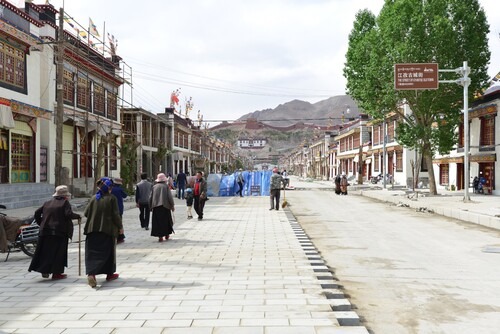
The man who approached me was hardly a representative example of public discussion in Gyantse or any other city I visited on the Tibetan Plateau. Nevertheless, the speed and impact of landscape-transforming projects were common points of discussion during my years of fieldwork. The scale of transformation in Gyantse was a manifestation of the territorial integration of the Tibetan Plateau with inland China through urbanisation, infrastructural connection, and everyday contact with China’s state-led development strategies (Grant, 2022; Roche et al., 2023). The comprehensiveness of these transformations altered the possibilities of everyday life, constricting a frontier through corridor development.
This article highlights recent efforts by Chinese authorities to build economic corridors that eliminate difficult-to-control frontiers in western China. In recent years, China’s western borderlands have undergone leapfrog development and rapid securitisation as Chinese authorities have pursued ambitious regional geopolitical and geo-economic goals, such as engaging neighbouring states with political cooperation, infrastructure development and increased trade with China. Disruptions to the status quo have led to emergent geopolitical tensions that revive latent territorial disputes and colonial expansion in the Himalayas, as left unfinished by the Qing and British Empires (Gardner, 2021; Gupta, 2021) and continued today by China and India through development efforts and ongoing boundary disputes. I argue that corridors are deployed as positive spaces that erase the negative space of the frontier, a concept increasingly used in the People’s Republic of China’s (PRC’s) social science writings to denote the socially unincorporated internal spaces of China’s borderlands territory.
2. LITERATURE REVIEW
Announced in 1999, China’s Open Up the West Campaign targeted western China for development. Its goals were to relieve industrial overcapacity in coastal China, to narrow uneven spatial development between western and coastal China, to mobilise local governments, and, finally, to promote border stability and national defence (Ye, 2020, pp. 38–40). Ye has argued that the Belt and Road Initiative (BRI), launched in 2013, is an attempt to both deepen the Open Up the West Campaign internally and to extend its economic logics – the deployment of Chinese capital to serve national economic interests – beyond its borders. Through its international corridors, the BRI has had wide-ranging economic and political implications for inter-Asian connectivity, as well as China’s influence in Europe and Africa (Hillman, 2020). Corridor projects are more than singular Chinese designs; they are co-constructed and shaped by the interests of cooperating states (Murton & Lord, 2020; Schindler et al., 2022). While the BRI cannot be reduced to its mappable corridors alone, official and popular engagement with historic Silk Road trade networks has been a key feature of the BRI imaginary, leading to border-spanning cartographies that seemingly dispel state boundaries (Grant, 2018) and local mobilisation to align developmental projects with state-endorsed semiotics to obtain capital (White, 2020).
BRI-linked initiatives have included important functional roles for China’s border provinces. Scholars have examined these border provinces from two primary perspectives. The first emphasises the practical fragmentation of BRI projects (Dean, 2020; Woodworth & Joniak-Lüthi, 2020) by emphasising how local actors in border provinces exercise agency in the face of centre-promoted projects like the BRI. Discussing Inner Mongolia, White (2020) has shown that regional governments and local businesspeople have co-opted Silk Road and BRI discourse to attract central government money for their own economic and social goals. China’s BRI-era policies, which often build upon or rebrand existing programmes, have also influenced who can benefit from border-spanning economic connections. This has included, as Rippa (2020b) has shown, the exclusion of local traders through new regulations to the benefit of big capital that easily makes use of corridor infrastructures. In sum, this literature complicates understandings of BRI corridors as directly benefitting border province populations. Borderland peoples must negotiate corridor investment and infrastructure by finding ways to pursue their goals amid continuous political and economic transformation.
By contrast, the second literature focuses more on the state-centred logics of China’s domestic borderlands development by examining how regional governments have created bridgeheads for border-spanning economic development. This research provides insights into provincial economic initiatives; energy and urban development; transborder trade; and non-traditional security strategies related to drug smuggling, illicit trade, and refugees from conflict in neighbouring states (Ptak et al., 2022; Song et al., 2024; Su, 2013). As with recent meta-theoretical discussions of capitalism in China (e.g., Dunford et al., 2021), these accounts are framed within larger discussions of smoothing out China’s national spatial development. Guided by the visible hand of Chinese state policy, the positive restructuring of borderlands provinces can be accomplished through multi-scalar planning, special economic zones, and regional infrastructure projects. This regional development, which we will see below has been subsumed into discussions of domestic ‘economic corridor’ development, is intended to bring benefits to bridgehead provinces’ populations, China’s overall development, and the economies of bordering states.
Scholars have recently employed the theoretical framework of uneven and combined geographies to account for the causes and directions of China’s economic development (Dunford et al., 2021; Rolf, 2021). This perspective has stressed the advantages and opportunities that spatially targeted leapfrog, or catch-up, development has brought to various regions of China at different historical moments. When leapfrog development takes form at national or sub-national scales, it may result in, or exacerbate, contradictory combinations of social and economic structures as new technologies, modes of production, and institutional connections begin to displace existing relations (Rolf, 2021). As socially heterogenous spaces targeted by the Chinese state’s visible hand for leapfrog development, China’s western and northwestern borderlands – key sites for corridor development – are seen by Chinese development planners as sites with transformative potential to realise China’s political and economic ambitions in Asia such as further opening markets in South Asia and breaking India’s regional hegemony, just as the opening of China’s coastal special economic zones (SEZs) transformed its position in global commodity chains and geopolitics (Rolf, 2023).
Leapfrog development on the Tibetan Plateau can deepen China’s influence across the Himalayas, consolidating state control in Tibetan regions and expanding the markets for Chinese goods in Nepal and potentially India. Nonetheless, the Tibetan Plateau is a socially combined geography where a diversity of community authority, economic production, and social organisation doesn’t straightforwardly align with imposed nation-state boundaries. It is into this mixture of undetermined social relations that China’s border-spanning corridors are being developed as gambits to generate development and influence among a multitude of individual, collective, corporate and state projects.
One illustrative case of border region leapfrog development is that of Dongbei, or Manchuria, in the late nineteenth and early twentieth centuries. In that era of inter-imperial competition, Chinese agricultural migrants displaced indigenous populations, and the region’s economy shifted from pelts and ginseng to soybeans, sorghum, and manufactured products. The expansion of foreign-managed railways, coupled with the compelled opening of treaty ports, such as that at present-day Dalian, fostered rapid political and social change (Duara, 2006; Eckstein et al., 1974). While state projects and economic planning played a key role in transforming the region, governance was inconsistent and weak; Chinese authorities manoeuvred tentatively and warily as they dealt with settlers and indigenous populations who broke Chinese laws and engaged in illicit economies in this contested frontier space (Lattimore, 1932).
Rapid economic change, the complexity of borderlands authority and sovereignty, and competing Soviet and Japanese political projects made it difficult for Chinese authorities to exercise sovereignty over the peoples in the borderlands it claimed. Today the development of China’s domestic corridor spaces is, by and large, being executed in places where Chinese sovereignty is not actively contested by neighbouring states. Nonetheless, Chinese authorities are deeply concerned about foreign political influence on non-Han ethnic populations, who have been disproportionately targeted for monitoring. The collection of biometric data (Dirks, 2022a, 2022b), the deployment of facial recognition technologies (Byler, 2021), the expansion of internal security checkpoints, the surveillance of cellphones, and authorities’ use of the Integrated Joint Operation Platform mobile app (Wang, 2019) have recast territorial surveillance across China’s western border provinces. These technologies go together with an increased police presence. Zenz and Leibold (2020) have tracked the large increase of informal police officers in Xinjiang under Chen Quanguo. These officers, who are often Uyghur, check IDs, monitor CCTV cameras and staff the ‘convenience stations’ that have expanded in ‘grid systems’ across Xinjiang’s villages and urban districts. Taken together, these security practices reveal state anxieties that China’s bridgehead provinces, and the corridors that transit them, are at risk of destabilisation.
The expansion of fire control also takes on a special significance in the positive space of the corridor. Across China, narrow and uneven roads, close building proximity, dense populations, flammable wood materials, and a lack of access to fire-fighting water resources are all factors that contribute to heightened fire hazard risks in historic towns and older urban centres. New policy solutions in contemporary China, such as the ‘Smart Fire’ system in Guiyang city, rely on a similar logic as the policing grid system: the leveraging of big data and spatial monitoring and the expansion of fire stations both in major cities and in villages where architectural heritage carries ‘local ethnic colour’ (Liu et al., 2022; Ma & Xiao, 2023; Zhang et al., 2020). Beyond the convergence of police and fire monitoring strategies, there is also a history of using hazard prevention and reconstruction to accomplish political goals. The redevelopment of Kashgar’s Old Town was carried out in the name of the benevolent provision of earthquake-resistant homes (Bellér-Hann, 2014). In Xinjiang and on the Tibetan Plateau, hazard-related reconstruction can open sites for deeper domestic tourism penetration as well as accelerate the displacement of populations from their heritage communities (Hua & Nakatani, 2023; Szadziewski et al., 2022). Disasters also open spaces for the contestation of sovereignty, as competing authorities, secular or religious, position themselves as stewards of victims or survivors (Makley, 2015). Despite its seemingly apolitical object, fire control in China’s borderlands is political.
This article focuses on domestic economic corridors by moving away from the usual subjects of corridor study – international routes and boundary sites – to analyse abstract spaces of conceived development planning, on the one hand, and the spaces of everyday experience, on the other. The first section of the paper offers a review of articles on corridors and frontiers in PRC-based Chinese-language (sinophone) journals. I elucidate top-down views of economic corridors in China’s western provinces and how the development of corridors is theorised to dispel the negative spaces of the frontier. The following sections examine the experiences of Tibetans in several sites on the Tibetan Plateau, showing how everyday inconveniences including obtaining official documents, passing transportation checkpoints, and the seizure of knives have affected their lives. I examine how people find agency using what I call the frontier of manoeuvre, both through actions and through humour. Restrictions on the use of fire further speak to the moral dimensions of Tibet’s uneven and combined geographies. The final section discusses state efforts to break ‘tyrannies’ and ‘occupations’ in digital and physical spaces where anti-state activity may take root.
This article uses two primary data collection methods. The first is a search of Chinese-language articles on CNKI related to corridors and frontiers in western China, as well as follow-up Baidu searches of government sources related to the projects discussed in these articles. Such searches are limited by political restrictions on search results, but the results were conducive to an explanation of the relationship between corridors and frontiers in research on western borderland development. I also conducted fieldwork at several sites on the Tibetan Plateau between 2013 and 2018. I conducted interviews and engaged in participatory observation among Tibetans. All names used in this article are pseudonyms.
3. FRONTIERS
In anglophone literature, frontiers have been analysed as responsive to shifts in the exercise of power over space. In European languages, ‘frontier’, ‘frontière’ and related terms have been used to refer to linear boundaries and zones adjacent to borders, as well as border fortifications. Changing sources of sovereign power and approaches to military strategy have meant that as political geographies, frontiers have seldom been stable (Febvre, 1973; Hirst, 2005). In late nineteenth and early twentieth century South Asia, British Imperialists promoted a ‘scientific frontier’ that, once discerned through careful topographic and cartographic study, could assist in the strategic control of vast zones of Himalayan borderlands to further colonial interests (Curzon, 1908; Gardner, 2021, pp. 62–67). In this research, frontier populations were rarely considered but as obstacles to conquest and domination. Where frontier inhabitants were given agency, it was the agency of the recent settler developing peripheral lands.
In recent years, anglophone scholarship on the frontier in Chinese history has focused on the agency of those who conquered Chinese states from the margins. Qing historian Mark Elliott (2014) has called for a frontier perspective to supplement Sinocentric narratives of China’s traditional outer regions, thereby revealing the political and cultural influence of the Manchu periphery on the centre. More recently, James Millward (2024) has argued against adopting such a frontier perspective as it reinscribes the political asymmetries of centre and periphery and thereby denies substantial histories of political and social separation from China. He argues that the terminology of colonisation and conquest, rather than frontier and unification, is more accurate for describing the character of China’s historical presence in its contemporary borderlands.
Conversations about the conceptual usefulness of the frontier can also be found in Chinese intellectual discourse. Recent sinophone literature on development and security in China’s western and northwestern provinces frequently uses the Chinese term for frontier (边疆), citing a variety of conventional political geography authorities, including Ratzel, Turner, Curzon, Mackinder, and Lattimore. While differing in some regards on the genesis and scope of the frontier concept (Lafitte, 2022; Yang, 2018a), sinophone frontier theorists share three concerns: (1) the topographical and locational quality of frontiers and their implications for geopolitical strategy and territorial security, (2) the low level of development in frontiers and the ameliorative potential of economic corridors to raise developmental levels and (3) the role of non-Han ethnic groups in frontiers and the need to ensure political stability by influencing these groups through development. Political and economic concerns are inseparable in these contemporary frontier writings because political insecurity is seen as being caused by a lack of development.
These concerns are expressed in writings in a variety of fields that advocate transforming China’s western and northwestern borderlands. International relations scholar Du Zheyuan (2018) argues that China’s western frontier, and Tibet in particular, plays an important role in China’s geopolitical strategy. From Du’s realist viewpoint, Xinjiang and the Tibetan Plateau form one topographic space that is relatively flat and easily traversable, granting the use of strategic mountain passes. This topography has made this frontier vulnerable, historically opening inner China to invasions from the Tibetan, Zunghar and British Empires. Du sees a pressing need to urbanise and populate Tibet for future national security and to fracture Indian regional hegemony, thereby defending Chinese interests in South Asia and the Indian Ocean.
The economist Yang Minghong (2018a) has argued for a scientific understanding of the frontier that foregrounds national threats and the role China’s frontiers play in strategic defence. Yang, in conversation with other PRC-based frontier scholars, has argued that while the primary frontier (主边疆) is formed by the belt of provinces adjacent to international boundaries (e.g., Xinjiang and Tibet), equally important are China’s sub-frontiers, or secondary frontiers, which form an intermediate zone between the primary frontier and inner China. Targeted development in frontier and sub-frontier (次边疆) provinces can help reduce threats within them, shrinking the ‘living space’ of splittist forces and foreign enemies (Sun, 2015; Yang, 2018a; Yang, 2018b). In this literature, the frontier is not historic vestige but a contemporary problem that demands security intervention and development for the sake of national stability and the success of China’s regional-cum-international economic growth. There is a clear ‘frontier effect’ at play; fear of a vulnerable frontier serves as a mobilising impulse for state builders to re-organise land and society where order and development are perceived to be lacking (Ballvé, 2020). The solution is economic corridors.
4. CORRIDORS AS POSITIVE SPACE
In policy-related sinophone discourse, economic corridors (经济走廊) are encompassing zones of infrastructural, industrial and urban development that focus development along key transit arteries and their hinterlands. These corridors differentiate and assign to borderlands spaces unique functions as trade gateways, logistics hubs, urban growth poles, industrial centres, mining belts, tourism circuits, etc. that secure them a place within state-guided comprehensive development plans. Corridor planning is aimed at coordinated growth and spatial balance. It plots axes and radial spokes of development that integrate urban and hinterland spaces, expanding the former while marking the latter for poverty alleviation as well as the development of ethnic and geologic particularities for value extraction.
While emphasising economic development, economic corridors have a dual political role: corridor development sets forth a positive dynamic for the consolidation of social and political control in China’s domestic borderlands and makes neighbouring states more amenable to Chinese trade and security practices; meanwhile, improvements in development and borderland integration in those states redound to China’s own political and economic security (Du, 2018). While Rippa (2020a, p. 207) found that in China’s borderlands, BRI corridors were linear and exclusive spaces that ‘block and leave out what is outside of them with the aim of channelising movement and increas[ing] speed’, a look at China’s domestic borderlands economic corridors find them to be as inclusive as possible, but towards controlled ends. Crucially, economic corridors are the positive spaces that work to dissolve China’s frontier challenges.
The Northwest Economic Corridor and the Tibet-Yi Economic Corridor, which both include portions of the Tibetan Plateau, are two such domestic economic corridors. They both have their bases in ethnological corridors expounded by the famed Chinese social scientist Fei Xiaotong (1980; Qin, 2011). Fei argued that the heterogeneous topography and diverse societies of ethnological corridors required they be developed to ensure regional and national cohesion. More recently, Chinese economists have highlighted the utility of a Northwest Economic Corridor in balancing the uneven development of China’s Five Northwestern Provinces. In this corridor every area has a specific function: urban agglomerations in Xinjiang, Shaanxi and between Qinghai and Gansu Provinces serve as regional growth poles where they act as ‘mediums’ and ‘platforms’ for radial regional growth, promising to return to corridor hinterlands the value that development risks siphoning away from them; Gansu Province is a connective logistics hub; and the extra-urban hinterlands of Qinghai and Ningxia serve as supporting spaces for tourism (which can include spaces enclosed under ecological protection programmes), agriculture and the extraction and processing of non-ferrous metals, coal and hydropower (Fu, 2021; Guo et al., 2020) (Figure 2).
Figure 2. Map showing the Northwest Economic Corridor and the Tibet-Yi Economic Corridor.
Source: Cartography by author, 2024.
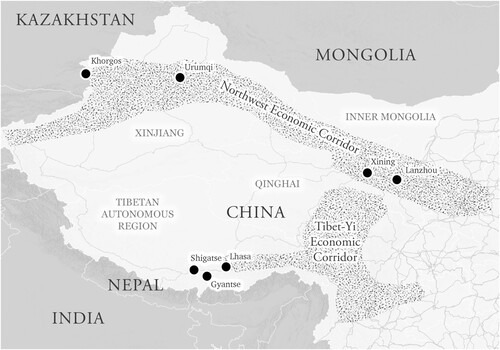
The Tibet-Yi Economic Corridor incorporates primarily Tibetan and Yi ethnic areas in the Tibetan Autonomous Region (TAR), Qinghai, Gansu, Sichuan, Yunnan and Guizhou Provinces. In step with the call from the Sixth Tibet Work Forum of 2015 to coordinate development in Tibetan regions in and beyond the TAR with the BRI, this corridor looks outward to Himalayan states including Nepal and India, utilising domestic cities such as Lhasa, Kunming and Lanzhou to anchor growth poles. By raising urbanisation levels, promoting ethnic cultural industries and alleviating poverty, the Tibet-Yi Economic Corridor has been theorised to bring development to a diverse regional topography, thereby securitising the borderlands against splittist threats and external influence (Li, 2017; Yang, 2018b). Provincial bridgeheads are thus conceived as more than hubs of growth and economic connection; they are barriers against outside political interference and ‘frontlines’ where China’s global interests are proactively pursued (Du, 2018). The transborder economies they foster have the potential, through leapfrog development, to remake the societies of the peoples that inhabit them, as well as to ‘break open’ neighbouring regions for political and economic restructuring.
5. FRONTIER OF MANOEUVRE
Coordinated development discourse is wide-reaching in its subjects and ambitious in its goals; nonetheless, the agency of China’s own borderlands populations complicates projects within designated economic corridors. Within China, borderlands dwellers experience an incessant churn of various state schemes and on–off programme implementation that they must continuously negotiate (Ptáčková, 2020; Woodworth & Joniak-Lüthi, 2020). Moreover, despite the increase in state capacity that comes with leapfrog development, its outcomes can’t be predetermined by state-guided spatial planning. As Hirst asserted (2005, p. 3), ‘Even when spaces are deliberately constructed by forms of power, the very properties of those spaces have consequences, and these spatial effects cannot just be read off from the forms of power themselves’. I introduce the concept of ‘frontier of manoeuvre’ to supplement the conceptualisation of the frontier and sub-frontier in sinophone writings.
In his essays on the early twentieth century Manchurian frontier, Owen Lattimore (1932) highlighted the figure of the indigenous ‘bandit’ who carved out a space of relative autonomy between the powerful interests and geographies of landlords, soldier-bandits and state bureaucracy during a time of rapid economic development and inter-imperial rivalry. I propose the concept of the ‘frontier of manoeuvre’ to make sense of the social and cultural dimensions of challenges to state sovereignty. The term manoeuvre emphasises the movement – martial, economic or intellectual – that occurs within unsettled frontiers. This understanding of political manoeuvre has its basis in Marxist writers including Gramsci and Trotsky, who theorised such manoeuvre as one strategy in political struggle (Egan, 2014). The bandit can be understood as a situated political agent whose actions challenge authorities and thereby animate frontier spaces. My Tibetan friends often approvingly referred to other Tibetans as bandits (土匪) or even, with rich laughter, the Taliban, when discussing stories of those who challenged the local state.
The bandit has a long history in China’s western regions. On the Tibetan Plateau, the bandit may be an admired social figure marked by bravery and courage; however, the bandit may also be viewed as criminal by statist authorities. In an article reviewing the social significance of the bandit (ཇག་པ།), Shakya writes that the term’s use as a derogatory label ‘is similar to the contemporary practice of using the term “terrorist” to depict an enemy of the state where there is no action involved but only a characterisation of an individual or group’ (Shakya, 2015, p. 360). Tibetan bandits have often surfaced at times of social instability stemming from contested political control and climate disaster (Shakya, 2015; Palden Gyal, 2024). Tibetan banditry could be predatory and executed for economic gain, targeting important trade routes, such as the Tea-Horse Road link between Xining and Lhasa. Bandits could also emerge as subjects of admiration and condemnation when political legitimacy was in crisis, such as when new governments levied taxes or disrupted existing structures of conflict resolution.
Osman Batur, a Kazakh pastoralist, attempted to carve out an autonomous nomadist state in Xinjiang’s Altai region between 1940 and 1951. As Jacobs (2010) has shown, Osman’s power was possible because of the contested status and incomplete rule of Xinjiang: Osman moved between various Soviet and Chinese sponsors, taking advantage of their incomplete power over the region. Whereas Chinese media slandered him as a bandit, Osman’s exiled supporters later crafted a mythic status for him, reimagining him as an ethnonationalist hero. Today, Chinese authorities still regard him as a ‘proto-terrorist’ with a dangerous political legacy (Jacobs, 2010, pp. 1291, 1314). Part of the appeal of the term ‘bandit’ for contemporary Tibetans is that it celebrates and simulates masculine resistance to the Chinese Communist Party (CCP) in a period when much political agency happens only through severe institutional and structural constraints. Analysing the negative space of the frontier along with acts of frontier manoeuvre, whether earnest or humorous, overt or covert, reveals the shifting spaces of contemporary politics.
6. MANOEUVERING ACROSS THE SUB-FRONTIER
This section explores the frontier of manoeuvre by highlighting cases of ‘banditry’ in which political authorities were sidestepped or defied. These cases demonstrate that amid coordinated rapid development, combined social geographies have proved a persistent irritant to corridor development. As non-Han activities across sub-frontiers have become objects of security concern, I highlight the tactics that people have used to navigate, challenge and cope with these restrictions. This includes registering under alternate identities, expressing humour or exasperation at state security practices, and expressing scepticism towards fire control practices.
After interacting with a young man named Tsering several times at social events, I interviewed him, fashionably dressed in a leather jacket, at a café in Xining City. He was cautious about his political status in China and was one of only a few interviewees who asked me not to record our sit-down interview. When we spoke in 2014, he had only lived in Xining for three years. Prior to this he lived in Dharamshala for thirteen years. He had initially gone to India with an uncle to pursue studies in a supportive schooling environment that provided career counselling for Tibetans. Facing low pay and few opportunities after graduating high school, however, the improving economic situation in China enticed him to return, and he left his school just months before completing his degree.
Despite the better economic conditions in China, he missed life in India, where ‘people are calmer because they are spiritually freer. In China, in the urban areas, everyone feels so much pressure’. He was now making a good living in a tour business, earning five to six thousand yuan a month during busy summer and fall months and twenty-five hundred yuan a month in the off season. Tsering’s international experience placed him in a difficult political position. As someone who had fled China years before, he did not want to use his old name and government identification number. Instead, he used a connection with a rural police bureau to create an entirely new identity. He concealed this fact from his coworkers, only confiding it in close friends. He was worried that if his history was discovered, he would be apprehended for questioning by the police and placed in jail. This situation was not entirely unique to Tsering or others who had gone to India; the opportunity to get a new ID card, as fraught as it could be, was something that rural connections made possible. Another man I interviewed also had a second ID card created to qualify for a public service position. Using connections with a high school classmate friend, he gave money and gifts to two officials from a nearby Tibetan town. After months of receiving bribes, these pliable officials agreed to create a second ID card with a new name, place of registration, and government number. They then erased his first ID card from the registration system. There was a danger in having two IDs; if you were found to have a second number, a Xining police officer who registered hukou told me, the penalty could be severe.
During my fieldwork period, in line with national trends, authorities were becoming stricter about national ID cards, and the government was cracking down on offenders and those without registration. Among Tibetans there was an awareness of increased police concern with those living partially beyond the reach of the bureaucratic state. The context of the late writer and filmmaker Pema Tseden’s (2017) story Tharlo, also an internationally acclaimed film, is a police campaign to issue new ID cards to Tibetan villagers. In the story, Tharlo is a young herder who authorities initially can’t even locate. The relative distance between the urban police station and Tharlo’s mountain home, had allowed him to unintentionally avoid official registration. A friend of mine jokingly referred to such off-the-grid herders as the ‘Tibetan Taliban’ because ‘they look fierce and they live up in the mountains, away from the government’. Curious about the explicitly political reference, I mentioned to this friend CIA involvement with Tibetan militants as a historical parallel. In response, he shook his head and emphasised the Dalai Lama’s Middle Way policy: ‘They are Buddhist Taliban. They wouldn’t hurt anyone’. By way of example, he then shared with me a story of Uncle Kongpo, a herder with long flowing hair who lived in a Kham area of northern Sichuan Province.
Uncle Kongpo lived with his family in a large house located hours on motorcycle away from the nearest town. One evening he got into a fight with a man from a neighbouring area. This resulted in him stealing that man’s car and driving it back to his own house. The police were summoned, but when they arrived to get the car back, Kongpo grew angry and beat several police officers. The police were forced to retreat. Later they returned with a larger force assembled from multiple towns. This larger force not only recovered the stolen car, but they imprisoned Kongpo for several months on theft and assault charges. He was a local public servant in addition to being a herder, yet he was able to keep his state position and its pay despite his crimes. Uncle Kongpo exhibited several of the bandit-like behaviours described by Shakya (2015) for which he was being celebrated; he exhibited courage, pursued material gain or recompensation, and defied state authority.
In Pema Tsedan’s film Old Dog, police are unable to prevent the theft of mastiffs. In his more fantastical Jinba, a story of impending murder, police are conspicuously absent. Fractured authority and fragmented codes of ethics are the condition of the roadside towns and roadway environments that feature in these films, in which Tibetan men navigate dilemmas made possible by the incompleteness of state authority. Local crime and feuds persist despite state attempts to assert control over conflicts, and Tibetans eventually resolve the conflicts themselves for better or worse. Conveyed in these films is a persistent reality that, despite continued economic development and political reform, the state is unable to guarantee social stability and justice without recourse to local mediators and non-state sources of authority (Pirie, 2013).
In these stories of defiance, humour and popular culture, the frontier of manoeuvre comes into relief against a background of rapid economic development as well as increased security. As discussed above, the development of the corridor is intended to support national security by removing the political dangers of the sub-frontier in China’s borderlands (Sun, 2015; Yang, 2018a). To eliminate the living spaces where political transgression has its social basis, security forces worked to expand borderlands surveillance to prevent protests, terrorist attacks and self-immolations. By the mid-2010s, a general culture of securitisation had permeated China’s western frontier. Its targets included bus riders and everyday objects like cigarette lighters. This would affect people’s ability to freely travel and engage in religious practice.
In 2017, I visited my friend Gelek Peljor who had moved from Xining City to a nearby county town and opened a Tibetan-styled KTV karaoke bar. When I visited, he gave me a customised zippo-style lighter embossed with a snow lion. As I would soon be flying out of the region, the lighter triggered a discussion of what was or wasn’t permitted on planes and other forms of transport. Gelek Peljor began by saying that it would be difficult to take the lighter on a plane, or even on a bus or train. He and his friends at the KTV began to debate what could safely be taken on what forms of transport. ‘You could take the lighter on a bus’, his friend Wangyal told me, ‘On a plane you could maybe check it in your luggage to protect it’. Someone else suggested that it would be safer if I put it in my wallet, where it would be mixed with other metallic objects and remain out of sight. Wangyal shook his head: increased security at all types of transit checkpoints would make this too difficult. He reminded everyone of the luggage scanners that had appeared at regional bus stations and urban subway stations. Gelek Peljor recounted growing angry at a security agent who asked him to put his bags through a scanner at a town bus station. ‘Why do you need me to put these things through?’ he said, recounting how he lost his temper and shouted at everyone within listening distance about how pointless the exercise was. Wangyal remarked that Tibetans couldn’t bring their knives anywhere anymore. Having recently attended a local archery contest, another friend made a bandit-inspired joke that they should start carrying high-powered bows, which are used in local archery contests, as alternatives to forbidden firearms.
In 2018, Lhasa was a city under close surveillance, with ‘service stations’ (务站) appearing every few urban blocks. Compared to recent years, when soldiers conspicuously patrolled rooftops with high-powered rifles, I was told by a friend living there that things were better in 2018. Nevertheless, the entrance to the Barkor – an important pilgrim circumambulation circuit and historic market in the heart of Lhasa – had many security checkpoints where guards scanned the state-issued ID cards or regional travel permits of Chinese citizens, Han as well as Tibetan. Without the proper identification, navigating the most religiously significant and politically sensitive parts of the city was difficult. A friend who was visiting the city had forgotten his ID card the day before and was unable to enter the Barkor without it. Another interlocutor told me that he had forgotten his card within the Barkor and went to three checkpoints in an attempt to find a lenient security guard. He was turned away by Tibetan guards at two of these gates but, at the third, a Han guard allowed him to pass through without his identification. This made him upset; Tibetans had refused to help him, but Han were willing to assist.
These checkpoints restricted mobility and heightened racialised difference. State rigidity at and within these checkpoints also included lighters and flames. As Yeh (2013) and Makley (2015) have recently argued, the use and regulation of fire has become a significant modality of political control and social regulation on the Tibetan Plateau. Unauthorised use of bonfires to immolate personal animal pelts after the Dalai Lama’s 2006 call to protect endangered animals and to cremate the victims of the 2010 Yushu earthquake, as well as the use of gasoline, lighters and other flammable objects to engage in individual acts of self-immolation after 2008, have resulted in the securitisation of fire use in sensitive circumstances. For Tibetans, fires and the potent fumes that arise from them straddle everyday life, Buddhist practice, and indigenous cosmologies (Tan, 2018). The same fires that Tibetans use to make offerings or create fumigants, Chinese security forces may regard as potential high-profile expressions of separatism.
At Lhasa’s Barkor checkpoints, I saw confiscated lighters piled high in plastic trays next to the magnetic detectors and baggage scanners. When I travelled through Tibetan towns in Amdo in the mid-2010s, fire extinguishers were conspicuously visible in public space, placed in glass cabinets set next to entryways or arranged on circular racks in heavily trafficked areas. Village authorities painted big-letter slogans on the brick walls of housing compounds; the local publicity bureau covered the wall of a friend’s family home with the phrase ‘Self-immolation is against society, against humanity, and against religious doctrine’. During my fieldwork, I never raised the subjects of the self-immolations to avoid endangering my research participants. On a few occasions, however, they came up in discussions of dissatisfaction with state policies on other topics. A retired cadre, acknowledging the danger of discussing the topic but resolved to tell me anyway, offered three main reasons Tibetans self-immolated: first, as a response to arrests at monasteries, such as those that had occurred at Kangmar Monastery in Sichuan in the early 2010s; second, because certain people had been paid by the Public Security Bureau to be informants and chose to self-immolate out of desperation as the Bureau pressured them to accelerate their work; and third and foremost, out of their commitment to their people or nation (མི་རིགས). As this cadre explained it, the fires were clearly rooted in social and cultural responses to growing surveillance and security interference in Tibetan life. While self-immolation included only a small subset of the Tibetan population, concern over its spread and popular repercussions was a chief focus of state stability maintenance.
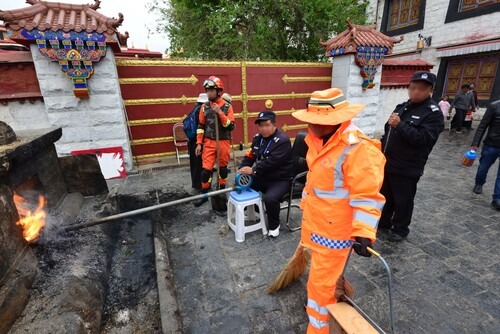
As an important symbolic centre for Tibetans, fire in the Barkor was closely controlled; the authorities would not allow a self-immolation near the centre of Lhasa. In 2018 troops marched double column around the Barkor wearing backpacks holding pairs of small fire extinguishers. Some soldiers also carried catchpoles, long metal poles with loops at the end, which an acquaintance told me was used to seize immolators by the neck while the other soldiers doused them with extinguishing agent. These patrols were still needed despite the confiscation of lighters because fires still burned within the Barkor. The Tibetan Buddhist offering ritual of sang demanded fire, so security forces permitted it so long as they could regulate it. Around the Barkor, large structures called sang bum or sang khri, which resemble small stupas, are placed at regular intervals. Tibetans and other Himalayan Buddhists use these structures to smoulder sang offerings (often small balls made from ground juniper and fragrant woods) and to recite prayers with the aim of pleasing deities and fumigating pollutions (Bhutia, 2021; Tan, 2018). Local district police were stationed at each sang bum, carefully watching how pilgrims interacted with the fires that burned within them. At the largest structures, which had open flames burning juniper branches, teams of fully equipped firemen and police officers operated bellows that could stoke or choke the flames. Fire control thus regulated religious offerings; it was part of a security system that permitted Tibetan pilgrimage practice but closely scrutinised and constrained an important element in Tibetan social and religious life (Figure 3).
Figure 3. At the Barkor in Lhasa, a police officer operates a bellows to control the fire in a sang bum. A sanitation worker keeps the operation tidy, and a fireman stands by to put out any unexpected flames.
Source: Photo by author, 2018.
The public performance of state fire security overlaps with the very real danger of fire as a public safety threat, which was widely publicised. Large posters on the need for fire safety could be found in regular buildings as well as important cultural sites, such as Drepung Monastery and Potala Palace. In monasteries, cartoons illustrating fire safety for the monastic community hung near cases with fire extinguishers, fire helmets, boots, and flame-retardant blankets. The population was enjoined to collaborate with the state to protect increasingly electrified earth and wood buildings. A sign in a Shigatse bus station depicted a Tibetan layman in a chupa robe, the speech bubble from his mouth reading, ‘Experience is the best teacher. Safely use fire and electricity. Double-check them before going out’. Fire disasters were a ubiquitous threat and often made national and international headlines. In 2014 in Yunnan Province’s Shangri-La, a popular domestic tourist destination, a dense wooden residential neighbourhood built at the site of a historic Tibetan dzong was destroyed in a nighttime conflagration. The blaze, caused by space heaters, raged for ten hours and consumed over two hundred structures over sixty thousand square metres (Ma & Xiao, 2023; Wan, 2014). On 18 February 2018, four months before I arrived in Lhasa, a fire had damaged Jokhang Temple, the key religious site on the Barkor circuit. This alarming event became the subject of much speculation, both locally and around the world.
One interlocutor told me he had been unable to enter the Barkor, where he lived with his family, on the night of the Jokhang fire. They closed the Barkor completely for two hours between seven and nine in the evening. During this time, authorities conducted rapid repair work on the burnt sections of the buildings. Rumours swirled about what exactly was damaged. Was the Temple’s ancient Jowo statue itself damaged? It appeared smaller now. Had it been repainted? The face looked different. Was the fire an intentional act? Part of on-going efforts to diminish Tibetan Buddhism? The walls and some of the figures near the gilded Padmasambhava statue had been damaged, I was told; where the fire damage wasn’t repainted, thangkas were being hung to conceal the damage. Another view was that the fire was an accident, perhaps started by a butter lamp offering that was knocked over by Tibetan pilgrims as they jostled through the tightly packed lane that separated them from Jokhang tourist groups. Whatever the source, these narratives placed the responsibility for the fire damage on the fire-management authorities; their failure was itself interpreted as a political act against Tibetans. A friend told me he was confident the truth would soon come out after the international UNESCO team investigated.Footnote4 Given the politicisation of everyday uses of fire, mistrust about the state’s fire protection measures was high. Perhaps they were a screen that could be used to carry out other attacks on Tibetan culture and civilisation.
This section has discussed Tibetans’ challenges to state authority, including acts of falsifying documentation, arguing with checkpoint staff and questioning the effectiveness of fire control in Lhasa. Humour and film provide additional insight into the social geographies of the frontier of manoeuvre. As bandit-like behaviours and the religious use of flames index non-state sources of sovereignty and moral authority, carrying knives and lighters across the sub-frontier has become problematic. Authorities have deepened everyday surveillance and security because signs of benign masculinity and commonplace religious practice have become anxiously misrecognised as indicators of terrorism and splittism. The next section further explores the spatial thinking that undergirds authorities’ efforts to stamp out unreconstructed frontier spaces and opportunities for manoeuvre, both online and offline.
7. SECURITISING PHYSICAL AND DIGITAL SPACES
During my 2018 visit to Lhasa, a People’s War was being waged against the ‘underworld forces’ (黑恶势力)threatening China’s social and economic development. The people of the Tibetan Autonomous Region were being asked to mobilise against this threat by reporting offending criminals to the Public Security Bureau. On buildings around Lhasa, large posters detailed twenty-three reportable activities that could be clues that these forces were at work. While many of these activities could occur anywhere in the country, half of them were tailored for the political situation in Tibet. First and foremost was the threat to China’s territorial sovereignty that stemmed from agents of the Dalai Clique, who operate both remotely and from corrupted religious spaces. People were encouraged to report on socially disruptive and illegally-operating ‘tyrants’ (霸) who monopolised power and occupied (占) spaces in the city and the village, on transportation and in markets. In Tibet, local manifestations of underworld forces easily tipped into international intrigue, with some underworld elements suspected of channelling funds to the Dalai Clique that directed their nefarious activities.
By encouraging reporting on local tyrannies, the TAR Public Security Bureau was waging war on forms of undesirable connection and manoeuvre that the upgrading of transport and digital infrastructures had augmented across its frontier. Underworld forces not only assembled in physical spaces, but also in cyberspace. The campaign accused the Dalai Clique of operating remotely, employing a ‘water army’ of posters to manipulate online information and influence Weixin groups. During the mid-2010s, Weixin, the Chinese social media application, had become indispensable for communication in urbanising areas across the Tibet Plateau. My interviewees used Weixin as a primary mode of communication with their family, friends and colleagues. Businesspeople told me how central the application was for advertising their products, soliciting employees and expanding their customer base. It also had important private use; member-only groups were used to communicate with kin and school cohorts, as well as to establish communities of interest, such as those for supplementary language schooling or horse racing.
During this period, however, it had also become a space for limited political expression, including reporting on state violence and local crime – real or suspected. Between 2014 and 2016, my Chinese social media feeds surged with images of bloodied and bandaged bodies on hospital beds with Tibetan and Chinese language text that explained the context for the violence, usually framing it as police brutality that violated the PRC’s constitutional protections for minority nationalities or betrayed the Party’s Mass Line policy of acting from the interests of the people (Grant, 2017). The content of critical posts crossed provincial and even national scales; Tibetan-language posts reported on happenings around the country that resonated with their own experiences of economic and environmental injustice: corrupt village leaders engaging in graft or embezzlement, Han or Muslim businesspeople cheating their customers, a story of thirty Inner Mongolian herders who were arrested for protesting a state-owned-enterprise’s theft and occupation of their land and so on. Over the course of several weeks, I was repeatedly asked to interpret a doctored photo of Michelle Obama holding a sign that read ‘Tibet is Burning’ in English. From the perspective of then-current internet security regulations and the later campaign against underground forces, such posts risked turning social media platforms into living spaces for instability and even separatism.
Although in the mid-2010s it felt relatively safe to share such messages – often compressed into easily sharable long-images that combined text, illustrations and photos – on Weixin and Weibo, urban Tibetans I interacted with were concerned that security officials were able to surveil phones as well as public and private spaces.Footnote5 Online activities could rebound into offline life. Posting on foreign social media and using a VPN could lead to a knock on their door, an invitation to tea or even temporarily losing the right to access the internet. Over the coming years I saw a sharp drop in the number of posts about violence against Tibetans being made on social media. By 2018 the posts had largely disappeared, and my social media feed was increasingly dominated by positive news: the growth of Tibetan businesses and a celebration of community initiatives including urban language schools. This shift in emphasis reflected a narrowing of permitted speech topics. As Carwyn Morris (2022) has argued, this is the result of more than platform censorship, but of the ability of state-regulated servers and platforms to engage in digital displacement by shuttering popular websites and trending hashtags as well as encouraging self-displacements in the form of user-deleted private chat groups. In both cases the outcome is to prevent not just the circulation of information, but possibilities of assembly.
Offline restrictions have paralleled online restrictions, changing the possibilities of what sorts of places Tibetans can build and what sorts of audiences they can have. After the passage of a law restricting non-governmental organisations was implemented in 2017 (Holbig & Lang, 2022), many Tibetan-run NGOs were shut down or converted into limited-scale businesses dependent on domestic funding. As non-profit and public sector jobs have become scarcer, young Tibetans have pursued entrepreneurial activities that balance the interests of their communities with the neoliberal practices that dominate Chinese business culture (Yeh, 2021). These private-market pursuits face challenges not just from the market, but the very state that has encouraged them. In 2021 China’s State Council imposed new restrictions on private schooling businesses across the country, forcing some to close and others to adopt curricula and teaching materials that conformed to state-sanctioned guidelines (Che, 2021). This law has had specific effects on private Tibetan-language education. For example, in Qinghai Province, students have been forbidden from attending winter-time supplementary education schools (Sangyal Kunchok, 2021). The closure limits the scope of Tibetan language education outside of direct state authority, and thus is in step with the People’s War against spaces where underworld forces might establish tyrannies that undermine China’s territorial authority.
The multi-faceted and invasive securitisation of China’s borderlands aims to stamp out the frontier footholds state security authorities imagine as irritants to social and political stability. Physical and digital controls have been combined into pervasive security and surveillance infrastructures that allow little room for manoeuvre. These restrictions, when deployed in borderlands domestic economic corridors, have continuously complicated Tibetans’ agency in using information technology for social connectivity and in pursuing economic and entrepreneurial possibilities in the unfolding developmental space of the corridor.
8. CONCLUSION
This article has looked at how China’s domestic economic corridors have been conceived as developmental spaces with specific geopolitical and geoeconomic consequences for the Tibetan Plateau and China’s Himalayan borderlands. Corridors are positive spaces that seek to eliminate the political and social insecurities of frontiers. While leapfrog economic development on the Tibetan Plateau has simultaneously increased mobility and connectivity in ways that fulfil Chinese-led development goals, it has also facilitated what sinophone scholars and security organs have flagged as dangerous challenges to China’s national security. They locate an archipelago of territorially unsettled spaces comprised of sub-frontiers and offline and online footholds of unwanted ideas, organisation and practices. In short, they point to the socially combined nature of the region, despite efforts to coordinate its economic and social development.
Efforts to control Tibetan social and religious practices in the frontier can be seen as the manifestation of a security culture that has linked the political grievances of China’s borderlands populations to separatism and terrorism (Smith Finley, 2019). The state’s incomplete control, real and imagined, provides opportunities for what I have termed a frontier of manoeuvre. Tibetans’ celebration of the figure of the bandit, as well as suspicion about state management of fire, offer insights into the tactics that borderlands peoples have used in spaces where combined forms of social organisation persist. These tactics should be considered alongside social practices including qualified consent to state-led urbanisation practices and counterhegemonic critiques of urban ‘civilising’ practices (Grant, 2022). Certainly, increased security and surveillance have shrunk spaces for manoeuvre where the state has limited mobility and information connectivity.
The existence of the sub-frontier, the frontier of manoeuvre, and the positive space of the economic corridor as interlinked conceptual objects is possible because of the internationalised context of the BRI and contemporary multipolarity. Chinese efforts to extend the Open up the West Campaign to deepen its economic connection to Asia is in step with efforts to challenge regional hegemons such as India. Concerns about wiping out transfrontier political threats within China have risen to the fore as leapfrog development puts unsettled frontiers into indeterminate motion. Where neighbouring states have embraced corridor connectivity, they have used ‘state restructuring’ to obtain foreign loans to develop their countries while retaining autonomy (Schindler et al., 2022). For these states’ populations, the effects aren’t always positive; Pakistan has used corridor development to deepen its control of separatists in Balochistan (Hillman, 2020), and Nepal’s government has, to please Chinese authorities, pressured its Tibetan population to reduce their political visibility (Mulmi, 2022). In other words, corridors have been used to mark and eliminate frontier spaces.
It is important to examine corridors not only in their international BRI guise or as outward-looking bridgeheads. The potentially vast spaces of the sub-frontier that domestic economic corridors seek to eliminate suggest the importance of looking at corridors as more than focused spaces of transit (Rippa, 2020a). Moreover, while it is important to avoid shouldering the ‘ideological work’ of PRC developmental planners (Woodworth & Joniak-Lüthi, 2020), it is also a worthwhile endeavour to understand how economic logics transform under the stresses of an authoritarian state anxious and impatient to consolidate its diverse borderlands for its global projects.
More Research
1/2