
Corridors, chokepoints and the contradictions of the Belt and Road Initiative
Published: March 22, 2024
•
Area Development and Policy
Abstract
In popular, scholarly, business and governmental conceptualisations, ‘corridors’ are identified as fundamental components of connectivity and central to the China-led Belt and Road Initiative (BRI). However, given how the BRI has challenged socio-spatial relations among participant states, elevating the corridor as the dominant mechanism framing the BRI is incomplete and misleading. Paradoxically, while some evidence on the ground supports the existence of functioning corridors, the BRI is equally characterised by chokepoints – processes that restrict the flow of goods, resources, services and information. Although BRI programmes are widely rendered as networks of connectivity via corridors, the analytics of chokepoints, and the frictions they generate, have not been critically applied to research on the BRI. Identifying and responding to the importance of this gap, we propose a ‘corridor-chokepoint dialectic’ to critically evaluate the operations of BRI development and apply this dialectical concept to multiple BRI-affiliated countries bordering China, including Kazakhstan, Pakistan, Nepal and Myanmar. Each of these countries play host to major corridors projected within widespread BRI agendas and lend both discursive and material support for ‘new Silk Road’ connectivity. However, contrary to state rhetoric and popular media depictions, an array of corridors in conjunction with chokepoints more accurately defines the operational realities and challenges of BRI progress across Asia.
Regions
Themes
Cite This
Murton, G. (2024). Corridors, chokepoints and the contradictions of the Belt and Road Initiative. Area Development and Policy. https://doi.org/10.1080/23792949.2024.2311904
Full Text
1. INTRODUCTION
Beginning in 2013, the Chinese government officially prioritised geoeconomic connectivity as one of the distinguishing features of China’s global vision through its announcement of the Belt and Road Initiative (BRI) in speeches in Kazakhstan and Indonesia. In so doing, contemporary notions of ‘Global China’ rapidly emerged, both theoretically and empirically, which differed from previous versions of international capitalist development. From ‘Going West’ to ‘Going Out’ as well as early forms of Beijing’s ‘One Belt, One Road’ programmes, China’s geoeconomic objectives now clearly prioritise connectivity.
Geopolitical depictions of the BRI, although varied, also employ discursive tactics to emphasise international connectivity (Demiryol, 2019; Derudder et al., 2018; Wang, 2018; Xi, 2014). This connectivity discourse rests on notions of universally comprehensible principles of ‘mutual exchange and prosperity’ (Liu & Dunford, 2016), frequently framed by Chinese leaders and target country leadership alike as involving ‘win-win’ interactions between states (Wang & Li, 2019). For governments in the Global South, the BRI often appears to directly address long standing challenges and struggles of ‘uneven and insufficient’ connectivity as a main hindrance to national development goals (Bachmann et al., 2021).
To ground the sometimes abstract aims of connectivity, corridors are routinely invoked and cartographically rendered as infrastructural projects and multi-state endeavours to help countries realise (and visualise) their own geoeconomic aspirations. That is, corridors represent both physical realisations and discursive aspirations of connectivity; in other words, corridors are ‘an often-cited vehicle for achieving these connections’ (Hillman, 2018, p. 2). While such maxims of economic progress are easily digestible and interpreted – by both political elites and public citizenry alike – the harmonious depiction of connectivity as the main driver of the BRI, in reality, ‘obfuscates rather than engages past geopolitical tensions and interimperial rivalries’ (Grant, 2018, 2020, p. 1; see also Sidaway & Woon, 2017).
We argue that widespread emphasis on corridors in the making of the BRI is fundamentally contradictory. On the one hand, popular geoeconomic discourse has in some instances materialised with the construction and completion of operationally functional corridors (e.g., roads, highways, bridges, sea-lanes) designed to grow transport linkages between countries and across regions. On the other hand, corridors rarely operate as the frictionless avenues for the free flow of goods as they are often portrayed by governments and businesses. Rather, they are invariably also characterised by points of delay, disruption, bottlenecks and breakdowns – spaces of friction otherwise known as ‘chokepoints’.
The geopolitical discourse of the BRI (emanating both from Chinese leadership in Beijing as well as from international economic actors (e.g., Eastern and Western governments and businesses)) is that corridors are considered as the dominant reality of the BRI, when in fact it is the existence and interaction between corridors and chokepoints (the corridor-chokepoint dialectic) that more accurately and completely captures the political economic reality of the BRI on the ground. In view of the regular tension between connectivity and friction that appears definitive to experiences with infrastructure development, we propose the ‘corridor-chokepoint dialectic’ as a new concept for analysing and understanding China’s BRI programme. Like corridors, chokepoints are also manifested in actual geographic features as well as discursive practices, both of which complicate geopolitics and render political economic practices contentious and debatable. In this paper, we complement an examination of the material realities of chokepoints with a close analysis of their discursive properties. In doing so, we expand upon how discursive constructions of chokepoints play an equally important role in hindering and complicating actual, on-the ground connectivity between countries and within regions. To be clear, we contend that both corridors and chokepoints play a fundamental role in geoeconomic objectives behind BRI imaginaries, where ‘infrastructure is the practice and outcome of connectivity’ (Flint & Zhu, 2019, p. 100).
In this paper, we demonstrate the analytical utility of the corridor-chokepoint dialectic by highlighting the paradoxes of infrastructure development in multiple BRI-corridor countries neighbouring China: namely, Kazakhstan, Pakistan, Nepal and Myanmar. Our analysis calls out the need for geography as a discipline to focus more attention towards the on-the-ground impediments that shape the reality of the BRI as much as (if not more than) the lofty-aims of corridorization across trans-Eurasian space. Emphasising the importance of a geographical approach, we employ a geopolitical lens to analyse the productive tensions between flows and blockages related to, but also going beyond, BRI development emanating from different global regions, including Southeast, South and Central Asia. As an intersection and spatial node of multiple corridors, the BRI plays a special role in an era where ‘the spatiality of global and regional connectivity is reconfigured through the process of China’s integration with the world’ and where ‘corridorization as a dominant physical and ideational process shapes Chinese investment projects and reconfigures state spatiality along the BRI’ (Mayer & Zhang, 2021, p. 974).
Our analysis is interdisciplinary, grounded in the spatialities of human geography but connecting and contributing to literature on the BRI, corridors and chokepoints from socio-cultural anthropology and security studies. We employ a political geographical analytic which accounts for multiple major political rivalries at play, in this case sometimes relating to ‘China versus the West’. In addition to pointing attention to how this study’s focal countries are affected by such rivalries, we also recognise the present geopolitical importance of other major political players from the Global South, such as India (Singh, 2023). Our study also complicates prevailing realist approaches which associate bottlenecks with power and competition relating to needs associated with protecting the state. By applying our corridor-chokepoint dialectic to the study of the BRI and Global China, our aim is to bring a critical geographical sensibility to bear on scholarship at the intersection of social science and policy-relevant research.
Our paper is organised as follows. We first conceptualise a corridor-chokepoint dialectic and establish a framework to more critically examine the tensions between BRI connectivity and friction. Above all, we do this to more broadly show how socio-technical systems operate through space and over time. Reading across literatures in human geography, anthropology and security studies, we highlight the dominant narratives that generally (but surely do not exclusively) characterise corridors and chokepoints in cross-disciplinary scholarship on the BRI. Following this conceptualisation and review of the literature, in the next section we examine and discuss key contradictions of the BRI through the lens of our corridor-chokepoint dialectic. We draw attention to the presence of such dialectical tensions in Kazakhstan, Pakistan, Nepal and Myanmar to establish a wider application for our conceptual contributions and the paper itself.
Finally, the conclusion underscores the analytical utility of the corridor-chokepoint dialectic in shaping the political-economic contours of the BRI as they impact different sovereign spaces and actors across Eurasia today.
2. BETWEEN CORRIDORS AND CHOKEPOINTS: TOWARDS A CRITICAL DIALECTIC
Reading across interdisciplinary approaches to corridors and chokepoints from geography, anthropology and security studies, we propose that a corridor-chokepoint dialectic provides a critical heuristic to better understand the operational realities, and failures, of BRI development. While the concern over corridors is well established in popular, policy and academic studies of the BRI, and international connectivity more broadly, our conceptualisation of a corridor-chokepoint dialectic points further attention to chokepoints as also constitutive for the mutual construction of space and society. The framework of this dialectic is based on the mutual relationship between contrasting geographic features and socio-spatial dynamics: the first of passageway and movement and the second of blockage and constriction, both existing materially and discursively, and many times even simultaneously.
In what follows, our contribution highlights that within the context of the BRI, chokepoints represent and function concurrently as areas of constriction (like bottlenecks) as well as passages of motion of people, transport, ideas, etc. (in other words, like corridors). In both instances, the political and economic implications of these sites extend beyond their immediate physical location along a specific corridor to also take on national, regional and global importance (see e.g., Liu, 2020, p. 152; Degani, 2019; Rothenberg, 2019). Before examining some of the productions, operations and tensions between corridors and chokepoints across different Eurasian spaces, however, it is necessary to first outline and define the terms and present the dialectical nature of the relationship between corridors and chokepoints – especially insofar as the BRI is concerned.
2.1. Corridors
Corridors combine physical and metaphorical dimensions; that is, they are both material and discursive. For the purposes of this paper, we build on Murton and Lord’s definition of corridors as ‘passages between places, materially and discursively co-produced, that prioritize certain spatial and social relations, and that connect and contain but also exclude’ (Murton & Lord, 2020, p. 2). In conversation with other critical studies of corridors, we recognise the need to give a fuller and more nuanced sense of both the material and discursive aspects of corridors; or, to situate our analysis with other empirical studies of infrastructural connectivity, where corridors often do have real and important meaning for people on the ground. That is, while discourse surrounding corridors associated with the BRI overstates the degree of their real-world practice, we do recognise that corridors have been constructed, to varying extents, within the BRI.
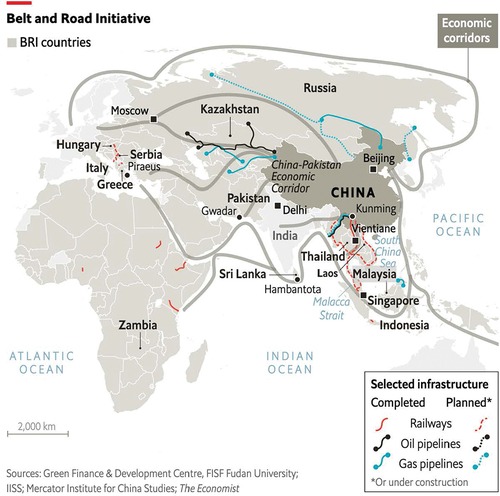
In popular media coverage as well as think tank country reports and white papers (McBride et al., 2023; MERICS, 2023), the constitutive basis of BRI connectivity is widely, if erroneously, depicted as a coherent network of corridors. This Belt and Road network itself is promoted and cartographically rendered as comprising more than a half-dozen economic land belts and maritime silk roads. From maps produced by The Economist, the New York Times and MERICS, to World Bank publications on the economic potentiality, if not inevitability, of Belt and Road enhanced global trade networks (Murton, 2021), corridors are imagined, articulated and reproduced as the dominant structural framing mechanism of the BRI.
The focus on corridors is evident across a vast array of outlets and constituents, from the Western press (Economist, 2023b) to geopolitical forums in China (Liang, 2023). At the recent China-Central Asia Summit (C+ C5) in Xi’an in May 2023, for example, the enhancement of Chinese-financed political, economic, cultural and technological connectivity via corridors across Asia was tied to broader visions of regional prosperity as well as greater international security (MERICS, 2023). Moreover, the importance of corridors in the making of greater international connectivity also goes well beyond BRI contexts. As another example, competitive alliances led by the US and India forged at recent G-20 meetings such as the ‘Partnership for Global Infrastructure Investment’ now also articulate corridors – and specifically the ‘India-Middle East-Europe Economic Corridor, or IMEC – as a key mechanism to counter-balance China’s global development agenda’ (Singh, 2023). In other words, the Belt and Road as well as other international infrastructure programmes are oftentimes seemingly part and parcel all about corridors.
To be sure, corridors matter both conceptually and physically. Corridors represent an attempt to overcome the ‘changing socio-spatial structuration of states and economies’ (Mayer & Zhang, 2021, p. 994) inherent in this era where states struggle to balance the displacing effects of globalisation with national and local political imperatives. BRI-recipient governments and businesses employ corridors as discursive and infrastructural tools to prevail over political fragmentation and uneven economic integration across space (Barbalet, 2014; Tooze, 2018; Turner, 2007). Contemporary debates concerning the impact corridors ultimately play on the economic, political and environmental trajectories of countries, regions and people speak directly to the ‘fresh geo-visions’ (Mayer & Zhang, 2021, p. 993) that are being discursively crafted to connect China with BRI-participant countries and organisations. Footnote 1
In many geographical contexts, associating BRI development with corridor-making provides political expediency via popular imaginaries. That is, corridors get work done even when they don’t really exist. For example, corridors as a central idea, framework and outcome of the BRI have captured the mindset of heads-of-state, state-owned enterprises, domestic Chinese and foreign firms, and countless international entrepreneurs. This is especially true in countries that share borders with China. In the case of Nepal, but also in Laos, Kyrgyzstan, Mongolia and other land-locked Asian states, ‘transport infrastructure and international trade … loom large in the popular imagination … and are significant at all levels of political discourse’ (Murton & Lord, 2020, p. 3). For countries both with and without coastlines, the expansion of transport networks can create viable channels for throughput and transit trade between larger economic neighbours. In this way, even corridors that run through landlocked countries – and their purported promise of increased economic activity as a streamlined pathway to modernity – contribute to the ‘turning-a-weakness-into-an-asset’ discourse of such countries being ‘land-linked’ (see, e.g., Kuik, 2021).
As has been shown by recent scholarship on Asian borderlands and the BRI (Woodworth & Joniak-Lüthi, 2020), achieving the dual goals of growth and security through cross-border and regional integration via the Belt and Road is perhaps the ultimate, overarching objective for leadership in Beijing. Moreover, according to numerous think tank reports and security studies perspectives from both Europe and Asia, the government ministries of China and Central Asian countries actively promote the corridorization through efforts to ‘strengthen cooperation on trade and investment, digital economy, green development, transit transport and other fields, and jointly promote regional economic cooperation’ (Liang, 2023). Because corridors represent the essence of political and economic integration across adjacent sovereign territories, they are employed as a useful conceptual trope that conveniently connects historical imaginaries about the ancient Silk Roads (Chin, 2013) with grander narratives of the BRI’s inevitable mission of shared economic prosperity. In the early days of the erstwhile One Belt, One Road (OBOR), Beijing bolstered such a view in hopes of ushering in a new era of mutual benefit for China and other BRI-participant states (Ministry of Foreign Affairs, PRC, 2015). However, such geopolitical reasoning exists despite the largely unrealised aspiration of BRI development and broader, yet still unfulfilled, corridorization of Eurasian space.
Beyond a doubt, the corridor also has important and impactful discursive power. Time and again, however, depictions and narratives of the BRI exemplify misplaced geographical concreteness, ‘implying that more is known about the initiative as a whole and what it has so far achieved than is in fact the case’ (Narins & Agnew, 2019, p. 2). While we recognise that in some cases actual, physical corridors at least partially exist materially across the BRI, we nevertheless assert that a singular, corridor-centric assessment of the BRI – as is often depicted by macro-scale analyses and rendered across innumerable BRI maps (see Figures 1and 2) – is both incorrect and misleading.
Figure 1. A widely circulated Mercator Institute for China Studies (MERICS) map emphasises overland corridors as being central to the development of new global infrastructure networks and the realisation of the Belt and Road vision.
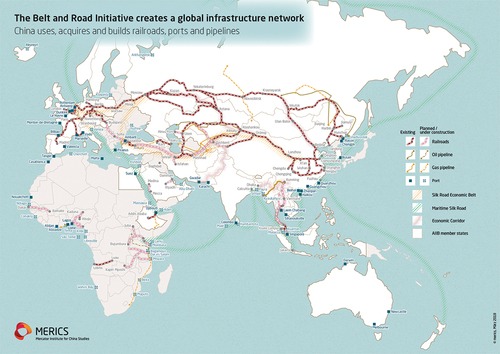
Figure 2. A recent Economist BRI map also emphasises corridors as being crucial to China’s emerging vision of regional and global economic connectivity.
2. Chokepoints
Shifting attention to chokepoints is an effective way to challenge and disrupt the prevailing emphasis on corridors as the sine qua non of the BRI. Chokepoints, by definition, can be geographic or topological in nature – like a physical obstacle that imposes a blockage or bottleneck to free-flowing mobility. Carse et al. (2020, p. 2) define chokepoints as ‘sites that constrict or “choke” the flow of resources, information, and bodies upon which contemporary life depends’. In classical political geography formulations, Saul Bernard Cohen (2008) draws from and extends the determinist influences of Halford Mackinder’s ‘heartlands’ and Nicholas Spykman’s ‘rimlands’ in the conceptualisation of chokepoints and ‘shatterbelts’ as key features in the geographies of international relations. Such classical concepts from political geography today influence much security studies scholarship on chokepoints in the contexts of great power rivalries and military security interests (Gresh, 2020; Nation, 2001), whereby geo-physical features of the earth condition and complicate the movements of such things as naval assets, petroleum resources and global commerce (Bailey & Wellesley, 2017; Cabestan, 2020; Styan, 2020).
But chokepoints are also often socially constructed and politically expedient. Cultural anthropology, in particular, brings awareness to the relationality of chokepoints and how they can also be strategically created by a variety of agentive actors (Carse et al., 2020). This work emphasises the embeddedness of chokepoints in global dynamics of trade, mobility, migration and other political economic flows of material things. Deconstructing the meaning of chokepoints into a framework of eight dimensions, recent social science research by Carse et al. ‘provid[es] analytical bearings and ethnographic entry points for navigating choked spaces and times’ (Carse et al., 2020, pp. 6–9). Cumulatively, the analytical utility of more critical engagements with chokepoints extends inquiry into these socio-physical spaces beyond mainstream, great-power and policy-oriented conceptualisations towards a broader and deeper understanding of geographic vulnerabilities (e.g., straits, ports, highways, supply chains) ‘as sites that funnel and constrict not just commodity flows, but broader possibilities and dynamics’ (Carse et al., 2020, p. 6).
By engaging with both the discursive nature and lived experiences of chokepoints, critical anthropological and geographical analyses and debates also help to extend the function and meaning of the term beyond the more traditional material conceptions of chokepoints’ geopolitical features and geostrategic concerns. Therefore, when looking at how BRI development and its concomitant geoeconomic flows really operate, numerous analysts with ‘views from the ground’ (Oliviera et al., 2020) show that breakdowns, logjams, detours and other metaphorical and material disruptions – aka chokepoints – are very much how the BRI is encountered and experienced by many people in numerous quotidian ways.
Everyday perspectives on local engagements with BRI development often describe and depict chokepoints, even when the vocabulary of ‘chokepoints’ is not used in explicit terms. This provides a counterpoint (or antidote) to prevailing policy narratives that often assert – and sometimes appear to reify – the corridor nature of the BRI (e.g., Derudder et al., 2018; Murton, 2021). In this sense, chokepoints in many ways also serve as a reminder of the political, economic and ecological realities on the ground that challenge the ‘seamless connectivity’ narrative inherent in the more dominant ‘corridor-centric’ geopolitical depictions of the BRI. But as mentioned above and as we show in more detail below, chokepoints can also be made to serve particular actors and interests. This is especially true in the playing-out of the contentious and paradoxical nature of the BRI throughout numerous participatory states.
Real-world observation confirms that corridors can transform and devolve into chokepoints because of geographical conditions, including but not limited to conflicting political rationalities, physical topographies, incompatible technologies, economic competition and other everyday complexities. As such, chokepoints pose significant obstacles that run counter to a main strategic goal of leadership in Beijing and to its preferred visualisation of the BRI and the Chinese Dream: as a set of projects and institutions focused on ‘weaving a web of interdependence across Asia and beyond’ (Miller, 2017, p. 240). Exemplified in multiple ‘corridor-centric’ states such as Kazakhstan, Pakistan, Nepal and Myanmar, but also evident in other empirically grounded examples addressed in broader scholarship, the dialectical tensions and contradictions of corridors and chokepoints more accurately reflects the global realities of BRI infrastructure development.
Building from early formulations of chokepoints in the political geography literature, security studies scholarship on chokepoints largely focuses on how these sites adversely affect shipping lanes, global resources, military interests and economic-state security (Bailey & Wellesley, 2017; Cabestan, 2020; Gresh, 2020, 2018, 2017; Styan, 2020). Oftentimes, this scholarship also places emphasis on supporting the status quo power hierarchy in the global political system. In a world-wide capitalist system that centres around global production networks (e.g., Dicken, 2015), navigating the delays and bureaucracy of chokepoints is understood as part of the cost of carrying out global trade and commerce. In these instances, chokepoints can operate in physical geographical as well as discursive ways by which commercial logics of capital accumulation are slowed down and rendered less efficient. Western think-tanks have also focused on security concerns related to combating piracy, maintaining open shipping lanes and the operations of global naval bases, with particular attention paid to chokepoints in the Pacific and Indian Ocean theatres most proximate to Chinese maritime territory (Greenwood, 2021; Gresh, 2015; Hillman & Sachs, 2021). While security studies scholars writing on chokepoints frequently emphasise the geographic nature and bottleneck conditions inherent in such sites (e.g., the Malacca Strait, the Suez Canal, Bab al-Mandeb, the Strait of Hormuz), political economic implications are given priority when assessing the influence such locations impose on inter-imperial rivalries and hierarchies of colonial powers. Footnote 2
In relation to China’s contemporary global integration, other social science perspectives adopt a broad view of ‘waterways-as-chokepoints’ by considering the BRI as cartographically ‘seizing’ some of the world’s important historic commercial and military chokepoints (e.g., the Cape of Good Hope, the Bosporus Strait, the Dardanelles, the Strait of Gibraltar). We argue that the visualisation of such waterways on maps serves as a geopolitical reminder of strong states and their ability to command realist notions of global trade and political economic power. Again, in alignment with how romanticised Silk Road tropes have been widely deployed in modern imaginaries of Global China’s infrastructural connectivity via the BRI (Chin, 2013), many studies of chokepoints also represent an ‘overlapping vision of the world order from past to present’ (Liu, 2020, p. 152).
While the reality of the BRI comprising – and characterised by – both corridors and chokepoints should be widely evident by now, geopolitical and geoeconomic analyses of the Belt and Road rarely examine these concepts in tandem. As we show below, it is essential to address this gap because the dialectical nature between corridors and chokepoints lies at the heart of the geopolitical connectivity challenges that the BRI seeks to champion. In what follows, we bring together these contradictions to further theorise and apply our corridor-chokepoint dialectic to the paradoxes inherent to Belt and Road development projects from local to global scales.
3. CONTRADICTIONS OF THE BRI – CONSIDERING THE CORRIDOR-CHOKEPOINT DIALECTIC ACROSS ASIA
Over the last five years, social science scholarship has examined the politics of BRI development through a range of heuristics including, but not limited to, financial modalities (Lai et al., 2020), ethnographic encounters (Oliviera et al., 2020) and critical cartographies (McConnell & Woon, 2021; Murton, 2021; Narins & Agnew, 2019). In addition to the many special issue journal collections and the rapid proliferation of numerous edited volumes (Gerstl & Wallenböck, 2020; Liouw et al., 2021), policy-oriented and security studies literature on the BRI is especially abundant. In an effort to focus and distill this prodigious scholarship, S. Lin et al.’s (2021) recent analysis of BRI research frames the literature according to four broad categories: BRI as geopolitics, geoeconomics, Chinese exceptionalism and ‘Silk Road’ imaginaries. Across almost all of these literatures, however, the ‘corridor imaginary’ of the BRI takes centre stage time and again.
In contrast to the corridor-centric analysis of the BRI exemplified in much of the think tank and policy-oriented literature, ethnographically engaged social science scholarship widely emphasises the negative impacts, uneven experiences and widespread breakdowns of Belt and Road development. While this generalisation is of course not absolute, a review of the literature shows that more and more ‘grounded’ studies of the BRI consistently identify social disruptions, debt burdens, cultural clashes and negative environmental impacts as common outcomes of BRI development in host and recipient countries (Oliviera et al., 2020; Sidaway et al., 2020; Sternberg et al., 2022; Woodworth & Joniak-Lüthi, 2020). In other words, an emphasis on what might be construed as chokepoints characterises much of the critical social science literature on the BRI. This is true even as what Carse et al. (2020) identify as ‘socially made’, ‘environmentally conditioned’ and ‘technologically complicated’ concerns aren’t always called ‘chokepoints’ in journals of human geography, cultural anthropology and development sociology.
To be sure, the Belt and Road is anything but clear lines and distinct projects (Hall & Krolikowski, 2022). It is not black and white, and the closer one looks, the murkier and more ambiguous BRI development appears to be. In short, the Belt and Road is not only full of holes (Oakes, 2021), it is also defined by contradictions. For example, despite a widely touted principle of Chinese non-interference in the internal affairs of sovereign countries, as the BRI increases in acceptance and as cross-border and cross-regional investments and trade continue to grow, it becomes apparent that the principle of non-interference has real limits (Gonzalez-Vicente, 2015). Two reasons inform this assertion. First, studies suggest that the Asian region alone will require $26 trillion in infrastructure investment from 2016 to 2030 in order to meet the sustainable development needs of its societies (Asian Development Bank (ADB), 2017). Second, across Asia, in large countries such as Kazakhstan and small countries like Nepal, China’s willingness to invest and its expansionist drive is often viewed ‘as the last hope to diversify and jump-start the economy … [with the widespread sentiment within these distinct countries that] … [a]ll the previous efforts and programs have failed to deliver results’ (Kassenova, 2017, p. 114; see also Murton & Lord, 2020).
To bring more critical awareness to this chokepoint reality (which, as elsewhere, is ordinarily overshadowed by popular attention to corridors), this section elaborates the corridor- chokepoint dialectic to analyse BRI development in Kazakhstan, Pakistan, Nepal and Myanmar. In our view, these countries provide a representative sample of the ways in which the presence of chokepoints across Asia is an inescapable dimension of BRI corridor making, and how chokepoints of many distinct types can have different economic, environmental, political and social aspects and ramifications. Chokepoints such as those seen, made and experienced on the ground throughout Central, South and Southeast Asia exemplify the political economic reality of business and government actors involved with the quotidian experience of the BRI development. By bringing some brief attention to just a few chokepoints in these countries, we highlight key factors that make actual functional corridors more the exception than the rule within the BRI context.
3.1. Kazakhstan
Kazakhstan’s size and central Eurasian location render it as a central and crucial space of BRI development and corridor aspirations (Toops, 2016). While recent scholarship has highlighted the international trade port at Khorgos – a logistical chokepoint – as one of many contested borderland-spaces along the BRI (Alff, 2016; Grant, 2020; LaMela, 2021; Neafie, 2022a, 2022b; Vitalis, 2023), closer examination also shows that Kazakhstan, as a broader territory and idea, exists as a major paradox for the BRI (Alff et al., 2023). As a Central Asian country, Kazakhstan is sometimes considered China’s ‘frenemy’, a country with close ties to China but which at the same time fears Chinese domination (Economist, 2023a). Kazakhstan is at once both a critical asset to long-term success of the BRI and a geopolitical challenge on multiple levels (Alff & Spies, 2023; Koch, 2013). Given the more expansive and liberal nature of Carse et al.’s (2020, p. 6) interpretation of ‘chokepoints’, as ‘sites that funnel and constrict not just commodity flows, but broader possibilities and dynamics’, Kazakhstan is more than a series of land ports and highways that must be moved through (at the local level). Rather, it is also a stage to negotiate the complicated geopolitical challenges posed by the topological features of the country’s terrain and by the political economy of the country’s government and elite leadership.
Geopolitically, Kazakhstan holds an especially important geographic position as leadership in Beijing seeks a non-Russian, overland trade route westward to connect China’s economy with European economies. According to Bitabarova (2018, p. 160), an important but problematic paradox for Kazakhstan is that its central location conjures geopolitical aspirations of potential corridors – passageways imagined to overcome the realities of innumerable chokepoints, thus making it inextricable and constitutive to what Beijing views as a successful BRI. In many ways, Kazakhstan embodies the corridor-chokepoint dialectic in that BRI development here is as much about contending with complex chokepoints as it is about realising corridors.
Rhetoric surrounding BRI connectivity as well as broader discourse around corridor making at times assumes that all players and parties want to cooperate in order to realise some type of social progress. The reality, however, is rarely so simple (Alff et al., 2023). Take, for example, discontent Kazakhstani citizens who protest against their government for the attempted legalisation of the sale of Kazakhstani land to Chinese investors. Such land sales, while superficially economic in nature, speak to the broader fear of an expanding Chinese state – a concern that has been at the heart of Kazakhstan social tensions for decades. Kazakhstani citizens’ discontent over the sale of land to foreigners acts as a type of discourse function and social chokepoint limiting the smooth flow of capital across the BRI from China to Kazakhstan. In this sense, Kazakhstan’s chokepoints, broadly understood, function as a type of economic and geopolitical ‘reality check’ on domestic and Chinese interests and serve to mediate a range of political and economic forces that are unequal and vie for power across Kazakhstan’s territory.
Lastly, the widely-publicised positive narrative of ‘win-win cooperation with China’, as a vantage point discussed and reinforced by political and business elites in Kazakhstan, in fact belies degrees of mistrust and alarmist reactions among experts and the general public in characterising other important Sino-Kazakh relations (see e.g., O’Neill, 2014). Most recently, this mistrust has centred around pressing humanitarian concerns related to ‘the ongoing securitization of ethnic minorities in Xinjiang, including Kazakhs’ (Bitabarova, 2018, p. 149; see also Szadziewski et al., 2022). In sum, BRI development on the ground reflects some of the key factors that together make Kazakhstan both representative and exceptional to the BRI in broader global contexts.
3.2. Pakistan
In numerous countries identified as major recipients of BRI development, such as Pakistan and Myanmar, empirical research and critical analysis shows that the anticipated corridors – namely, the China Pakistan Economic Corridor (CPEC) and Bangladesh China India Myanmar Economic Corridor (BCIM-EC), respectively – are more accurately characterised by their breakdowns and bottlenecks (Akhter et al.,2022; Rippa, 2020a; L. Kiik, 2020; Rafiq, 2017; D. S. W. Chan & Pun, 2020). From geological landslides and social marginality in northern Pakistan (Karrar & Mostowlansky, 2018) and political rivalry in Balochistan (Safdar, 2021) to military coups and Sinophobia in Rangoon (Mark et al., 2020) and ethnic conflict in Myanmar’s restive northern borderlands with China (Dean, 2020; Dean et al., 2022; Rippa, 2020b), such places promoted as BRI corridors are clearly anything but fast-moving and free-flowing geoeconomic and infrastructural realities. As a clear example of the corridor-chokepoint dialectic at work on the ground, Belt and Road development in Pakistan and Myanmar is as much about resolving breakdowns and navigating chokepoints as it is about building corridors.
In both cartographic renderings and strategic policy discourse, Pakistan’s geographic location is seen by some observers as functioning as a terrestrial corridor connecting western China with the maritime shipping lanes of the Arabian Sea. This conceptual corridorization of Pakistani territory allows Chinese oil importers, in theory, to avoid relying on the Strait of Malacca, which is viewed by many as one of the major chokepoints in the global oil transport system. Alternatively, and via CPEC, Beijing might instead rely on its ‘all weather friend’ and neighbour which has accumulated upwards of $30 billion in Chinese debt as a result of its BRI involvement. Reality on the ground, however, is far from the free-flowing trade passageway that Pakistani or Chinese government and business proponents claim and promote (Ahmed, 2019; Karrar, 2022). Nevertheless, even if CPEC does not yet function according to its aspirational geoeconomic and geopolitical logics, flows of goods and people as well as built environments and policy agreements have come together in new assemblages that are surely material and much more than merely discursive (Boni & Adeney, 2020; Karrar & Mostowlansky, 2018).
3.3. Myanmar
In Myanmar, the paradox of being included as part of one of the six major BRI corridors is noteworthy given the fragile and failed state-nature of its government. Comprising one of four countries in the BCIM-EC, Myanmar is a politically weak regime situated amongst the international economic plans of China and China’s ambitious vision of coordinating development between East Asia, Southeast Asia and South Asia. Currently, however, the BCIM-EC represents more chokepoint than corridor given the low level of ‘China-Indian political mutual trust’, underdeveloped transportation infrastructure, insufficient human exchange and cooperation among participant countries and the increase in intra-regional trade competition (Islam et al., 2022).
Social and cultural concerns around Chinese investment and development in Myanmar (Sarma, Rippa et al., 2023) in many ways echo similar soundings of Sinophobia that also reverberate in Kazakhstan. Indeed, there is a profound ‘emotional geopolitics’ to BRI projects in Myanmar (Mostafanezhad et al., 2023) that itself generates uneven social and material terrains that in turn coalesce as chokepoints. As Mostafanezhad et al. recognise in the case of widespread and popular uncertainties related to BRI development in Myanmar, sovereign anxiety – or the ‘generalized condition of unease over the security of one’s political community’ (Mostafanezhad et al., 2023) – takes shape as social practices of affect and emotion. In turn, these social practices themselves manifest in material ways – as chokepoints – through activism, protests and other forms of resistance that can deliberately, and effectively, throw a proverbial (and at times even physical) wrench in the spokes of the Belt and Road machine wheel (Sarma, Rippa et al., 2023).
Controversy related to Chinese construction of the Myitsone Dam in Myanmar, for example, also demonstrates that the emotional geopolitics of sovereign anxiety for many Burmese and Kachin communities in fact predates the advent of the Belt and Road (L. Kiik, 2020; Sarma, Faxon et al., 2023). It is also important to note that just as the BRI is often recognised as an international, global extension of Beijing’s development campaigns to first ‘Open up the West’ and then ‘Go Out’, so too have forms of local resistance to Chinese development in Myanmar evolved and escalated in equal measure. Taking the Myitsone Dam as an acute but also demonstrative point of contention, critical geographical scholarship (Laur Kiik, 2016; Wan Chan & Sze, 2017) shows how rumours and conspiracies over economic modalities and environmental impacts also function as socio-material chokepoints in the practical development of China’s imagined infrastructural corridors. As an instance of civil society organising and mobilising to take back power from state-level entities, the case of Myitsone, as well as Myanmar more broadly, shows how mistrust and speculation can derail the best laid plans.
Transforming state-led development projects like hydropower dams, fruit plantations and railroad lines into programmes of indeterminate suspension, practices of counter-development are themselves fundamental characteristics and components of chokepoints that inherently exist within the production of corridors. For these reasons, like CPEC, the BCIM corridor is anything but a free-flowing economic pathway. In fact, these accelerated trade zones are in many instances more imaginary than real and the so-called corridors’ multi-modal transportation infrastructures comprising highways, railroads, pipelines and transmission cables are still far from fully functional.
3.4. Between and Beyond the BRI in Nepal
In other Asian regions proximate to the ‘official’ BRI corridors, such as Nepal, corridor-making remains a national aspiration and political ideology despite a breadth and depth of chokepoints that are social, political, geological and technological (Murton, 2023, 2013).
Especially across the Himalaya region, talk of corridors, Chinese development and the BRI more broadly has exceptional discursive power (Murton & Plachta, 2021; Paudel, 2022). From political chambers of Kathmandu to rural development programmes in the Himalayan borderlands, the BRI and its purported promises of corridor making often get work done by name alone.
In the case of Nepal, the country’s BRI paradoxes exceed the contradictions of many other nearby states, including even Pakistan and Myanmar. On the one hand, Nepal is routinely missing from maps of the Belt and Road (Murton, 2021), and its future corridors are rarely illustrated according to international frameworks of transport and geoeconomic connectivity. On the other hand, the viability of such corridors, popular as they are imagined to be, remain suspended and in serious question because of geological and political instability across the Himalaya region (Murton & Lord, 2020). Building railroads through seismically active and politically opportunistic landscapes is a dubious task, to say the least. And while Chinese firms have successfully accomplished infrastructure development across spaces defined by both sorts of topological uncertainties before – such as the Tibetan Plateau of the People’s Republic of China and Pamir Mountains of Tajikistan – the confluence of chokepoints in the case of Nepal suggests that such BRI contradictions are likely to endure.
Both within and beyond South and Central Asia, the BRI is understood as a China-led geoeconomic and geostrategic project and there is a directionality to its imagined connectivity. This directionality often seems orchestrated to largely favour central state actors – political, economic and otherwise – based in Beijing and the capital cities of BRI-partner countries. Given this logic, powerful actors in Beijing understandably try to enhance some types of connectivity with the BRI while inhibiting others. In order to do this, Beijing’s key actors at times must also introduce friction into BRI logistical operations. This is frequently done at certain points in the BRI network (i.e., ‘chokepoints’) so as to control and monitor the flow of goods and people coming or going through certain physical locations across the BRI. Spatially-thinking, it is of course more effective to do this at particular nodes rather than across the wider network. In the case of numerous BRI-members countries – all of which are central to the primary corridorization of BRI planning and implementation – Kazakhstan, Pakistan, Nepal and Myanmar – speculation suggests that China has also helped finance and construct some of the very chokepoints that have come to define the lack of efficiency built into the BRI.
4. CONCLUSION
The corridor-chokepoint dialectic operates, applies and connects across a range of scales. At an imagined macro scale, the Belt and Road Initiative itself embodies geopolitical contradictions including the promotion of linkages and various projects between China and other countries while at the same time defending China’s own territorial sovereignty (Narins & Agnew, 2019). At a more constitutive regional scale, corridors and chokepoints within the BRI also act as contradictory vectors of international commercial and political accord and exchange, while at the same time being sights of national identity making and domestic discord and political tension. In view of these cross-scalar perspectives, we argue that our corridor–chokepoint dialectic provides new angles and opportunities for analysis of the BRI as well as Global China and international development more broadly. As both corridors and chokepoints serve conceptually and abstractly as the base and frame of the BRI, they also operate both materially and symbolically at a variety of scalar levels and across widely varying socio-spatial landscapes.
From Central, to South, to Southeast Asia, this paper traces a regional trajectory of BRI contradictions of corridors along with material and discursive chokepoints that increasingly traverse Eurasian space. Bringing human geography together with cultural anthropology and security studies, we have tried to demonstrate that contrary to aspirational state rhetoric about geoeconomic connectivity and promissory media and think tank depictions of Belt and Road possibilities, an array of corridors in conjunction with chokepoints more accurately defines the operational realities and challenges of BRI development today. Moreover, we also stress that such a discussion is missing from discussions in contemporary scholarship in geography. In an attempt to help fill this gap, we have conceptualised a corridor-chokepoint dialectic to frame and analyse these fundamental contradictions and applied this dialectical framing to the cases of Kazakhstan, Pakistan, Nepal and Myanmar to establish some initial conceptual traction and reveal how paradoxes exist inherently within the BRI across a range of scales, spaces and places.
To this end, we also propose future steps to further integrate the corridor-chokepoint dialectic across wider theoretical and empirical approaches to the BRI, including through economic, environmental and political lenses. For example, the decline in popularity of BRI projects in recent years also provides compelling evidence to the practical implication of acknowledging chokepoints when attending to corridor making in both academic and policy- related terms. This is in part due to China’s isolationist policy during the height of the COVID-19 pandemic and more recently with respect to economic crises at home in the PRC. Another aspect of chokepoint-generation concerns BRI host countries not wanting to take on increasing amounts of debt and seeking to avoid a perceived atmosphere of increased corruption. All of this, we feel, is clear evidence of the enduring importance of chokepoints. Within the BRI, we argue that now chokepoints are more prevalent and hold more political economic sway than initially forecasted by governments and private BRI contractors. In this sense, chokepoints play a regulatory function of forcing a government and a populace to consider the realities of space, society and economic challenges, while avoiding overly optimistic slogans of ‘win-win’, ‘mutual benefit’ and so forth.
Finally, as learned from previous studies of the BRI, to really understand the discourses and political complexities of Belt and Road development, we need to invert prevailing perspectives on and analyses of corridors as the main driving force behind this series of infrastructural initiatives. To make progress on such inverted thinking, we have formulated our dialectical approach as a middle ground that locates corridors and chokepoints together both conceptually and analytically. And as we have argued above, this demonstrates an awareness of the contradictions and paradoxes inherent in BRI efforts not only in Central and South Asia but across the globe as well. Lastly, while geopolitics popularly concerns itself with the policy repercussions and relative power dynamics of different states, this paper attends to the geopolitics of the Belt and Road on the ground in Asia because of the practical geopolitical challenges the region presents for the wider operationality of the BRI.
More Research
1/2