
Home / Research / Crossing Khorgos: Soft power, security, and suspect loyalties at the Sino-Kazakh boundary
Crossing Khorgos: Soft power, security, and suspect loyalties at the Sino-Kazakh boundary
Published: January 31, 2020
•
Political Geography Volume 76, January 2020, 102070
Abstract
As China's Belt and Road Initiative (BRI) development projects deepen connections across Eurasia, the Sino-Kazakh border has been rematerialized in a manner that complicates the exercise of Chinese BRI soft power. On the one hand, the border city of Khorgos is being rebuilt as a bridgehead to facilitate trade and development between the countries; new infrastructure and spectacle at Khorgos and beyond works to entice Kazakhs to cross the border in pursuit of economic opportunities. At the same time, recent crackdowns on Muslims in China's Xinjiang Province has led to the detention and harassment of cross-border migrants with differentiated migrant statuses. Chinese security forces' continued anxieties about separatism in its borderlands imperil the developmental horizons the BRI project uses to entice Kazakhs. It also threatens the translocal development that a border conductive to mobility has provided for Kazakhs over the past thirty years. I argue that the BRI in northwest China fuses soft power rhetoric with territorial security practices in a way that is proving to be counter-productive. This is because border hardening can reactivate borders as “difference condensers” that draw from imperial and national legacies to reinscribe the othering of spaces and peoples beyond the border.
Regions
Themes
Cite This
Grant, A. (2020). Crossing Khorgos: Soft power, security, and suspect loyalties at the Sino-Kazakh boundary. Political Geography Volume 76, January 2020, 102070. https://doi.org/10.1016/j.polgeo.2019.102070
Full Text
1. Introduction
I began my trip to Kazakhstan in 2017 with an envelope that contained admissions documents from China's Lanzhou University for Serik, the brother of a Kazakhstani Kazakh student enrolled at that school.1 After spending a few days with Serik in Almaty, I was perplexed why he wanted to go to China at all. He expressed almost no interest in the country and insisted that he was only considering going because of China's Silk Road scholarships, which would cover tuition and living expenses. I tried to talk with him in Chinese, which he had been learning, but he demurred. He was more comfortable using Russian, which I spoke only haltingly. He told me he was going to China because his family thought that it would help him establish a career in business or trade. Like other study destinations for Kazakhstanis, China was a place to gain skills and connections, as well as to have some fun, before returning to Kazakhstan to start a family and career. For most of the Kazakhstani I met studying in China, however, it was not a country to be openly desired.
Following the inauguration of China's Belt and Road Initiative (BRI), ethnic Kazakhs with both Chinese and Kazakhstani citizenship are crossing the Sino-Kazakh border as shoppers, business people, and students in pursuit of new opportunities. While these mobilities are encouraged by BRI rhetoric that proposes turning China's borderlands into a zone of mutual exchange and prosperity (Liu & Dunford, 2016), they are also complicated by practices of securitization that can reinscribe anxieties about borderlands populations' political loyalties. At the heart of both risk and opportunity in the era of the BRI is the border, which works as a bridgehead for BRI economic development, soft power symbolism, and securitization practices.
This article argues that in order to understand the limits of BRI soft power and developmental opportunity, border materializations and their impact on border-crossing populations must be considered. While the BRI has been cast as an anti-exploitative reset of globalization (Liu & Dunford, 2016), the rhetoric of BRI harmony describes an ideal and aspirational order that obfuscates rather than engages past geopolitical tensions and interimperial rivalries (Sidaway & Woon, 2017). Today, BRI border-spanning economic integration occurs in tandem with the pursuit of security goals (Su, 2016). The Sino-Kazakh border is no exception. These borderlands have long seen states violently impose mobility restrictions in pursuit of security. The materialization of this border has, at many historical moments, turned farmers, pastoralists, and traders into labor migrants and refugees (Cameron, 2018). By enabling and disabling mobility, the senses in which the international border is open or closed for particular peoples and ideas has the power to shape identities both among populations dwelling in the borderlands, as well as the national populations educated to view the border as demarcating different societies and developmental trajectories (Paasi, 1996; Reeves, 2014). This paper explores how contemporary BRI materializations of the border to promote development and soft power are complicated by border securitization. Furthermore, it shows that BRI soft power risks being undone when Kazakhs are harassed at the border. Such practices can rapidly turn the border into a “difference condenser” that draws from a legacy of mistrust and othering of neighboring states and societies created during earlier periods of border hardening.
Research for this article is based on interviews and participant observation among border-crossing Kazakhs in Chinese and English languages on both sides of the border during the years 2013–2014 and 2017. I conducted participant observation among Kazakhstani Kazakh students pursuing degrees in Lanzhou, China; this research was conducted both in China and in Kazakhstan. I also interviewed a half-dozen Chinese Kazakhs in Khorgos and Zharkent. These groups provide two compelling views of the unfolding relationship between China and Kazakhstan: the Kazakhstani students are objects of Chinese BRI “people-to-people” soft power, while the Chinese Kazakhs have taken advantage of an opening border to profit from increased cross-border capital flows. Both groups must negotiate soft power, developmental, and security realities on both sides of the border.
The article is divided into four sections. The first section discusses theories of borders and the impact they have on migration and political imaginaries. It proposes that the Sino-Kazakh boundary under the BRI works to promote both soft power and maintain regional security. The second section discusses historical materializations of the border, as well as experiences of transborder mobility made possible by the border opening in 1987. The third section analyzes contemporary BRI mobility and soft power and its relationship to the legacy of past border hardenings that worked to denigrate and other developmental horizons across the international boundary. The final section focuses on the recent security re-materialization of the border and how it has refashioned the long-standing figure of the dangerous “foreign agent” and imperiled budding BRI dreams. Ultimately, I argue that the hardening border's operation as a difference condenser that rapidly brings to the fore anxieties about bordered others is counterproductive to BRI soft power goals.
2. Borders and soft power
Joseph Nye (2009: 24–27) describes soft power as a seductive or co-optive power that utilizes the attractiveness of cultural myths and the positive opinion generated by policies and institutions that soft power subjects view as beneficial. While China often employs coercive practices domestically in the South China Sea, Xinjiang, and Tibet, outwardly China often uses soft power to entice countries to enroll into its “win-win” political order, including through the BRI (Callahan, 2015; Kosnazarov, 2019; Narins & Agnew, 2019). Such rhetoric has been at the heart of Xi Jinping's Silk Road discourse, which has promoted a notion of Chinese civilization concerned with enriching places beyond the boundaries of the Chinese nation-state, including Kazakhstan (Grant, 2018). Drawing from the practices of soft power politics, Chinese officials and media outlets at home and abroad promote the BRI as both deeply attractive economically, but also morally superior to exploitative Western alternatives.
Kazakh cross-border migrants are subject to BRI soft power insofar as it influences where they aspire to live and work. BRI-related policies and programs also reshape the possibilities of transborder mobility. At the same time, China's increased securitization of its northwestern borderlands complicate the deployment of BRI soft power in the borderlands of northwest China, where a totalitarian securitization effort in Xinjiang Uyghur Autonomous Region has rendered Turkic-speaking Muslim populations' loyalties suspect and political status precarious (Leibold, 2019). Contemporary securitization in China's northwest, and along China's border with Kazakhstan, is related to state anxieties over peoples whose loyalties and ideas aren't homologous with state boundaries. The state and its publicity organs imagine foreign elements to be dangerously present within domestic territory.
Borders are of key importance for realizing territorial securitization and for dividing national spatial imaginaries. Nick Megoran (2017) has argued that domestic politics play a key role in the production of borders, not only because such politics can materialize interstate boundaries, but also because they can perform the places beyond the border as sites of fear. They also lead to border regimes that disrupt boundary-spanning communities.2 In practice, the BRI at the Sino-Kazakh border blurs ostensibly domestic and international objectives. Its analysis necessitates that we look beyond the “territorial trap” to consider the interplay between domestic security and border-spanning developmental practices (Agnew, 1994). Indeed, these mixed objectives can make cross-border relations for migrants materially and imaginatively difficult. While an opened border permits a broader shared economic and social region than closed borders would, the sudden severance of previous trans-boundary connections can traumatize communities and reorient their identities to national spaces (Paasi, 1996; Reeves, 2014).
Modern borders are selectively permeable, allowing trade goods and those privileged to hold passports and visas from wealthy countries to pass, while restricting mobility for poor labor migrants and those deemed security risks (Jones, 2016; Toktaş & Çelik, 2017). For these less fortunate mobile populations, discriminatory border regimes create places of fear, such as interminable queues and detention camps, that jeopardize future trajectories, residency statuses, and senses of belonging (Mountz, 2011). The BRI bridgehead that China's regional development planners hope will generate soft power enticement and cultural exchange, the dangerous border that security forces patrol, and the borderland that Kazakhs experience as they pursue their livelihoods and aspirations are all very different sorts of borders. As Madeleine Reeves (2014: 245) argues in her ethnography of Central Asian borders, the border “is intrinsically multiple – the border of the map, the border guard … and so on, are different borders, not merely different perspectives on a singular spatial entity.” An understanding of the border as a multiplicity of objects that facilitates or severs certain connections and that fosters certain conceptions about the national other across the border is crucial for grasping the paradoxical space of the BRI border.
In contemporary Eurasia, the materialization of economic connections across borders can go hand-in-hand with, but also occlude, materializations of border security. As Reece Jones (2012) has observed, a key impetus for global barrier-building in the 21st century is perceived threats of terrorism from states with Islamic populations. As walls, barriers, and security checkpoints materialize, governments and media outlets locate terror beyond territorial borders and render border-crossing bodies suspicious. Furthermore, border materialization practices work symbolically and materially to promote the homogenization of identity on either side of the border, facilitating the shoring up of state sovereignty both in diverse borderlands and across national territories (Nevins, 2002; Paasi, 1996; Thongchai, 1994). When state securitization disrupts cross-border migrants’ senses of economic and personal security, it acts as a difference condenser that recalls long-standing prejudices about the “other side” of the border. Such bordered prejudices are largely the products of earlier state border hardenings that have produced expectations that danger originates beyond and attempts to cross state boundaries. Today, this threatens the success of BRI persuasive power and has material consequences by imperiling the ability of populations to improve their livelihoods by creating new corridors for translocal development.
The relationship between the international border and translocal development opportunities is crucial for understanding both the nature of the geopolitical influence of BRI projects at China's borders and how it affects the attitudes of border-crossing migrants, who are key objects, even agents, of BRI soft power. Recently, scholars have shown that China's regional borderlands development is a form of “neighborhood diplomacy” aimed at both creating markets for Chinese enterprises and generating political goodwill and economic development through Chinese-led investment (Summers, 2016; Yeh & Wharton, 2016). Though developmentalist rhetoric is also part of the China's official BRI vision (State Council, 2015), gauging how such development manifests on the ground, that is, how infrastructure and market development translate to mobility and opportunity for particular marginal populations, requires studies attentive to specific contexts. In order to benefit, local places and populations touched by connective processes must actually be linked through development corridors rather than surpassed by them (Zoomers & Westen, 2011). Analyses of BRI practices must not only attend to the juncture of soft power visions, economic development projects, and security routines, but also the production of border experiences. Such experiences enable or disable the mobilities necessary to make BRI development accessible for Kazakhs; they make or break the soft power of China's BRI geopolitics.
3. Mobility and the materializing border
In late summer 2017, the one hundred kilometers of highway connecting Yining, a city in China's Xinjiang province, to Khorgos, located on the border between China and Kazakhstan, was busy with traffic. As our swift-moving public bus moved towards the border, it passed oncoming traffic that included trailers piled high with imported cars, clusters of olive-colored military transports, and pickups carrying weary-looking farmers. Having just left Yining and its atmosphere of martial law, I was relieved to enter into a friendly conversation with an upbeat Han Chinese woman sitting near me. “Why are you going to Khorgos?” I asked her, puzzled why a solitary Chinese civilian would venture closer to what I assumed would be a militarized border crossing. “To go shopping,” she said, “It's a lot of fun. We often go for the shopping - the malls!” Out the window, I glimpsed a billboard sign created by a branch of the paramilitary Xinjiang Production and Construction Corp. The sign declared, “New Silk Road, New Future” in large Chinese characters and featured a map of a border-spanning transportation route.
This section explores the biography of the Sino-Kazakh boundary, highlighting how border materializations there, in response to state security concerns, have worked to divide populations over time. A biographical approach allows for a better understanding of how geopolitical dynamics may, over time, lead to processes of border materialization and dematerialization at the international boundary (Megoran, 2012). In the wider geopolitical contexts of imperial competition, frontier state-building, and the Cold War, states on either side of the boundary have attempted to document and control the mobility of populations liable to migrate across the border when conditions on the other side appear better. Materializing borders produce structural violence for poor migrants and refugees that economic permeability does little to alleviate (Jones, 2016). Although the current BRI promise to rematerialize the border to make Eurasia more conductive to trade appears promising for contemporary migrants, the legacy of bordered othering continues to render borderlands migrants’ political loyalty suspect.
Inner Asia has many places, including the Ili River Valley, that have historically supported mobile pastoralists, farmers, and traders. Hundreds of years ago, with the rise of the Muscovite and Qing empires in Inner Asia, these places and the people that lived in them became points of political tension. For security puproses the empires wanted to tax and settle the locals. Once settled, local populations could act as labor to support the military garrisons that made state presence and power there possible. The first materialization of a modern interimperial boundary between the empires was created in 1689 with the Treaty of Nerchinsk, where the Muscovite and Qing empires agreed on a delimited boundary and negotiated regulation of and sovereignty over mobile borderlands populations. Both states were anxious about the allegiance of the populations they tried to settle in their borderlands and wanted to limit mobility to stop these populations from leaving their settlements, as well as to end the escape of fugitives, the defection of political figures, and the flight of cross-border raiders (Perdue, 1998; 2010). The Treaty of Nerchinsk is notable both as the first formal Sino-Russian boundary and as a document largely successful in limiting large-scale population mobility. Later boundary treaties, such as the 1881 Treaty of Saint Petersburg, also formally demarcated Inner Asian boundaries and compelled borderlands dwellers to declare state loyalties.
As Sarah Cameron (2014: 49) has demonstrated, in the late 19th century Dungan (Ch. Hui), Uyghur, and Kazakh populations crossed an increasingly hardened border in both directions “to flee repression or unfavorable economic conditions.” In the early 20th century, thousands of Kazakhs entered the Ili Valley as Russian settlers began to colonize the steppe. Ill-planned collectivization policies during the Soviet Union's First Five Year Plan resulted in a massive famine that ravaged the newly created Kazakh Soviet Socialist Republic (SSR) between 1930 and 1933. Collectivization led to the death of over one million ethnic Kazakhs, the decimation of the SSR's livestock, and the end of Kazakhs' pastoral mode of production (Cameron, 2018).3 During the famine, when Kazakhs attempted to migrate en masse to Xinjiang, thousands were shot by Soviet border security forces, who suspected wealthy Kazakhs of collaborating with foreign agents to spread rumors that China was tax-free and prosperous. The presumed goal of this rumor-mongering was to fuel a population exodus that would weaken Soviet Central Asia. In the eyes of authorities, the figure of the economic refugee was joined to that of the foreign-influenced agent of destabilization (Cameron, 2014, pp. 58–62; Jones, 2016). Despite these efforts, the Kazakh population of Ili and other territories on the Chinese side of the international border swelled by the tens of thousands (Ablazhey, 2016, pp. 83–84).
As the border hardened in the 1930s, Kazakh bodies and Kazakh transborder connections became seen as territorial liabilities to the USSR. Soviet security forces used coercion to stem suspected soft power enticements that could be used to draw Kazakhs across the border. From the 1940s to the early 1960s, the relative attraction of the “other” side of the border shifted, as wartime upheaval in Xinjiang, PRC consolidation of the province, and finally collectivization compelled Kazakhs to begin to migrate to the Kazakh SSR, which now desired migrants to labor in the Soviet Union's Virgin Lands campaign. Not wanting to lose skills and labor to the USSR, the PRC attempted to retain Kazakh migrants. In early 1962 over 60,000 people, including many Kazakhs, fled northwest Xinjiang for the USSR. Afraid of losing labor in this sensitive borderland, Chinese officials accused the Soviet Union of agitation and giving false identification documentation to ethnic Kazakhs. As the PRC closed its border to prevent further out-migration, violence broke out in Yining. Later in 1962, the paramilitary Xinjiang Construction Corps built 11,000 square kilometers of borderlands farms to serve as a territorial buffer and guard the border (Ablazhey, 2016, pp. 84–88; Fravel, 2008, pp. 101–105). These buffers and border controls further materialized a border that the Sino-Soviet split finally sealed off.
After nearly a century of continuous border hardening, in 1987, the border opened at Khorgos, a town that straddles a tributary wash of the Ili River. Starting as an entrepôt for goods traveling between the USSR and the PRC, by the early 1990s Khorgos had become a key transit point for traders shuttling goods across the new Sino-Kazakh international border (Roberts, 2004, p. 219). Today, Khorgos is the main transit point for road traffic between Almaty, the former capital of Kazakhstan, and Ürümqi, the provincial capital of Xinjiang. Since the border has opened, passing through it has become a regular part of life for Kazakhs that work and live in the cities and towns arranged on either side of the border. More relaxed mobility rules and developmentalist regimes on either side of the boundary has meant that Kazakhs can strategize across the international boundary when seeking to improve their livelihoods. But the legacy of earlier border hardenings is still significant.
For example, I met Marat, a 26 year-old Kazakh man, traveling on a bus I took from the Khorgos border checkpoint to the nearby Kazakhstani city of Zharkent. He was working as a translator for a Russian company doing business in China. This work dealt with car imports, which were one of the most visible trade items in the area; car-laden transport trucks constituted a significant amount of the eastbound traffic from Khorgos to Yining. Marat's father was from Yining, and his mother was from the Kazakh Autonomous Prefecture north of Ürümqi, the city where Marat actually grew up. Marat, his parents, and his older brother were living cross-border lives: they owned houses in Almaty, Ürümqi, and Yining and moved between them to visit family and do business. Marat was a Chinese citizen, and he used his Kazakhstani green card to travel with relative ease across the border as late as August 2017, when we met.
Marat emphatically identified himself as Chinese (Ch. zhongguoren). For him there was no contradiction between being a Kazakh and a Chinese. Indeed, his entire family confounded national categories: his father also had a green card, but his brother had become a Kazakhstani citizen. The de-materializing border and an expanding documentary regime was producing itineraries that disrupted national mappings. In 1955, when the Chinese state was attempting to prevent return migration to the Kazakh SSR, it proposed that all children of the earlier generation of famine-era refugee immigrants would become Chinese citizens, and in 1957 the PRC rejected a Soviet proposal to grant these migrants dual citizenship (Ablazhey, 2016, p. 86). The current period was making more flexible the documentary differentiation of the earlier era of hard borders.
When we arrived in Zharkent, the terminal point of the transborder bus, Marat used the China-based smartphone app WeChat to contact his friend Ershat, whose livelihood was also dependent on an opening border. Ershat worked in the tourism business, and when we met he had just finished a multi-day trip with a Chinese tour group, who had been cruising the Ili River and inspecting famed petroglyphs. Ershat had also grown up in China and arrived in Kazakhstan at age ten. He had a degree in computer science from a Kazakh university, and his first significant job was at an oil processing plant in Shymkent, in southwest Kazakhstan. He happily left that grimy job for this tourist guide position, as it allowed him to turn his Chinese language skills into a resource for an opening borderlands. He was happy so many Chinese tourists were now coming to Kazakhstan, and he hoped to turn this seasonal position into a full-time occupation.
These young Kazakhs were happy to move beyond their inheritance of a hardened border, as were the Chinese tourists arriving to shop in Khorgos to shop and tour in Kazakhstan. The stark contrast between ludic Khorgos and militarized Yining is a reminder of the legacy of centuries of state efforts to exercise sovereignty over their borderlands. Successive state enticement and securitization efforts have divided populations and created state paranoia over mobile Kazakhs’ allegiances. Still, the current age of BRI promise and spectacle appeared to be suspending the border’s operation as a difference condenser that othered people and places across the border.
4. Spectacle and enticement
Over the past several decades, Chinese domestic economic policy has aimed to raise the developmental levels of its western regions. Many of the developmental programs being promoted by China's “Going Out” strategy have impetus in its western development strategy (Yeh & Wharton, 2016). Moreover, the development of borderlands regions such as Xinjiang in the northwest and Yunnan in the southeast are dependent upon the establishment of new regional bridgeheads (Ch. qiaotoubao). These bridgeheads facilitate capital accumulation and provide stability for trade and transborder infrastructure development such as transborder oil pipelines, as well as surveillance of and control over illicit flows of people, goods, and ideas between China's borderlands bridgeheads and their neighboring countries (Bitabarova, 2018; Su, 2016). In addition to financial, material, and military measures, China has also promoted the BRI as a soft power supplement to obtain regional development objectives.
This section will explore the people-to-people and imaginative work that BRI connections are creating along and across the Sino-Kazakh boundary, highlighting how they figure into soft power politics in this borderlands. Once institutionalized and circulated among national publics, the boundary is generative of symbols and “structures of expectation” that have durable effects on how people see their national identity in relation to those who inhabit the territorial outside (Paasi, 1996, pp. 33–36). Soft power symbols include not just places at the border, but also those that enchant national spaces, including cities, which often serve as indexes of relative development and modernization. The deployment of soft power symbols can work to diffuse the effects of the border as a difference condenser, but soft power competition in this register can also risk deepening these differences.
Since the border opening in 1987, new possibilities for mobility have encouraged borderlands communities to pursue cross-border trade (Alff, 2018; 2016).4 As they move across the Sino-Kazakh boundary, border-crossing Kazakhs encounter, evaluate, and even come to embody for others the relative desirability of China and Kazakhstan as places with their own horizons of modernity. The developmental horizons that both states offer necessarily become entangled with the legacies of border materializations. Kazakhs that cross the boundary must negotiate between the opportunities available to them as well as the potential dangers and disillusionments of living between national homelands. For example, Chinese-born Kazakhs use their Chinese language abilities to find jobs in Kazakhstan, such as working as translators for businesses in Almaty and Nur-Sultan or in tourism for Chinese travelers, many of whom cross the land border at Khorgos.5 In Zharkent, I interviewed Aydar, who was raised in Xinjiang, but who was now living and attending business school in Almaty. He said that he strongly disliked Kazakhstan but had decided to come because the education was cheaper there than in China. He preferred China for its more open social policies and because it was more developed than Kazakhstan. As we passed a roadside town east of Almaty, he commented on the general level of development in the country, criticizing what the Kazakhstani people had accomplished since declaring independence from the USSR: “They have had twenty-five years, and they have done nothing. This is the best that they can do.” In contrast, he offered the rapid growth of the Chinese city of Khorgos as a concretized example of what Chinese development was capable of realizing.
The city of Khorgos has grown rapidly in recent years, developed to stand as a high-tech outlier in Inner Asia, bringing the trappings of a world-class economy to the Ili River Valley. Chinese Khorgos has been promoted as a future manufacturer of robots for export to Central Asia and beyond (Xinhua, 2017a), and, by offering low tax incorporation, the city has attracted film companies that have generated billions of yuan (China Daily, 2017). Yet the most spectacular presence in Khorgos, and the attraction that draws the most visitors, is certainly the liminal space of the International Border Cooperation Center. The Center has been built in partnership between the Chinese and Kazakhstani states as a massive duty-free zone with shopping malls and a monumental Silk Road cultural center that symbolically smooths out regional difference (see Fig. 1). The Center covers 5.28 square kilometers, which is divided into 3.43 km2 located on Chinese territory and 1.85 km2 located on Kazakhstani territory. Imported goods are sold in this joint duty-free space, where Kazakhstani and Chinese shoppers may crisscross the tax-free zone in shuttle buses, stopping to peruse exotic goods from the other side of the international border, including chocolate, clothing, toys, and luxury goods. The Center has proved popular. For example, in the first ten months of 2017, a reported 4.65 million visitors entered it (Xinhua, 2017b). This has been made possible because of new documentary rules that have facilitated mobility: Chinese shoppers need passports or second generation ID cards to enter the trade zone, and Kazakhstanis can access the zone without the need for a regular international passport and visa (Alff, 2016, p. 380).
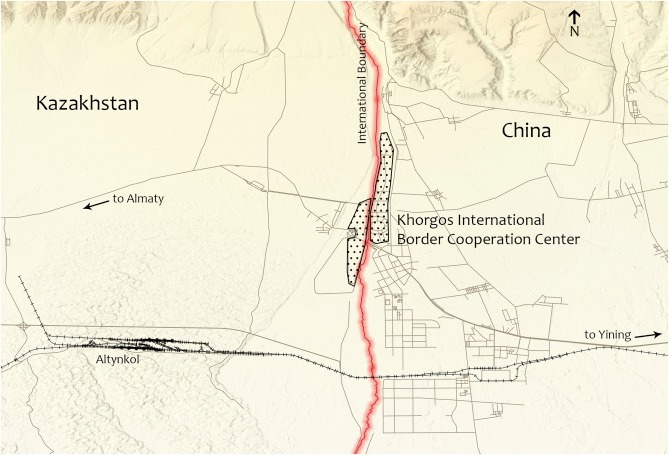
Fig. 1
For shoppers and tourists, the border zone operates as a place where the soft power of BRI horizons materialize. When I visited in the summer of 2017, many large buildings and structures were still being constructed, including a Pearl Viewing Tower derivative of its massive counterpart in Shanghai's Pudong district. Signs celebrated the International Border Cooperation Center as the first such “strategic cooperation zone” between China and a neighboring country, suggesting that more were to emerge at other important borderlands bridgeheads. The China-Kazakhstan Khorgos International Cultural Exchange Center is the crown jewel of the area (see Fig. 2). Despite its pretensions to be a center where cultures come together, the structure is strikingly Chinese in appearance. It recalls traditional wood architectural aesthetics, strongly resembling the Chinese pavilion of the 2010 Shanghai World Expo. The Exchange Center boasted a “traditional” Chinese tea house, itself an emblematic venue of Chinese soft power. Nearby signs in Chinese, English, and Russian suggested that in the near future the cultural entertainment would expand to include Central Asian-themed events including wrestling, suggesting the soft power utility of sports (Koch, 2013).
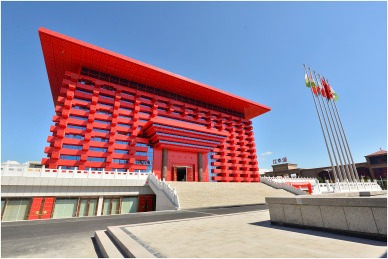
Fig. 2
BRI soft power in Khorgos is most effective for those whose trajectories take them to the actual border, many of whom are Chinese. Another prominent avenue for projecting Chinese developmental imaginaries for a more general Kazakhstani audience was the Expo 2017 Astana, an event affiliated with the Bureau of International Expositions. The Chinese Pavilion promoted a number of Chinese developmental symbols: a mock-up of the driver's compartment with a film that simulated a potential high-speed rail journey between Xi’An and Nur-Sultan and a short film that featured an apartment in the “city of the future,” a gleaming metropolis resembling a futurized version of the contemporary Chinese urban middle-class dream.
Is China successfully persuading the citizens of Kazakhstan, which Alff has described as a “largely sinophobic environment,” to embrace the Chinese developmental vision (Alff, 2014, p. 15)? The rhetoric of the BRI project continuously intones the mutual benefits of economic, cultural, and educational exchange. In step with desires to “create demands and job opportunities, enhance ‘people-to-people’ and cultural exchanges, and mutual learning among the peoples of the relevant countries, and enable them to understand, trust and respect each other and live in harmony, peace and prosperity,” the State Council’s (2015: n.p.) Vision and Actions on Jointly Building Silk Road Economic Belt and 21st-Century Maritime Silk Road has called for more student exchanges between countries along the BRI. Chinese universities have successfully attracted Kazakhstani students to come to China on “Silk Road” student scholarships, which at Lanzhou University, for example, provide full tuition and a living stipend for bachelor's degree and graduate students for three to five years (Lanzhou University, 2017). In recent years tens of thousands of Kazakhstani students have studied abroad in China, including 14,000 students enrolled in universities across the country in 2016 alone (MOE, 2017). This far outnumbers the number of Kazakhstani students studying abroad through Kazakhstan's state-funded Bolashak scholarship program. Established in 1993, the Bolashak program has so far sent over 10,000 students abroad with the goal of training citizens at top tier universities, primarily Western, so that they bring skills back to Kazakhstan (Sordi, 2018). Silk Road scholarship awardees are concentrating at universities in Xinjiang and across China. Those I talked to hoped to leverage their visas to look for future business opportunities in Chinese cities strong in trade, such as Guangzhou.
Over a sixteen month period between 2013 and 2014, I spent several days each month in Lanzhou, the capital city of Gansu province and historic Silk Road trading node. Lanzhou and its environs have large Muslim populations, and the city has become a popular place for Kazakhstani students to study Chinese. These students held China at a considerable distance, only sparingly complementing China or Lanzhou, a relatively modern and bustling city. Instead, it was common to talk about negative aspects of Chinese urban life, such as dealing with the city's ubiquitous dirt, churned into the air by continuous subway construction. Urban dirt disrupted their dormitory home-making, contaminating the rugs the students placed in the centers of their rooms. They also took fault with Chinese Muslim cuisine, stressing the poor flavor of Chinese lagman (Ch. lamian) noodles and meat. Back home in Kazakhstan, I often heard, agricultural practices and products were cleaner.
Similarly, perceptions of the relative purity of Islam between the two states influences Kazakhstani Kazakhs' ideas about China. Many Kazakhs perceive Islamic practice in Kazakhstan to be stronger than it is in China (Shanatibieke, 2016). When in the summer of 2014 a group of Kazakhstani students studying in Lanzhou came to visit Xining, where I was living, they expressed great interest in seeing the city's notable Muslim sights. We took photos together in front of the Dongguan Mosque's modernist façade. Later, when we entered the Sufi Phoenix Temple, they were less impressed, and one student, Kausar, grew apprehensive. She didn't even want to look at the tomb that the complex housed. “It is too Chinese,” she explained, “the religions are mixed together.” She shook her head as she pointed out a group of Chinese Muslims lighting large incense sticks, a practice also common at Chinese Daoist and Buddhist temples. Similar to Alff’s (2014) findings that Almaty Kazakhs viewed Chinese goods as degraded, or Billé’s (2014) findings that Russians view cross-border Chinese cities as superficial imitations of modernity, these Kazakh students, participants in the BRI “people-to-people” exchange program, hesitated to embrace any aspect of contemporary Chinese modernity or culture as developmentally superior.
This suggests the needs to look beyond China's BRI agenda and exercise of soft power to understand the alternative developmental horizons that engage Kazakhs. Central Asian states including Kazakhstan continue to promote their own national developmental agendas that seek to make foreign development investment work to meet their goals, rather than override or distract from them (Bitabarova, 2018; Diener, 2015). In Kazakhstan, the state invests heavily in persuading its population that massive economic projects will benefit its people. Edward Schatz (2009: 203–207) has called Kazakhstan an exemplar of successful soft authoritarianism, an approach that relies “more centrally on the means of persuasion than on the means of coercion” and uses “discursive preemption” to promote state political and economic visions. Such states promote a nation-building project that “links the people to a homeland (territorial bonding) and to the state (statist bonding)” (Koch, 2013, p. 43). It is in such a light that we should consider the persuasive power of the Kazakhstani government own banner modernization schemes, including Kazakhstan 2030 and Kazakhstan 2050. These programs have emphasized institutional reforms to bolster the middle class, diversify the economy, and encourage patriotism, among other goals (Sullivan, 2017). Such policies are aimed at promoting a national vision of Kazakhstan within the country that resonates with all Kazakhs, including those that go abroad.
It is in this way that the capital city of Nur-Sultan, singled out as a potent national symbol in the Kazakhstan 2050 agenda, works to imaginatively promote the notion of national modernization. The city serves as synecdoche for regional development (Koch, 2018b), and when set against Chinese cities, becomes a powerful symbol of bordered difference, of “our” development against other competing forms. As suggested above, cities are the destination sites of Kazakhstani cultural exchange students, and therefore cities enter into regular conversation as the evaluative measures of national refinement and thus soft power competition. My Kazakhstani student friends were adamant about the livability of Kazakhstani cities, indicating that Nur-Sultan was just as modern as any Chinese city. When we were visiting Almaty together, one friend grew upset when I was surprised to see a Burger King there. Baffled, she informed me, “Almaty is a modern city, of course we have Burger King.” For Kazakh students, grime and urban congestion in China, as well as Kazakhstani cities' high level of development, were all deployed as refusals that China's modernization was outpacing that of Kazakhstan. They were resistant to the sort of hypermodern visions the Chinese state was promoting. Developmental horizons continued to be divided by bordered visions, even despite BRI attempts to enroll neighbors in China's vision.
Kazakhstan not only has policies to encourage patriotism among its own population, but the state has also had a migration program geared towards enticing Kazakhs living elsewhere to move to the country. The Oralmandar, or “returners,” program was put in place under the country's first President Nursultan Nazarbayev in 1994. The program was created to encourage “far abroad” ethnic Kazakhs, that is, those from outside the former USSR, to migrate to their reputed homeland of Kazakhstan (Diener, 2005). As a result, the rate of Chinese Kazakhs permanently or semi-permanently moving to Kazakhstan has accelerated from the 1990s into the 21st century, and now up to two hundred thousand Chinese Kazakhs have either naturalized, obtained Kazakh green cards, or are regularly engaged in transborder activities (Shanatibieke, 2016).6 Despite the impressive numbers of returners, as Alex Diener (2005) has shown, the reality of the “return” experience can be difficult for ethnic Kazakhs immigrants, who in many cases find themselves isolated in remote settlements, discriminated against culturally and economically, and disappointed to discover that Kazakhstan is not the land of pure Kazakhness they had dreamed, but instead relatively russified. Chinese Kazakhs may also be perceived as “traitors” who turned their backs on Kazakhstan during the famine of the 1930s (Alff, 2016). Again, the differences sown by past border materializations - the border’s operation as a difference condenser - have continued to affect contemporary experiences and perceptions of the “other side” of the border.
For instance, Aydar rejected what he saw as strictness and hypocrisy among conservative Islamic practice on both sides of the border and the rudeness of Kazakhstani Russians. The latter was all the more irritating because of the prominence of the Russian language in Kazakhstan. “Now I have to learn this language that I don't even respect,” Aydar told me. He felt that Russian rudeness had percolated throughout the entire country, making it a less attractive place. In contrast to the Kazakhstani Kazakhs in China, the Chinese Kazakhs I met at the border crossing all agreed that the lagman noodles in China were superior to the versions found in Kazakhstan. They also agreed that the Kazakh language was purer in China than it was in Kazakhstan, where it had been degraded by Russian linguistic influences.
Yet while domestic soft power practices may gain strength from the “structures of expectation” put into place by past border materializations, economic realities can stress deep-set biases and make the “other side” look more enticing. Since being announced in 2012, Kazakhstan has struggled to implement the comprehensive reforms related to Kazakhstan 2050, largely due to a fall in oil prices starting in 2014 (Sullivan, 2017). As the economy soured between 2013 and 2018, my Kazakhstani friends fretted that the promise of Nur-Sultan had faded. In place of the optimism that Kausar had had for Expo 2017 Astana back in 2014, there was now a sense that it was a costly boondoggle that had misdirected and drained Kazakhstan's resources. She told me that she and her friends felt let down by the state, as they had hoped the Expo would bring job opportunities. Her sojourn in China would thus be lengthened, as she hoped to establish lucrative business relations there that would help her in the future. China was looking like a better bet in the short term than Kazakhstan.
The Kazakhstani state has also turned to China during the economic downturn. Kazakhstan's own national development plan, the Bright Path, or Nurly Zhol, includes infrastructure upgrades that are being supported with Chinese capital (Bitabarova, 2018, p. 161). The BRI and Bright Path programs began officially coordinating, and the two countries were set to jointly invest in upgrading Kazakhstan's transportation infrastructure and agricultural capacity. Projects that predate the launch of the BRI, such as the dry port and Kazakhstan's Altynkol railway station, are now linked together in a shared Silk Road discourse. This raises the question of how economic integration across the border is being realized as China has deployed draconian practices to securitize Xinjiang.
5. From mobility to security
While the materialization of infrastructure connections between China and Kazakhstan have facilitated trade between China, Kazakhstan, and greater Eurasia, they also occur against a backdrop of anxiety and exclusion in the Sino-Kazakh borderlands. Nation-state insecurity has guided Chinese policy towards Xinjiang, where “ethno-national peoples with their own narratives of homeland” create anxiety for China's national representation (Anand, 2019, p. 130). These fears are embodied in mobile groups, such as Uyghurs and Kazakhs, who are subjected to accusations of bringing undesirable ideas into China. Lands beyond the national boundary, where Chinese territorial controls on media and religion lose their force, may pose a threat to stability in Xinjiang. Chinese scholars have warned of ethno-nationalism among Kazakhs and the perils of “cross-border patriotism” (Ch. kua guojie aiguo zhuyi) as well as threats of Pan-Turkism, the fear of which has animated Russian and Chinese based governments throughout the 20th century (Ding, 2014; Shanatibieke, 2016, p. 5). Such nation-state concerns have led to security cooperation. In 2001, the six countries of the Shanghai Cooperative Organization, including China and Kazakhstan, agreed to coordinate to fight against terrorism, separatism, and extremism, three destabilizing elements that in China are glossed as the “three evil forces” (Rodríguez-Merino, 2019; Roberts, 2004, pp. 233–234).7
Within Xinjiang, the result has been a state effort to homogenize borderlands communities and create patriotic national subjects. Since 2016, Xinjiang's new provincial Party leader Chen Quanguo has presided over a security crackdown that has placed an estimated hundreds of thousands of ethnic minorities, including Uyghurs and Kazakhs, into detention camps for political re-education and vocational “training” (Zenz, 2019). Furthermore, Chinese security forces are increasingly surveilling Xinjiang's population through security cameras, home visits, and participation in patriotic public events. This surveillance goes hand-in-hand with new categories that cut across ethnic and religious lines while ultimately reinforcing them. That is, the practice of Islam or criticism of compulsory Mandarin education can lead Muslims to be labelled “deviant” or “abnormal” in their commitment to a normative Chinese nation (Leibold, 2019). Turkic populations with transnational connections are at increased risk of being thus categorized and disciplined as potentially susceptible to the “three evil forces.”
The materialization of the border is concomitant with the consolidation of national space and control over the national population (Thongchai, 1994; Reeves, 2014). Furthermore, the securitization and homogenization of borderlands is linked to the hardening of a border's migration regime. China has detained dozens of Kazakhs, including Kazakhstani citizens, at its borders and held them for indefinite periods (Shih, 2018). These detentions have reverberated through Kazakhstani media, casting China in a negative light (Kang, 2019). They also reinforce bias against the “other side,” created through long-standing “structures of expectation” generated by historical border materializations and only recently being attenuated through economic development and cultural soft power. That is, they rapidly obscure the imaginary of the border as a connective space, bringing to the fore its capacity to work as a difference condenser and revealing the border as a stubborn reminder of intractable difference.
The recent change in border securitization vexed the Kazakh students I knew. For some, it confirmed their negative stereotypes of China, and for others, it gave pause to their BRI plans. When I returned to Lanzhou briefly in 2018 I met with Serik's sister Kausar, who had provided the application materials to deliver to him in Almaty the year before. The brother had already returned home, abandoning his Silk Road scholarship after less than a year. “He didn't like it here; there were too many cultural differences,” she briefed me. Kausar was now in a difficult position herself. She was worried that the kitchen supplies market that she wanted to enter, importing white goods from China to Kazakhstan, was already saturated.
Moreover, she had concerns about the securitization of the Sino-Kazakh border. She said she was confident that she would be able to continue to cross it, because, she had heard, the only Kazakhs having problems were those whose Kazakhstani passports were marked “born in China.” These were the naturalized Chinese Kazakhs. But she also admitted that many Kazakhs in her position were concerned. They felt just last year that relations were good and that China was open and inviting towards them. Now many weren't so sure. They were feeling aversion (Ch. fangan) to China over the fact that Kazakh mobility was being fettered. Her WhatsApp was full of messages warning of detentions at the border, but she couldn't trust them - she didn't know which were real and which were fake. This was all troubling for Kausar because now that her future business plans were less clear, she wanted to spend more time in China to find other opportunities. She even admitted that she liked being in China. With Nur-Sultan an expensive and less viable option for her than it had seemed in the past, China was in general more developed, and desirable, than Kazakhstan. Would she still be able to carve out a livelihood between the two countries?
For Kausar, a recipient of the Silk Road scholarship and target of the “people-to-people” element of the official BRI project, her cross-border future appeared more difficult. Even stronger anxieties, however, would be experienced by Chinese Kazakhs, historical objects of geopolitical wrangling. Over the past several decades, the migration of Chinese Kazakhs in pursuit of naturalization or long-term residence has continued, but it has also been marked by periods of Chinese state demands to hand over Chinese Kazakhs' passports (Radio Free Asia, 2017). Within Kazakhstan, these migrants have strategized using green cards, visas, temporary borderlands travel permits, and nationality transfers to advantage of economic opportunities, while also keeping their dwelling and mobility options open (Alff, 2016; Shanatibieke, 2016). Chinese security forces' detention of border-crossing Kazakhs, including those with Kazakhstani citizenship, has disrupted borderlands mobility and the livelihoods of Kazakh communities (Kang, 2019; Kuo, 2018; Shih, 2018). Beyond the spectacle of Khorgos's International Border Cooperation Zone, the Sino-Kazakh borderlands are under strict surveillance and martial control.
Even before the most recent securitization surge, the city of Yining had become a model site in the Chinese state's efforts to “de-radicalize” (Ch. qu jidanhua) those it views as Islamic terrorists through its “Social Rehabilitation Center” for suspected radicals (Zhou, 2017). During the summer of 2017, the city appeared to be in a state of military lockdown. Security checkpoints throttled traffic, and armored trucks bristling with militarized police patrolled the streets, jostling for road space with local melon trucks. When I discussed this with Aydar, I was shocked to hear him tell me that he thought that the repressive situation in Yining would actually be good in the long term: “[The protesting Uyghurs] are too conservative and need to get out of the past.” The same conservatism should also be removed, he thought, from Kazakhstan. The country should be “sinified” or “turned Han” (Ch. hanhua).
It would be hard to make the case that either Aydar, Kausar, or anyone else I talked to were “foreign agents” that would disrupt either China or Kazakhstan. They are influenced by the soft power promises of their respective countries, but are also confronted with the difficulties of navigating cultural and political difference as they try to realize their dreams. Moreover, they are also experiencing the disappointment and confusion sown when states struggle to deliver their lofty cross-border developmental promises while also remaining suspicious of those to whom these promises are made.
6. Conclusion
While BRI soft power de-materializes borders to facilitate “people-to-people” exchange and a Sino-centric regional development vision, security inventions simultaneous re-invest borders with the capacity to other the peoples and ideas imagined to belong to spaces beyond them. At the Sino-Kazakh border, such hardening can potentially undo BRI soft power gains that were only starting to gain traction among Kazakhstani Kazakhs, and which some Chinese Kazakhs were earnestly promoting. Borderlands security crackdowns disrupt not only the ability of these Kazakhs to generate translocal development, but also sow suspicion and fear by reactivating the border as a difference condenser that recalls past border materializations. Border crossing populations are stigmatized as they come to embody the foreign agents of instability that have long haunted interimperial and international frontiers.
Border and borderlands securitization efforts work to homogenize national and regional spaces. Official and media pronouncements during such periods of retrenchment can amplify narratives of instability beyond the border (Koch, 2018a). More intimately, ethnicity can become the identity marker that subjects people to discomfort and humiliation at borders, producing resentment towards the states that subject them to such checks and generating narratives of border harassment (Megoran, 2007; Megoran, 2006, p. 634). In such ways, borders come to condense not only spatializations of national othering, but also temporalities of difference that both include recent events and draw from histories of border hardening stemming from anxiety over disloyal or separatist foreign agents crossing the border.
Indeed, as Madeline Reeves (2005) has argued, while securitizing borders might be a employed as a state strategy to reduce conflict in restive borderlands, it can actually work to inscribe and deepen differences. By limiting mobility and subjecting populations to harassment, borders can create the very tensions they seek to resolve. When this happens, the border can suddenly become, for Kazakhs, something much different than a symbol of cooperation and facilitator of mobility; it becomes more militarized Yining than ludic Khorgos. Capricious borders are borders that betray, and such betrayal can sharpen national division, stress cross-border migrants, and diminish the soft power reach of regional development programs such as the BRI.
To understand how counterproductive BRI policy can be in this regard, I suggest that geopolitical analyses of BRI must supplement political economy approaches (Flint & Zhu, 2019; Narins & Agnew, 2019) not only with consideration of Silk Road borderlands legacies that predate the PRC (Lin, Sidaway, & Woon, 2019), but also with a focus on how securitization can complicate soft power objectives. Su Xiaobo (2015) has argued that bridgehead economic integration can help China accomplish regional security goals by promoting unique development programs, such as subsidies to facilitate the agricultural replacement of opium crops in Southeast Asia's Golden Triangle. But BRI-era borderlands security practices aren't always “win-win” for states or borderlands populations. As events in China's northwest demonstrate, security practices can be reactive, paranoid, and ultimately counterproductive.
More Research
1/2