
Research / MGC Stories / Accra
From trade to production amongst Chinese businesses in Ghana
Accra, Ghana — Abidjan–Lagos Corridor
Published:
The Abidjan-Lagos Corridor seeks to connect five West African states to encourage cross-border trade, promote industrialisation and increase employment rates. Indeed, in its planned form, the corridor is expected to link five major ports: the Port of Abidjan in Côte d’Ivoire, Tema Port in Ghana, the Port of Lomé in Togo, Cotonou Port in Benin, and the port of Lagos in Nigeria.
- Abidjan–Lagos (5 countries)
- Corridor
- Abidjan · Tema · Lomé · Cotonou · Lagos
- Ports linked
- 75% of West Africa
- Coastal share of activity
- 42% of the region
- Coastal share of GDP
- 400+ (2004–2024)
- Chinese mfg firms in Ghana
- September 2024
- Makola market fire
The corridor’s ‘ultimate objective is to create formal labour via infrastructure development (Gambino and Reboredo, 2024). Indeed, the Economic Community of West African States (ECOWAS) commission estimates that 75% of economic activity takes place along West Africa’s coast (ECOWAS Commission, 2017, p. 27), generating 42% of the region’s total GDP (WB, 2022). Trade is a central component of the development of this corridor. A steady stream of trucks can be seen crossing borders across these five countries, yet they often use the corridors in bits and pieces, rather than as a whole (Nugent, 2022). This can be explained by the different trade regimes coexisting in West Africa, which lead to different locations emerging as key trading hub for specific products or specific clienteles, served by varied set of sellers, which now, increasingly includes Chinese traders.
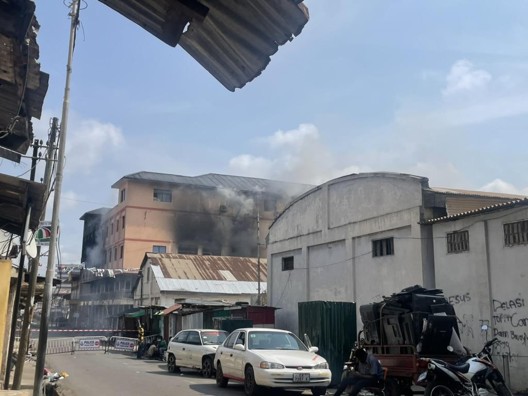
This is also the case in Makola market, which hosts the largest trading hub in Ghana, becoming a space of opportunity for Chinese businesses. In September 2024, a fire tore through Makola market, Accra’s largest market and one of the most important trading hubs in West Africa.
The fire consumed a storey building that housed several Chinese shops, completely destroying their stock of imported goods and the Chinese shopkeepers’ apartments above. No one was hurt, but the losses were felt deeply in the market (GhanaWeb, 2024). Among those affected was a trader who lost everything in the fire and had soon thereafter returned to China. Just a few months later, he was back in Ghana, bringing with him a family member – a recent graduate and apt English-speaker – and a new business idea.
Tucked into a corner of a Chinese-led industrial park on the outskirts of Accra, he now manufactures food products. Having made a modest initial investment to import the necessary machinery and spices from China and setting up local sourcing for the main ingredient, beef meat, he was operational within a few weeks.
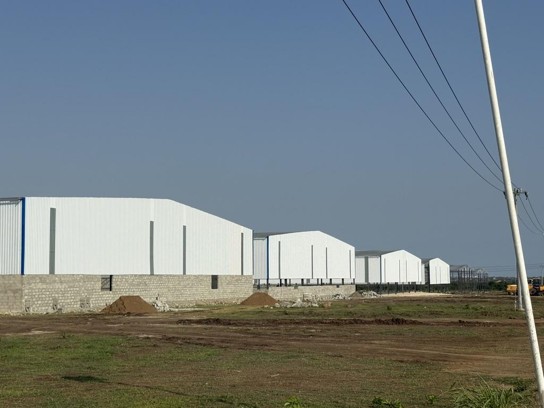
His workforce is similarly small, comprising only a couple of employees who previously worked alongside him in the market. His main clientele is the Chinese community in the Greater Accra region as he supplies Chinese restaurant and supermarkets nearby.
His trajectory, notwithstanding the great personal resilience demonstrated, is far from unique. Over the past decade, Chinese business in Ghana and the broader West Africa have been shifting away from the import of China-made finished goods towards producing in loco (Tang, 2016). In Ghana alone, more than 400 Chinese-owned manufacturing companies registered between 2004 and 2024 (Gambino, 2025).
The industrial park is itself a window onto this transition, as it is part of a broader constellation of Chinese-led manufacturing enclaves that have emerged across Ghana. The picture that emerges, however, is highly uneven.
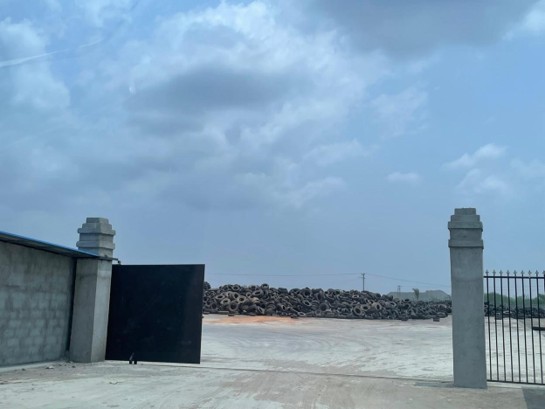
First, businesses in the enclave vary greatly in size, ranging from small scale operations such as the previously-discussed food products factory, to large-scale corporations in the plastics or metal sectors. Second, their degree of embeddedness in the context of operation – meaning the ways in which firms are anchored to institutions, practices, and networks shaping economic activities, and how, in turn, they engage with said political economies (Gambino and Franceschini, 2025) – varies greatly.
In the same industrial area, just meters away from the food producer business, Chinese-owned firms producing mats and mattresses have struggled to both conform to local market requirements and to fulfil its standards. Laboratory tests conducted by the Ghana Standards Authority (GSA) found mats produced using polystyrene – a material used for packaging electronics – rather than the polyurethane required under Ghanaian safety standards. This led to the issuing of closure orders and, in some cases, to the arrest of managers who decided to resume production (MyJoyOnline, 2026).
These cases reflect the pressures and possibilities of the current conjuncture in global China’s economic engagement, whereby firms, mostly private ones, are rapidly expanding in the Ghanaian and broader West African manufacturing sector.
The story of this trader, and the industrial park he now operates in, matter because they are rarely told in global China research.
- Gambino and Reboredo, 2024 — Territory, Politics, Governance
- ECOWAS Commission, 2017, p. 27
- World Bank, 2022 — coastal resilience in West Africa (press release)
- Nugent, 2022
- GhanaWeb, 2024 — Makola (Zongo Lane) storey building fire
- Tang, 2016 — SAIS-CARI Working Paper 08
- Gambino, 2025 — International Affairs 101(6)
- Gambino and Franceschini, 2025 — Review of International Political Economy
- MyJoyOnline, 2026 — GSA arrests Chinese managers for reopening locked mattress factory
- Abidjan-Lagos Corridor
- A planned ~1,000 km coastal highway linking five West African ports — Abidjan, Tema, Lomé, Cotonou and Lagos — to speed cross-border trade and industrialisation.
- Makola market
- Accra's largest market and one of West Africa's busiest trading hubs. A September 2024 fire tore through it, destroying several Chinese-run shops.
- ECOWAS
- The Economic Community of West African States — a 15-member regional bloc promoting economic integration and free movement of people and goods. Learn more
- in loco
- Latin for 'on the spot' — here, Chinese firms manufacturing inside Ghana rather than importing finished goods from China.
- Ghana Standards Authority
- Ghana's national standards body. It tests products for safety and compliance — and flagged local mattresses made with packaging-grade polystyrene instead of polyurethane.
- embeddedness
- How deeply a firm is anchored in local institutions, practices and networks — and how, in turn, it engages with the surrounding political economy.
Cite This
Gambino, E. (2026). From trade to production amongst Chinese businesses in Ghana. Mapping Global China, MGC Stories. https://mapglobalchina.com/research/mgc-stories/accra/article
Share your Global China story
These stories come from people who were there — researchers, journalists, and residents of the places China’s global presence is built in. If you know such a place, tell us about it: a market, a border post, a plant, a campus. We work with you on the reporting, the data and the map.
Pitch a story