
Home / Research / Trans-Himalayan power corridors: Infrastructural politics and China's Belt and Road Initiative in Nepal
Trans-Himalayan power corridors: Infrastructural politics and China's Belt and Road Initiative in Nepal
Published: March 11, 2020
•
Political Geography Volume 77, March 2020, 102100
Abstract
This article examines the shifting dimensions of Chinese infrastructural aid in Nepal, focusing on the politics of anticipation and enunciation that shape Nepali perceptions of Chinese-facilitated development and negotiations concerning Beijing's Belt and Road Initiative (BRI). Drawing from ethnographic research focused on sites of ongoing and planned infrastructure development in Nepal's two northern districts of Rasuwa and Gorkha, we analyze the uncertain remaking of these areas into trans-Himalayan power corridors. Our examination reveals the gamut of transitions, opportunities, reorientations, and expectations that the BRI and other forms of Chinese investment evoke in Nepal, showing how politics articulate infrastructures, and vice versa. After reviewing the historical context of Nepal-China relations, our empirical analysis begins in late 2014 when China became the single largest source of foreign direct investment in Nepal, continues through several rounds of negotiations about the BRI and other forms of Chinese infrastructural investment and aid, and concludes with a review of significant Nepal-China agreements at the Second Belt and Road Forum, held in Beijing in April 2019. Tacking between remote construction sites, scenes of diplomatic debate, borderland villages, investment summits, and speculative media coverage, we demonstrate how the Belt and Road Initiative is differently enacted and co-constructed by a variety of Nepali and Chinese actors who interpret, reimagine, and rhetorically appropriate the BRI within their own narrations of future possibility.
Regions
Themes
Cite This
Murton, G. (2020). Trans-Himalayan power corridors: Infrastructural politics and China's Belt and Road Initiative in Nepal. Political Geography Volume 77, March 2020, 102100.
Full Text
Nepal takes pride in seeing China's growing profile on the world stage, both politically and economically. China's role is very important in shaping the global agenda for a just and equitable world order … We strongly believe that Nepal-China friendship will always be in the interest of our two countries and people. Territorial size, population and level of development have never been the elements of constraint in defining Nepal-China friendship. Rather, sovereign equality and mutual respect have always remained at the centre, buttressing our cooperative partnership.
Foreign Minister of Nepal Pradeep Gyawali. ‘China Reform Forum,’ Beijing, April 20, 2018
1. Introduction: China in Nepal
In recent years, debate over Nepal's development trajectory has increasingly focused on the role of Chinese aid and inclusion in China's Belt and Road Initiative (BRI). The expansion of geopolitical and developmentalist linkages between Beijing and Kathmandu has been characterized by new forms of infrastructure-oriented Chinese aid, the cultivation of public-private partnerships involving Chinese firms, and the intensification of trans-Himalayan trade, popularly and diplomatically described as “a handshake across the Himalayas” (Murton, Lord, & Beazley, 2016). After formally signing onto the Belt and Road Initiative in 2017, the Government of Nepal (GoN) has engaged in several rounds of negotiations with Chinese leaders focused on defining the scope of the BRI in Nepal and increasing transboundary connectivity through a variety of channels. As the President of Nepal, Bidhya Dev Bhandari recently stated at the 2nd Belt and Road Forum in Beijing: “For a landlocked country like Nepal, connectivity is of paramount importance in its socio-economic development. With enhanced connectivity, vast opportunities for trade, investment, tourism and people-to-people relations will open up” (Bhandari, 2019). As the GoN maps out a constellation of different national-priority infrastructure projects that would require Chinese assistance or technical expertise – some officially BRI and some otherwise – a range of different actors, constituents, and potential stakeholders in Nepal are enmeshed in broad field of uncertain infrastructural possibilities.
Using a blend of discourse analysis and ethnographic methods, our study examines the geopolitical and social implications of recent BRI negotiations and Chinese infrastructural aid and investment in Nepal. Focused on contemporary and historical patterns of Sino-Nepali relations shaped by trans-Himalayan infrastructure development, we trace the shifting infrastructural trajectories of two strategic districts: Rasuwa and Gorkha. In these borderland spaces, Chinese institutions are constructing hydropower projects, upgrading road networks, expanding trade and border facilities, and surveying the possibilities for new infrastructural mega-projects, such as trans-Himalayan railroads and international transmission lines. We conceptualize the development of such geographically-specific, infrastructurally-dense spaces as the making of trans-Himalayan power corridors. Drawing from research conducted over a five-year period, 2014–2019, we examine the ways that Chinese-facilitated infrastructure development and the promise of infrastructural futures (Anand, Gupta & Appel, 2018; Harvey & Knox, 2012) are already working to reshape local livelihoods, political economies, mobility regimes, and center-periphery relations in these areas. By foregrounding the discursive politics and economies of anticipation (Adams, Murphy, & Clarke, 2009; Anderson, 2010; Cross, 2015) that shape dreams of Chinese development in Nepal, we show how the BRI, understood as both a concept and an assemblage of material interventions, is co-constructed by an array of differently positioned actors, rather than simply imposed as top-down monolithic development programs. In so doing, we also consider some of the ways that Chinese aid is both perceived and received as a different kind of development in Nepal. Working across a range of scales, our analysis demonstrates how politics are articulated through infrastructural developments and, vice versa, how infrastructures also articulate political relations.
Our analysis advances three main arguments: First, BRI plans and dreams of Nepal-China connection are co-constructed by a variety of national, subnational, and local actors that narrate and anticipate infrastructural promise differently. Second, understanding the BRI in Nepal requires attention to the broader historical, geopolitical, socioeconomic, and environmental factors that shape Nepal-China linkages over time. And third, BRI-fueled infrastructural promises are already reconfiguring social and political life for a variety of subjects and stakeholders in many different project-affected areas throughout Nepal. Highlighting the processual and co-constructed nature of BRI programming, our analysis operates primarily at the subnational scale throughout the paper, focusing on the ways that BRI plans and Chinese-supported infrastructure projects reconfigure political and economic landscapes in borderland districts and watersheds envisioned as trans-Himalayan power corridors. Importantly, we also seek to clarify a common misconception by stressing the fact that not all Chinese infrastructural aid to Nepal is actually part of the Belt and Road Initiative; rather, numerous different vectors for Chinese aid and investment and many different project modalities exist. By analyzing the making of imagined power corridors in Rasuwa and Gorkha we illustrate how these different programs are woven together in borderland spaces over time.
In our formulation, power corridors are strategic spaces of passage and infrastructural assemblage: places where hyper-mobility, transboundary commerce, hydropower production, and cascading economic opportunities underwrite and articulate other forms of power. Corridors are passages between places, materially and discursively co-produced, that prioritize certain spatial and social relations, and that connect and contain but also exclude. From another perspective, these are high-value territories created by state efforts to secure volumes and volumetric space (Billé, 2019; Elden, 2013), be it mass-produced Chinese goods, new forms of trans-Himalayan tourism, fuel supplies, electricity, or fiber-optic connections. Power flows to, through, and from corridors. In Nepal, processes of corridor-making cut across scales, imbricating geopolitical ambitions, national development priorities, provincial politics, and an array of different local ambitions and anxieties. By focusing on the uncertain making of these power corridors, we show how differently positioned Nepali and Chinese actors invoke, reimagine, and rhetorically appropriate the BRI within their own narrations of risk and opportunity.
Contemporary scholarship on Beijing's increasing role as a leader of global infrastructure development typically focuses attention on geopolitical intrigue, state logics, and the macro-economic concerns that appear to motivate new modes of Chinese-led international development programs.1 However, numerous scholars have also drawn attention to specific and place-based experiences of Chinese development programs abroad (Gu 2009; Mohan, 2013; Siciliano and Urban 2017; Yeh, 2016). In concert with other articles featured in this special issue, we call for more critical and grounded analyses that chronicle the social lives and co-construction of the BRI and research that examines the diverse effects and lived experiences that accompany Chinese-led or Chinese-facilitated development in an array of host countries.
Critically, recent BRI discourse and excitement about the future possibilities of Sino-Nepali partnerships must be situated within a broader history of Nepal-China relations. Contemporary debates about the costs and benefits of Chinese infrastructure projects in Nepal are shaped by older discussions about developmental strategies, geopolitical logics, and recurring concerns about Chinese influence in Nepal (Fujikura, 2013; Gyawali, 2017; Paudel & Le Billon, 2018). Similarly, the initiation of formal dialogue about Nepal's official inclusion in the BRI – which began in 2015, during a previous ‘One Belt One Road’ moment (Adhikari, 2015) – was but one turn within broader histories of trans-Himalayan deal-making, negotiation about Chinese investment in Nepal, and infrastructural diplomacy in the Nepal-China borderlands. By the time Nepal ultimately signed onto the BRI in 2017, several Chinese-facilitated development projects had already been completed decades before, and several new projects in Rasuwa, Gorkha, and elsewhere were already underway or being discussed in earnest (Murton et al., 2016).
Our analysis is organized into two historical-conceptual sections and two geographically-specific case studies. In the first section, we examine recent histories of Sino-Nepal relations in order to contextualize the current ‘BRI moment’ in Nepal and highlight the systematic escalation of Chinese commitments in Nepal from 2014 up to the 2nd Belt and Road Forum in 2019. Here, we also show that Chinese interventions in the aftermath of the 2015 earthquakes have significantly affected, at multiple scales, both Nepali perceptions of China's geopolitical positionality and the ways that a BRI-enhanced future is currently imagined in Nepal. In the second section, we introduce trans-Himalayan power corridors as a concept that captures and describes the spectacular infrastructural transformations and reorientations happening in the Himalayan valleys of Rasuwa and Gorkha districts. By situating our analysis along and across two historical trans-Himalayan trade routes, we place our empirical observations of corridor-making in Nepal in conversation with other studies of changing mobilities, trade patterns, and pathways through the region (Campbell, 2013; Saxer, 2016). In so doing, we also join broader conversations about the centrality of corridors to the BRI across Asia and beyond (Akhter, 2018; Karrar, 2019).
In the third and fourth sections, we analyze patterns of infrastructural, social, and political change in Rasuwa and Gorkha, highlighting the unique mixture of potential impacts, shifting subjectivities, and possible futures that different infrastructural interventions carry, especially those labeled ‘national priority projects.’ In Rasuwa, we track the expansion of a transboundary highway, the construction of several large hydropower projects, and two new proposed BRI mega-projects – a trans-Himalayan railway and a cross-border transmission line – which complement each other and fuel visions of infrastructural abundance. In Gorkha, we consider the infrastructural promises that circulate in the Budhi Gandaki Valley, where BRI dreams focused on the Budhi Gandaki Hydropower Project (BGHPP) have waxed and waned. Here we illustrate how associations between the BRI and this 1200 MW ‘national pride project’ are not only subject to swings of the geopolitical pendulum between Beijing and New Delhi, but also contested and debated in the context of Kathmandu politics. In contrast to the intense level of development activity in Rasuwa, where BRI-related programming is explicit and imminent, the making of a power corridor and Chinese investment in the Budhi Gandaki Valley remains much more speculative and uncertain (see Fig. 1).
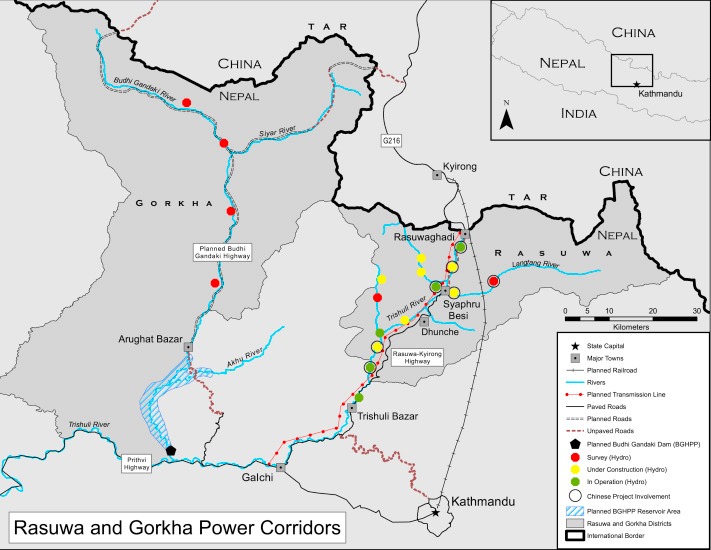
Fig. 1. Map of Rasuwa and Gorkha Power Corridors.
Caption: This map illustrates all major infrastructure projects built or proposed in the Rasuwa and Gorkha corridors included in our study, as of May 2019. This map includes all hydropower projects (HPPs) in operation, construction, or survey phases, excluding smaller projects under 5 MW capacity. HPPs with ‘Chinese-involvement’ (encircled in black) are defined as projects where a Chinese firm has been involved in the process of construction (either as project developer or as a major contractor) at some point during the life-cycle of the project. We have also excluded some of the highly speculative and uncertain HPPs licensed in both corridors, that are not actively being discussed currently - for a full map of HPPs, see www.hydro.naxa.com.np
Source: Map produced by Quintin Petersen with Galen Murton and Austin Lord.
2. A brief history of Sino-Nepal relations through infrastructure
Infrastructure development, and road construction in particular, has long occupied a central place in Nepalese visions of a modern, bureaucratic state (Gurung, 1969, 2005, pp. 1–89; Murton, 2017; Rankin, Sigdel, Rai, Kunwar, & Hamal, 2017). Since the late 1950s, when Nepal first opened its borders to the outside Western world and the Chinese Communist Party annexed control of Tibet, political and economic relations between Beijing and Kathmandu have frequently and increasingly focused on infrastructure and the expansion of trans-Himalayan trade. Nepali conceptualizations of development, or bikas, are routinely associated with material interventions and the flow of tangible goods (Pigg, 1992). Representing two pillars of Nepal's national development dream, transport infrastructure and international trade thus loom large in the popular imagination of Nepal and are significant at all levels of political discourse. For decades, Nepalese leaders – including the former King Mahendra and more recently multiple leaders of Nepal's Maoist and Communist parties – have routinely played Delhi and Beijing off of one another to get various road development and infrastructure projects done in different borderland regions. Transforming political tensions into physical infrastructures, the Nepalese state has time and again strategically managed and leveraged Cold War and contemporary geopolitics into foreign aid and development funding (Rose, 1971; Paudel & Le Billon, 2018).2
In the past five years, Sino-Nepal relations have become especially close, animated by several large agreements and commitments. In November 2014, Beijing and Kathmandu signed a new MOU committing 10 million RMB (US$ 1.63 million) annually from 2014 to 2018 for the development of Nepal's northern districts (Sharma, 2014). In March 2015, marking the 60th year of bilateral relations, Beijing committed a five-fold increase to its annual grant assistance to Kathmandu, with a pledge of 800 million RMB (US$ 130 million) earmarked largely for infrastructure development (Ekantipur, 2015). This commitment built on the foundation of previous joint Sino-Nepali infrastructure projects such as the Arniko-Friendship Highway, the Kathmandu Ring Road, and a variety of hydropower projects being built by Chinese contractors and state-owned enterprises (SOEs). In the wake of these agreements, Nepalese and Chinese officials have engaged in several rounds of dialogue focused on the development and maintenance of transboundary infrastructures, greater economic connectivity, trans-Himalayan mobility, and the further elaboration of Sino-Nepal partnerships.
When a 7.8 magnitude earthquake struck Nepal in April 2015, China responded with its largest-ever humanitarian effort to date and, in so doing, helped reshape geopolitical and financial relationships with Nepal. At a moment when Beijing was establishing increasingly close ties with Kathmandu, the Gorkha earthquakes generated a variety of post-disaster needs, opening the door for even greater Chinese aid to Nepal. This Chinese aid reinforced Nepalese-state efforts to respond to the disaster and tend to its citizens and reflects an ongoing pattern where Nepali projects of development and concomitant processes of state making are underwritten by Chinese gifts of development (Murton et al., 2016; Yeh, 2013). Not only was Beijing's response to the 2015 earthquake unprecedented, but at the International Conference on Nepal's Reconstruction in June 2015, the Chinese Foreign Minister committed RMB 4.7 billion (US$ 480 million) for infrastructural repair and development across Nepal (Khatry, 2015). Speaking to the geopolitics of post-disaster aid in Nepal, Paudel and Le Billon note that “China's response to the earthquakes was also framed by a politics of reengagements, notably through providing grants, infrastructure development assistance and alternative routes to supply construction materials” (2018: 14, emphasis added).
In late August 2015, as Nepal was still attempting to recover from the earthquake, an ‘unofficial blockade’ organized along the Nepal-India border effectively shut down all legal commerce for almost four months.3 The blockade paralyzed the Nepalese economy and created a critical fuel crisis across the country (Rinck & Adhikari, 2016). Post-earthquake reconstruction work was significantly delayed and the construction of several ‘national priority’ infrastructure projects ground to a halt, prompting renewed anxieties about chronic energy insecurity (Lord, 2018; Shrestha, 2016). In response to this emergency, several politicians highlighted the need to decrease Nepal's dependence on India and enhance Nepal's national ‘energy sovereignty.’ This crisis also prompted a strategic and symbolic move whereby Nepal's Prime Minister KP Oli turned to Beijing (and away from Delhi) to provision emergency fuel supplies; many referred to Oli's action as ‘playing the China card’ (Poudel, 2018). With much diplomatic fanfare and media coverage, Chinese authorities delivered a modest twelve metric tons of petrol to Nepal via the Kyirong-Rasuwa Highway. This action in a time of crisis carried a symbolic and geopolitical significance exponentially greater than the sum of its parts, reinforcing in the popular imagination framings of China as a benevolent neighbor and one noticeably less aggressive and more reliable than India (see Fig. 2).
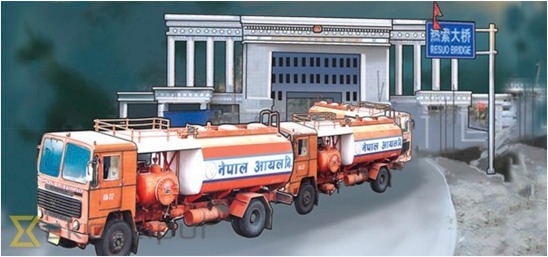
Fig. 2. Chinese Fuel Delivery to Nepal via Rasuwa, October 2015.
Caption: Cartoon image published in The Kathmandu Post depicting delivery of Chinese petroleum via Kyriong-Rasuwa power corridor border crossing in Fall 2015.
Source: The Kathmandu Post 2015 (https://bit.ly/2kB67PQ)
In many ways, the fuel crisis was an ‘infrastructural event’ (Carse, 2017) that highlighted systemic vulnerabilities and surfaced latent concerns about energy insecurity which help “render the future geographies of infrastructure actionable” (Anderson, 2010, p. 785). For example, the ‘energy emergency’ prompted the GoN to introduce policy reforms focused on promoting rapid hydropower development (Lord, 2018), which in turn created an even greater niche for Chinese hydropower firms and an invitation for BRI possibilities. In the wake of all these events, the hopeful narrative of ‘a handshake across the Himalayas’ has gained even more currency in Nepal, from the political chambers of Kathmandu to roadside villages in Nepal-China borderlands. Thus, Chinese responses to the dual humanitarian crises of 2015 – first the earthquake and then the fuel crisis – created new vectors for Sino-Nepal relations and new patterns of dialogue between Nepal and China.
Since the crises of 2015, there has been a rapid escalation of statements, protocols, and agreements between Nepal and China that re-centers their geopolitical relationship around international infrastructure development. In May 2017, after Nepal signed onto the BRI, Nepalese officials sent Beijing a list of thirty-five potential BRI projects. Chinese officials responded by requesting that Nepal reduce this infrastructural wish list to a more viable portfolio of nine projects (Giri, 2019a). Foreign Ministers of Nepal and China officially signed a series of agreements on 29 April 2019 at the 2nd Belt and Road Forum (BRF) and China has now formally incorporated Nepal into its grand BRI vision for ‘Belt and Road Cooperation: Shaping a Brighter Shared Future’ (Belt and Road Portal, 2019). In order to operationalize development programs outlined in the ‘Joint Communique’ that emerged from the BRF, officials also signed the Sino-Nepal ‘Protocol on Implementing Agreement on Transit and Transport.’ In addition to prioritizing land highways and trans-border railroads, this ‘Protocol’ also establishes shipping agreements that allow the land-locked nation of Nepal access to six Chinese ports, all part of the so-called ‘Nepal-China trans-Himalayan Multi-Dimensional Connectivity Network’ (Giri, 2019b).4 Commenting on these agreements, Nepal's President Bidhya Dev Bhandari stated that:
The development of a ‘Trans-Himalayan Multi-Dimensional Connectivity Network’, including the Nepal-China Cross-Border Railway, will boost connectivity not only between Nepal and China but other countries in the region. After a prolonged political transition, Nepal has achieved political stability. Our objective ahead is to bring about visible transformation in the living standard of our people (Bhandari, 2019)
In Kathmandu and across Nepal's new federal provinces, a discourse of and desire for ‘corridors’ is central to Sino-Nepal development thinking and action. Both official dialogue with China and popular narrations of Nepal-China relations typically enunciate the making of corridors in terms of longstanding Nepalese dreams of developing a ‘Strategic Road Network,’ a national project of trans-Himalayan connectivity increasingly imagined to merge with transport infrastructures within China (Department of Roads (DOR), 2014).
3. Conceptualizing power corridors
Corridor making reconfigures and reorients landscapes, but unevenly so. While a corridor is meant to increase or enhance mobility, it is also inherently exclusive. Oftentimes, corridors reflect an investment in channeling certain energies, prioritizing or canalizing particular kinds of socio-spatial relations. Projects of corridorization often facilitate or complement other spatial reconfigurations, such as the making of resource frontiers (Cons & Eilenberg, 2018). The concept of a corridor usually implies a spatial intensity (high volumes of users or traffic, busy places where paths are smoothed from repeated passage, areas of abundance and efflorescence), as well as an anticipatory or accelerated temporality (a place where new forms of movement, encounter, mixture, energy, or innovation are possible). Corridors reflect infrastructural desires for increased connection, greater speed, or frictionless transit. As a concept or lived experience, enchanting and affective powers help underwrite the political powers of each corridor (Harvey & Knox, 2012; Larkin, 2013). Critically, a corridor runs to and through certain places, but not others.
Corridors are often plotted along axes, implying (often falsely) a mutual directionality and a freedom of movement between two endpoints, an abstraction that often overlooks or elides the topography, texture, and friction of existing spaces and places in-between. In modern economic parlance, the metaphor of a corridor is also routinely invoked to define a specific kind of special economic zone, or to give a particular shape to economies of anticipation (Cross, 2015). In many ways, the BRI is itself a vast project of corridor-making: creating belts and roads and lanes and other focused arteries, increasing the speed of material conveyance and political communication, prioritizing certain connections over others. This is especially true with respect to the BRI's China-Pakistan Economic Corridor (CPEC) and Bangladesh-China-India-Myanmar Corridor (BCIM). Moreover, Beijing has explicitly framed its global BRI vision as a project of corridorization, defined in terms of ‘six corridors of integration.’
In this paper, we conceptualize the emerging power corridors of Nepal as spaces of infrastructural and geopolitical connectivity, pathways transformed by intensifying flows of capital and resources, and places where everyday lives are enmeshed in multiple economies of anticipation. Across contemporary Nepal, long-standing Himalayan trade routes are being reimagined as pathways for intensified trans-Himalayan commerce and connection. We call these power corridors for several reasons: First, the Government of Nepal has explicitly and repeatedly stated its desire to build strategic Nepal-China road corridors throughout the country as part of its official development master plan (MoPIT 2016). Second, intensive hydropower development is occurring in each of these areas: Nepal's rivers are being harnessed in the name of national energy security or ‘energy sovereignty,’ transmission lines evacuate electricity from these watersheds toward national and transnational grids, and hydropower construction and revenues are expected to support local economic development (Lord, 2016). Third, Nepalis across the country (and at all scales) frequently and openly discuss the ways that infrastructure development directly corresponds with political power, particularly in areas where Nepal-China connectivity and contracts are creating frontier-like economic opportunities (Murton et al., 2016). Informed both by recent discursive trends and local accounts of corridor-making in Rasuwa and Gorkha, we suggest that these power corridors are more than just an abstract conceptualization: they are socially significant spaces of political economic aspiration, infrastructural assemblage, and material transformation.
Current dreams of connectivity are, of course, not entirely new. In the Himalayan region, where points of passage are often limited or channeled by topography, newly imagined corridors often track older pathways of trade and exchange (van Spengen, 2000; Cowan, 2013; Saxer, 2016; Beazley & Lassoie, 2017).5 Often, these routes follow rivers and other paths of lesser geographic resistance, socially and economically elaborated over time (Fürer-Haimendorf, 1975). Our analysis of the formation and shaping of BRI-era power corridors in Nepal is informed by two key sources: Ben Campbell’s (2010, 2013) critiques of road construction and developmentalist attempts to build a ‘thoroughfare of globalization’ in Rasuwa district and Martin Saxer’s (2016) historical analysis and methodological arguments about Himalayan ‘pathways’ which are shaped, regenerated, and animated by lived practices of passage and exchange. In our thinking, the concept of power corridors attends to the brash political economic ambitions of the ‘thoroughfare’ as well as the historical conditions and material practices of trans-Himalayan routes conceived as ‘pathways.’ Lastly, our ethnographic analysis of the making of corridors between China and Nepal also contributes to previous scholarship published in this journal focused on the trans-Himalayan intersections of borderland lives, trade routes, development imaginaries, and state-making between Nepal, India, China, and Tibet (Harris, 2013; Murton, 2019; Shneiderman, 2013).
Critically, however, while discussing power corridors in the BRI-era we are also careful not to reify their existence, nor do we suggest the BRI to be a monolithic, infrastructural spatial fix. We use corridor terminology instead to highlight the affective quality of international infrastructural dreams and the poetics of BRI discourse in Nepal, not to endorse the teleologies they seek to manifest. Foregrounding the overlapping and conflictual processes by which different actors attempt to establish and reroute channels of political economy, our work highlights the ways that corridors are multiply imagined and enacted through encounters at various scales.
4. Rasuwa: a corridor in the making?
The Rasuwa-Kyirong corridor is an historically important trade route that has linked the populations and economies of Nepal with those of China, Tibet, and India for centuries. Today, the road through Rasuwa remains the shortest route between China and India through Nepal (at 265 km from Rasuwaghadi to Raxaul) and so is a prime target for a variety of infrastructural improvements – from highway widening to the expansion of customs facilities to ambitious proposals for trans-Himalayan railway lines. The genealogy of trans-Himalayan connectivity via this geographically compelling route helps us contextualize contemporary infrastructure development in Rasuwa and its strategic importance in Nepal-China dialogue.
In recent years, the social and political economies of Rasuwa have become increasingly conditioned by domestic and transnational objectives of access and extraction. At the time of writing, a diverse portfolio of infrastructural projects is being built in Rasuwa, and many of these projects are either contracted to Chinese firms, undertaken through Sino-Nepali partnerships, or developed with the support of Chinese aid or Chinese financial institutions. These overlapping projects, sited in dense proximity along the Upper Trishuli River valley, are creating a space of intensive infrastructural assemblage characterized by increased Nepal-China connectivity, enhanced trade volumes, and rapid hydropower development - creating what many see as a model power corridor for the rest of Nepal.
The first motorable road into Upper Rasuwa was built in the 1980s to facilitate the opening of the Somdang Mine. Extending a track previously built during the construction of the Trishuli Hydropower Station in the 1960s, the road was then improved to enable the construction of the Chilime Hydropower Project in the late 1990s. Subsequently upgraded with funding from the Asian Development Bank in 2007, the project framed Rasuwa as the future site for a ‘thoroughfare of globalization’ that would link Nepalis in remote areas with globalizing markets in South Asia and China (Campbell, 2013).6 Since 2007, this evolving road network has enabled the construction of several additional hydropower projects that make Rasuwa central within Nepal's bid to become a ‘hydropower nation’ (Lord, 2014). Critically, the development of this power corridor was supported by Chinese financing and contractors even before the BRI was officially announced.7 In early 2014, a Tibet-based construction firm backed by the Chinese government completed construction of the final 20 km segment of the road connecting northern Rasuwa with the Chinese border, establishing the foundation for a new major international trade route. In November 2014, as the (pre-BRI) One Belt One Road initiative was being formulated and launched, Nepalese and Chinese authorities were celebrating an ahead-of-schedule road opening at the Rasuwa-Kyirong border, with a media-friendly ribbon-cutting ceremony jointly-hosted by the Chinese Ambassador to Nepal and Nepal's Consul General to China in Lhasa.8
In the wake of the 2015 earthquakes, Rasuwa became the principal trans-Himalayan trade route between China and Nepal. This shift followed the indefinite closure of the primary Arniko-Friendship Highway through Sindhupalchowk due to a series of landslides and infrastructural failures. Over the past four years, Rasuwa has become the indisputable center of trade between Nepal and China, host to a booming frontier economy animated by all kinds of brokerage and businesses and attracting tens of thousands of card-carrying ‘border citizens’ involved in transboundary trade (Shneiderman, 2013). In this way, a borderland space historically characterized as ‘peripheral’ or ‘backward’ and marked by the absence of infrastructure and state presence fast became Nepal's new front door to China. Speaking to the boom in international investment and state-led development planning, a young man working at one of several new banks in Rasuwa proudly stated: ‘Rasuwa pahila durgam thiyo, ahile hero ho’ (‘Rasuwa was remote before, now it is a ‘hero’).
Over the years, people in Rasuwa have repeatedly told us that Chinese promises materialize much faster than Nepalese ones. One shopkeeper in the borderland village of Timure caricatured and pantomimed these differences using bricks stacked along the new road. ‘The Government of Nepal works like this,’ he said, moving one brick at a time while drawing on his cigarette. ‘But the Chinese work harder and faster, like this’ as he picked up several bricks in each hand, running to and fro. ‘So if the Chinese say it will be done in three years, that is how it will be.’ While the speed of Chinese-assisted development is a common trope internationally, the people of Rasuwa have experienced this speed locally and materially to such a degree that the rapid pace of infrastructural development in Rasuwa is widely renowned across Nepal.
In the immediate aftermath of the Gorkha earthquake of April 2015, we also observed Chinese humanitarian relief efforts in Rasuwa mixing with a range of infrastructure-based development projects. Chinese machinery was mobilized to clear transboundary roads, Chinese NGOs distributed relief materials or helped support camps for displaced communities, and Chinese helicopters were used to move supplies and personnel throughout the district. While engaged in our own relief efforts in the post-earthquake aftermath, it became apparent that these activities were helping bring about new perceptions of China and its relationship to Nepal, visible as a matter of everyday experience for earthquake-affected citizens (Lord & Murton, 2017). As several locals told us: ‘We needed help, but nothing came from Kathmandu. Our government never gets anything done. But China is interested in Nepal, and they came to help. Why wouldn't we take this help?’
While some remain ambivalent about or even wary of Chinese largesse and benevolence, the majority of borderland residents pragmatically highlight the ways that the expanding scope of Nepal-China relations creates new economic possibilities and political capital. Thousands of Rasuwa residents work in the transboundary shipping industry, for Chinese hydropower contractors, or across the PRC-border in the Tibetan city of Kyirong itself. After generations of institutionalized exploitation and neglect vis a vis the Nepalese state (Campbell, 2010) the largely Tamang and ethnically Tibetan populations of Rasuwa have themselves become critical brokers in the making of this imagined power corridor. In June 2018, a hotel owner in the market town of Syaphru Besi reflected: ‘Now Rasuwa people don't have to migrate abroad for work. They can make money here. Now Rasuwa is important for the government in Kathmandu. Now they will have to listen.’ However, the emergence of this frontier economy also increases certain risks, as land speculation and an influx of increasingly transient communities generate new, uneven, and highly gendered vulnerabilities for marginalized groups living and working in the region, particularly women and migrant laborers (Beazley & Lassoie, 2017).
As the BRI takes shape in Nepal, three of the nine BRI projects currently being discussed focus on the development of the Rasuwa-Kyirong corridor: a highway upgrade between the border facilities and Kathmandu, a 400 kV trans-Himalayan electricity transmission line, and the trans-Himalayan railway (Giri, 2019a). In addition to these anticipated megaprojects, Chinese financing has been deployed to help reconstruct the Nepal customs house destroyed by a landslide during the 2015 earthquake, and the GoN recently awarded the contract to a Chinese firm for the construction of a massive new dry port facility at Timure. Moreover, Chinese hydropower companies such as the China Gezhouba Group Corporation and the China International Water and Electric Corporation continue to operate throughout the watershed. While Sino-Nepal transborder transport and trade facilities further to the east along the Arniko-Friendship Highway through Sindhupalchowk district have reopened asof May 2019, the Rasuwa-Kyirong road is expected to remain the major commercial route between Nepal and China.
The prospect of a train line between Nepal and China is definitely the most spectacular and most-discussed of all Nepal's proposed BRI projects – the coup de grace of the promised ‘handshake across the Himalayas.’ China's Ministry of Commerce and the China Railway Construction Corporation Ltd. are currently at work extending the Qinghai-Tibet railway south-westward across the Tibetan Plateau and the track is expected to reach Kyirong (just 30 km from the Nepal border) sometime between 2020 and 2022 (Giri, 2019d). In recent years, Chinese and Nepalese authorities have discussed extending the track through the border at Rasuwaghadi and onward to Kathmandu. This prospect of trans-Himalayan rail connection figures prominently in nationalist infrastructural imaginaries and speculative geopolitical polemics in Nepal, while the merits, realities, and risks of the proposed project are also frequently debated in Nepali, Chinese, Indian, and international media outlets (Ghimire, 2019; Nyaichyai, 2016; Bose, 2016). Speaking to popular sentiment and the affective power of infrastructure, Paudel recently observed “that an overwhelming majority of Nepalis consider this proposed railway infrastructure as a ‘national liberation project’ that will help to secure national sovereignty and the people's wellbeing” (Paudel, 2018, p. 1). Recently, such discussions about a Chinese train to Nepal also figured prominently in negotiations at the 2nd Belt and Road Forum, with the railroad included in the ‘Nepal-China Trans-Himalayan Multi-Dimensional Connectivity Network’.
However, as one might imagine, the technical and financial challenges of building a railway line through the seismically active geology of the Himalayas are also immense.9 A pre-feasibility study conducted in December 2018 projected that roughly 98.5% of the proposed track constructed within Nepal between Rasuwa and Kathmandu would require the construction of tunnels or bridges, and estimated that the total cost of the 121-km Kyirong-Kathmandu railway would run to approximately USD $2.75 billion (Giri, 2018).10 In fact, the cost of the ‘detailed project report’ alone is projected to run over US $200 million (Giri, 2019d). At the time of writing, Nepalese and Chinese authorities continue to discuss the modality for the pending detailed project review and potential project financing. Speaking at a Kathmandu press conference in May 2019, Chinese Ambassador to Nepal Hou Yanqi clarified that the proposed “cross-border railway is a complex project which will take time to construct… it is not going to be ready overnight” (Ghimire, 2019).
The shape of recent dialogues about bilateral infrastructural collaborations also reflect significant asymmetries between China and Nepal with respect to political-economic power and technical-developmental capacity. These imbalances are not lost on anyone who visits the border at Rasuwaghadi, where a massive Chinese customs facility and its security apparatus stands in stark contrast to the modest customs and border facilities on the Nepal side. The construction of a $200 million domestic dry-port in the growing city of Kyirong provides additional evidence of power imbalances and infrastructural largesse (Gyawali, 2017). It is also clear that the proposed BRI project of a 400 kV international transmission line through Rasuwa would be a strategic investment in energy security for Nepal (and a symbolic move away from dependence on importing power from India) rather than a means of exporting electricity to China. Recently, several commentators have also highlighted the largely one-way direction of trade the proposed railway might bring, and Nepalese officials have struggled to answer the question: what exactly will Nepal export to China via the train? (Bhushal, 2019)(see Fig. 3)
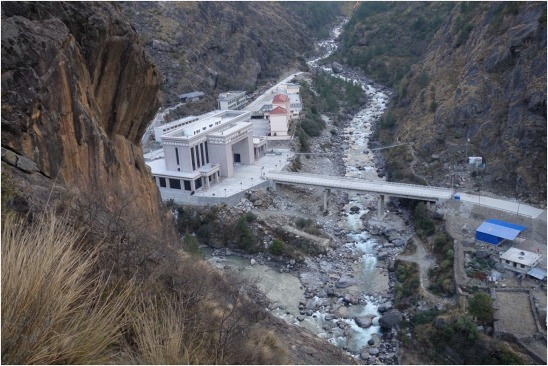
Fig. 3. Border Infrastructure at Rasuwaghadi.
Caption: Nepalese and Chinese customs houses, respectively, at the Rasuwaghadi Nepal-China border.
Photo: Galen Murton, February 2016.
Overall, the gradual (and uncertain) accretion of connections and collaborations in Rasuwa demonstrates the ways that BRI plans are co-produced through a convergence of overlapping projects and aspirations in Nepal. While the making of a Rasuwa-Kyirong power corridor began before the initial articulation and inauguration of the BRI, the scale and scope of infrastructure through this corridor is intensifying in the BRI era. Importantly, while these official plans and programs are articulated by official and expert actors – politicians in Kathmandu and the district headquarters, Nepalese technocrats, Chinese state and business institutions – they are also woven into complex webs of locally-situated ambition. Therefore, the emergence of a Rasuwa-Kyirong power corridor does not simply index the advance of Chinese interests in Nepal; rather, it reflects a weaving together of multiple processes of negotiation, in many cases driven by Nepali aspirations and requests. In the current moment, both Nepalese and Chinese interests use infrastructural projects (completed and pending) in Rasuwa to enact dreams of other ‘power corridors’ in Nepal and summon broader visions of Sino-Nepali connectivity.
5. Gorkha: the geopolitics of waiting
In the Budhi Gandaki Valley of Gorkha district, located just one river basin west of the Rasuwa-Kyirong corridor, a similar assemblage of transboundary roads, hydropower projects, and complementary infrastructural interventions is envisioned. In Gorkha, as in Rasuwa, past infrastructural ambitions are also inflected by the fervor of renewed geopolitical debates and initiatives like the BRI. And yet, while Rasuwa is already well on its way to becoming the power corridor so widely imagined, dreams of an infrastructural future perfect are more uncertain and inchoate in the Budhi Gandaki Valley. As the Gorkha region slides in and out of broader BRI portfolios, different patterns of anticipation, anxiety, and uncertainty are voiced and performed across a range of interconnected scales.
In recent years, infrastructural dreams in Gorkha have centered around the Budhi Gandaki Hydropower Project (BGHPP) – a 1200 MW ‘national pride project’ estimated to cost $2.5 billion that has become a central topic in conversations about Nepal's energy futures. As proposed, the BGHPP would become the largest reservoir project in Nepal, storing water that would help resolve dry season shortages, and enhance Nepal's energy security by selling its power into the domestic market. And yet, the GoN has routinely struggled to find a developer for the project, with successive administrations proposing and cancelling a variety of different modalities for project development. Specifically, the BGHPP contract was controversially awarded to a Chinese developer, cancelled within a year, and then tentatively renewed amid government transitions. This oscillation has fueled continual debates about the geopolitics of Chinese and Indian development in Nepal as well as Nepal's BRI bargaining power (Joshi & Pokhrel, 2018). At the time of writing, the future of the project progress remains clouded largely by Nepal's internal political struggles, and government elites and locals alike are unsure about the infrastructural futures of the region.
At an earlier stage, the BGHPP was slated to be partially financed by a US $1 billion soft loan from Delhi, an effort announced by Indian Prime Minister Narendra Modi during his first diplomatic visit to Nepal in 2014.11 But the momentum and goodwill generated by Modi's attempts at statecraft were soon eclipsed by the debates over India's role in orchestrating the ‘unofficial blockade’ and fuel crisis that crippled the Nepalese economy in late 2015. After project planning was put on hold in the immediate aftermath of the 2015 earthquakes, the GoN soon began formulating new plans for the BGHPP, shaped in part by new policies designed in response to recurring concerns about energy sovereignty (Lord, 2018). At this time, an increasingly nationalist political discourse buoyed by ‘anti-Indian’ polemics mixed with the political goodwill generated by the Chinese humanitarian response to the earthquake and fuel crisis to create even greater space for Chinese development action in Nepal.
At the Power Summit of December 2016, Dr. Laxmi Prasad Devkota, of the Nepal Electricity Authority (NEA), positioned the BGHPP as the keystone of national energy security and economic prosperity for Nepali citizens in a presentation provocatively titled Budhi Gandaki Hydroelectric Project: Can it Be the Grand Ethiopian Renaissance Dam of Nepal? At the center of this presentation was an image showing an ambitious master plan for the ‘Integrated Development of the Budhi Gandaki Corridor.’ This rendering of common infrastructural imaginaries included both the proposed dam and a major trans-Himalayan transportation corridor through Gorkha, but also a special economic zone that would feature shopping malls, a university, a hospital, and a sports stadium. The aspirational and nationalist tenor of this attempt to redraw the map of northern Nepal garnered applause from the crowd, though his rather crude depiction of the proposed infrastructural dreamscape also begged the question: was such a transformation really possible? (see Fig. 4)
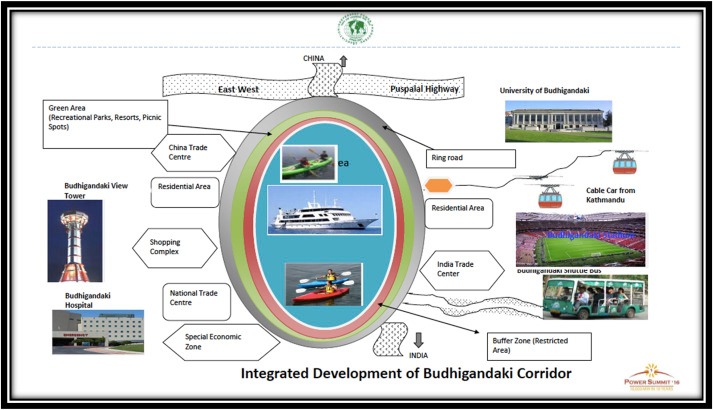
Fig. 4. Budhi Gandaki Integrated Development Vision.
Image of ‘Integrated development of Budhigandaki corridor.’ 2016 Nepal ‘power summit.’.
Source: Dr. Laxmi Prasad Devkota, presented at the 2016 Power Summit.
Further intrigue ensued when, on May 23, 2017, on the eve of the expiration of the Maoist government led by Pushpa Kamal Dahal, Nepal's then Energy Minister Janardan Sharma awarded a construction contract for the BGHPP to the China Gezhouba Group Corporation (CGGC). This hasty decision quickly raised red flags about the decision-making process and the lack of competitive bidding, spurring procedural concerns and accusations of corruption that persist to the present. In November 2017, after the Nepali Congress Party (perceived to be more India-friendly and China-wary) took control of the GoN, then PM Sher Bahadur Deuba terminated the agreement with CGGC, citing the case of previous procedural flaws during the contract award, and announced that Nepal would build the project on its own. However, after the Nepal Communist Party (a newly unified leftist coalition) regained control of government just a few months later, Prime Minister KP Oli, who was PM during the 2015 blockade and has repeatedly advocated for building stronger ties with China, reversed the previous decision yet again, promising to restore the contract with the Chinese firm.
In 2018, debates over the BGHPP and the shape of the BRI in Nepal garnered broader, international media attention. As China's role in the BGHPP remained uncertain, a second Chinese-funded hydropower project (the West Seti HPP) proved unsteady, and the global press was abuzz with the idea that Nepal might be ‘saying no’ to Chinese infrastructural largesse (Sharma, 2018; Joshi & Pokhrel, 2018).12 These reports grouped Nepal with other countries reconsidering the terms of Chinese investments and concerns about ‘debt traps’ tied to the BRI – such as Malaysia, Myanmar, and Sri Lanka – complicating ongoing debates over these two dams in Nepal, and offering proof that the BRI is not guaranteed (Lo, 2018). Meanwhile, the Oli administration responded to these uncertainties by denying that the BGHPP was ‘cancelled’, promising a new deal with the Chinese firm, and sending government envoys to Beijing to negotiate new terms and the project's position within the BRI. But when the GoN shared its short list of proposed BRI projects in early 2019 (Giri, 2019b), the BGHPP was conspicuously absent.
At the time of writing, while BRI negotiations are moving full-steam ahead, the official modality for the development of the BGHPP remains unclear and unconfirmed, and the project remains in limbo. In May 2019, the current Minister of Energy Barsha Man Pun stated: “We are not in contact with the Chinese developer since long. At this point in time, I do not see any possibility of taking forward the project due to various reasons … we have to look for another model to develop this project” (Giri, 2019c, p. 1). Sources close to the Ministry of Energy and hydropower experts in Kathmandu have intoned that the state is now considering using other ‘internal resources’ to build the project. Options include selling publicly traded equity shares to Nepali investors, using NRs 30 billion in funds collected as ‘infrastructure tax’ on sales by the Nepal Oil Corporation, or taking a soft loan from another country or multilateral financial institution to finance the project (Giri, 2019c; Subedi, 2018). While Chinese hydropower contractors may eventually be involved in the project, the BGHPP is no longer slated to be part of the BRI.
As political and economic theater continues, thousands of Nepalis living in the Budhi Gandaki Valley are wondering how their lives might be impacted by the development of this project. For people residing in the ‘project-affected area’ and further upstream, the BGHPP and the infrastructural assemblages planned around it would bring massive spatial and social changes. The 33-km-long reservoir created by the 293 m proposed dam would inundate a massive swath of the valley, submerging 3560 houses and partially affecting an additional 4557 households. Just to mitigate such massive projected impacts, the GoN will have to acquire an estimated 7250 acres of land (BHPDC 2016). Interestingly, though the future modality of the project is uncertain, the GoN has persisted in acquiring land and paying out compensation for this ‘national pride project.’ (see Fig. 5)
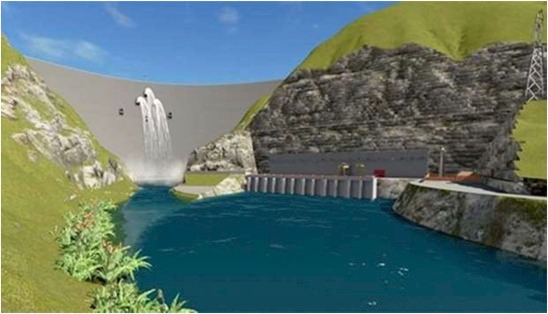
Fig. 5. BGHPP Dam Rendering.
Caption: Rendering of BGHPP dam site included in Budhigandkai Hydroelectric Project Development Committee Feasibility Study (BHPDC 2015).
Source: BGHPP Feasibility Study 2015.
In September 2017, a general sense of liminality pervaded the region, and locals described several kinds of uncertainty. Almost everyone with whom we spoke said they were lacking critical information about the project, and some were even confused about whether their lands would be acquired or not. Ramesh, a shopkeeper along the road told us: ‘We are not sure if the project will happen or not … even the sarokar samiti [the local ‘project concern committee’ created to interface with project developers] doesn't know anything.’ Near the proposed dam site (just 25 km from the epicenter of the 2015 Gorkha Earthquake) some people acknowledged the risks of building a dam in a geologically unstable area. ‘If the dam bursts then that means the water will create problems not just below in Siurenitar [a market downstream] but Bharat samma [all the way to India].’13 Another man recently returned from employment abroad and at work repairing his earthquake-damaged home wondered: ‘If the project is being launched and we are to be relocated, then why did the Government allow people to rebuild their houses in the flooded area [the area that will be inundated by reservoir] after the earthquake?’
Despite such reflections on risks and pervasive uncertainties, there is relatively little local resistance to the proposed BGHPP development. As road construction proceeds in fits and starts, many people are attracted to the economic possibilities and infrastructural entailments that the dam project might bring. Many people stated that they wanted their lands to be acquired, expressing frustrations with being stuck in limbo. In the village of Arukhet, a shopkeeper anticipated grand infrastructural possibilities congruent with power corridor thinking: ‘The future will be very good here … the hydropower will bring benefits and there will be a 100-m road around the dam, with a cable car and a road to China. Gorkha may be the better than all other districts in the future.’ Another man described trans-Himalayan connection as both inevitable and uncertain: ‘We know the road will be built to China, but we have no idea when.’
Like others waiting in spaces animated by the promises and perils of planned and unfinished infrastructure, people in the Budhi Gandaki Valley are living ‘in suspension’ (Gupta, 2015). In this liminal state, attempts to visualize possible futures evoke a complex mixture of ambition, anxiety, and ambivalence. Amid considerable uncertainty, some people hope for a spectacular Gorkha power corridor similar to the one sketched out by the government official at the Power Summit: an infrastructurally enhanced landscape with dams and electricity, roads and resources, and local economies inextricably joined to China. Here, enduring local hopes of ‘becoming bikasit’ – or ‘developed people’ marked as modern (Pigg, 1992) – mix with the broader political and economic prospects of the BRI and enhanced Nepal-China connectivity. As political leaders at the national, provincial, and district levels continue to debate whether Chinese institutions will help build this national priority project, local people in the Budhi Gandaki Valley are experiencing the Belt and Road Initiative as a new but also familiar and everyday form of waiting – for infrastructure, development, and the opportunities that have long been promised to come with it.
And as further shown by the case of the BGHPP, where the decision to cancel the existing agreement was not at all univocal (and more akin to a ‘not now’ than an outright rejection), BRI negotiations must be considered within a broader field of speech acts shaped by a geographically and historically inflected politics of enunciation. Moreover, while BRI discourse in Nepal has shifted away from the BGHPP to focus on other places and projects across the country, the BGHPP may very well still involve Chinese aid, investment, or expertise of some kind in the future, even if it is not officially BRI-related. With this case study in mind, we argue that a broader lexicon is needed to describe the patterns of enunciation, anticipation, and indeterminacy that BRI dreams can evoke.
6. Conclusions: uncertain futures
International media coverage of the BRI often reflects simplistic ‘rise of China’ anxieties, skepticism animated by longstanding Orientalist biases, and tropes of struggle over new global orders in the 21st century. Our grounded analysis of Chinese aid and investment in two very specific places in Nepal challenges this kind of solipsism and abstraction, using discursive analysis and ethnographic methods to understand the many different ways that the BRI is understood and enacted in the context of contemporary Nepal. Focusing on infrastructural politics within the imagined power corridors of Rasuwa and Gorkha districts, we have examined the ways that differently positioned political leaders, government officials, contractors, and local stakeholders narrate and broker the BRI and its different entailments. Ultimately, we argue that the Belt and Road Initiative, as a concept and a shifting assemblage of infrastructural interventions, is co-constructed via multi-scalar processes of anticipation, enunciation, negotiation, and reorientation. This process of co-construction, which involves an array of different Nepali and Chinese actors, shapes the ways that the BRI is discursively leveraged and understood along with the spatial and temporal configurations of BRI-financed projects.
In both Rasuwa and Gorkha, grand plans of infrastructural transformation, ongoing negotiations, and periodic bursts of project information have generated palpable ‘economies of anticipation:’ zones where “diverse ways of knowing about, imagining, and living toward the near and distant future converge with particular intensity” (Cross, 2015, p. 435). Building on several years of Chinese-facilitated development that predated the BRI, the Kyirong-Rasuwa corridor remains a major strategic priority and three of Nepal's nine BRI projects will focus here: an expanded highway, a transboundary transmission line, and the trans-Himalayan train. Given current momentum and the scale of future investment, it is clear that Rasuwa will remain a politically, economically, and materially significant power corridor. On the other hand, the troubled case of the BGHPP – which was once a fulcrum for Sino-Nepal deal-making and a focal point for BRI dreams – remains in a state of limbo. As the political tides continue to shift within Nepal, the prospects for megaprojects like the BGHPP or the spectacular Kyirong-Kathmandu railway wax and wane, creating both a high-stakes economy of anticipation and a great deal of uncertainty for a range of constituents. This again shows that BRI-infused futures are neither inevitable nor guaranteed. Moreover, the capacity to anticipate is also highly uneven, and much like what has been observed elsewhere in Nepal, this reflects chronic problems of political access and social exclusion, as well as heavily gendered patterns of information asymmetries and civic participation (Lord, 2016; Nightingale, Bhattarai, Ojha, & Sigdel, 2018).
While evaluating the significance of the BRI in Nepal, it is imperative to remember that the current ‘BRI moment’ is just one part of a broader history of connectivity and infrastructural diplomacy between Kathmandu and Beijing. Further, Chinese infrastructural aid does not operate in a vacuum in Nepal. For decades, a variety of different foreign governments and donor institutions have been designing and financing infrastructure projects in Nepal – from the World Bank and the Asian Development Bank to the United States and Japan. Recently, amidst ongoing BRI negotiations, the United States committed US$ 500 million for expanding and upgrading Nepal's electric grid through the Millennium Challenge Corporation Nepal Compact. And yet, looking back on decades of development failures in Nepal, one cannot help but ask in what ways might Chinese development be different in and for Nepal?
It is also critical to remember that the Government of Nepal has a great deal of agency in all of these negotiations. Longstanding desires for self-determination drive current political decision making. As we reviewed above, political leadership in Nepal has long been successful in courting donors and translating geopolitical anxieties into infrastructural investment. Especially now, the GoN is also acutely aware of the concerns about Chinese presence and influence in Nepal that officials from India and the United States have expressed, and they shrewdly navigate these waters as new deals are brokered. Meanwhile, popular sentiment is also shifting rapidly, if unevenly, in Nepal. As Chinese investment, tourism, and increased market connectivity creates new business opportunities in Kathmandu and elsewhere, many Nepalis also ask why shouldn't we accept Chinese aid or development?
And yet, while the BRI might suggest a new form of ‘development with Chinese characteristics,’ some also question whether contemporary Chinese aid really comes with no strings attached. Other scholars have analyzed the dual role that Chinese development programs played in ‘taming’ Tibet (Yeh, 2013) and suppressing social freedoms across the peripheries of China (Steenberg, 2019). While Xi Jinping is working hard to dispel internationally circulating concerns over China's ‘debt trap diplomacy,’ anxieties about debt-related soft power and the territorializing entailments of Chinese aid are palpable for a small country like Nepal that borders directly on China's sensitive Tibetan areas. In recent years, China has explicitly and repeatedly called upon the GoN to help apply its One China policy (Giri, 2019e), especially with respect to Tibetan and other ethnic minorities abroad. In 2019, several waves of public protests erupted in Kathmandu in response to a new Media Council Bill that would severely restrict the freedom of the press and limit the autonomy of human rights organizations in Nepal. For many civil society groups, these are worrying developments that raise questions about if and how BRI-era Chinese aid to Nepal might also be a vector for Beijing's extra-territorial control over restive minority populations outside the borders of the PRC.
In the current moment, a great deal remains uncertain about the dimensions of the BRI and the effects that the BRI and other forms of Chinese aid will have in Nepal. As of late 2019, the majority of BRI projects are still in the study phase, and the proverbial ink is barely dry on several major Nepal-China agreements. Tellingly, despite several rounds of negotiation and the winnowing down of Nepal's BRI proposals, many people in Nepal – politicians, experts, scholars, and local constituents alike – remain unsure about what the BRI actually is, and what it can do. Our analysis of Chinese-facilitated infrastructure development in Rasuwa and Gorkha shows how differently positioned actors conceptualize the BRI and Sino-Nepal linkages and enunciate their own visions of infrastructural promise and precarity at multiple scales.
By highlighting contrasts in the ways that uncertain infrastructural futures are envisioned and implemented in two adjacent river valleys, our study points to the need for greater nuance and specificity when interpreting BRI negotiations, in Nepal as elsewhere. Disaggregating the BRI into an assemblage of distinct projects that prompt situated struggles refuses the possibility for a monolithic BRI vision or agenda, and draws attention to the layers of discursive politics beneath. As a variety of different actors attempt to complicate, or even challenge, sweeping narratives about Chinese infrastructural aid or the promises of BRI-enabled development, it can never be as simple as just ‘signing on’ or ‘saying no’ to Beijing's BRI efforts.
To be clear, we do not uniformly oppose trans-Himalayan infrastructural projects or Chinese development interventions in Nepal. More importantly, we do not seek to dismiss or denigrate the very real mixture of needs and aspirations that animate infrastructural development, BRI or otherwise. Our research, individually and collectively, maintains that infrastructural dreams of economic security and increased mobility are real and important things. Further, Chinese infrastructural aid has proven to be incredibly effective so far in Nepal, especially in the wake of the 2015 earthquake and compared to other national infrastructure projects that have lagged for decades. In view of these realities, we again voice two critical questions being asked in Nepal today: Can Chinese infrastructural aid or ‘development with Chinese characteristics’ change longstanding development trajectories in Nepal? Who will profit from the sprawling promises of the BRI, and who will inevitably pay for them? As Nepal's nine proposed BRI projects and transboundary infrastructural assemblages begin to materialize in the imagined power corridors, ongoing grounded research is essential to interpret the multi-scalar processes through which politics articulate infrastructures and infrastructures articulate politics.
More Research
1/2