
Home / Research / China’s port investments and influence abroad: a comparative analysis of Italy and Pakistan
China’s port investments and influence abroad: a comparative analysis of Italy and Pakistan
Published: June 30, 2026
•
TERRITORY, POLITICS, GOVERNANCE
Abstract
China’s investments in port infrastructure globally have sparked considerable debate as to whether or not they translate into greater influence over host countries. Yet, the existing literature presents mixed findings on the extent and mechanisms of this influence. This study contributes to these debates through a comparative analysis of the ports of Vado Ligure in Italy and Gwadar in Pakistan. Drawing on a mixedmethods approach, including ground-truthing observations in both ports and the use of geospatial data, we propose a framework which disaggregates China’s influence across the political, economic and spatial dimensions at both national and local scales. Our findings reveal that China often acts as a preference multiplier, and that its investments adapt to host countries’ political economy, target strategic geographical locations and have a medium-term time horizon. This study advances emerging scholarship in International Political Economy and Geopolitics on Global China by offering an empirically grounded, multi-scalar and relational framework for analysing China’s influence.
Regions
Cite This
Boni, F. & Zoppolato, D. G. (2026). China’s port investments and influence abroad: a comparative analysis of Italy and Pakistan. TERRITORY, POLITICS, GOVERNANCE. https://doi.org/10.1080/21622671.2026.2684486
Full Text
1. Introduction
China’s investment in ports globally over the past decade has become a key feature of Beijing’s infrastructural push under the Maritime Silk Road (MSR). With a total of 129 port projects outside China with Chinese investments (Council on Foreign Relations, 2024), China’s interest in ports abroad has triggered intense debates regarding the implications that these investments might have for the global order and for host countries. A common thread in scholarly analyses on the topic is the focus on how connectivity represents a source of economic statecraft and power for China (Andrijauskas & Boruta, 2025; Blanchard, 2024; Breslin & Nesadurai, 2023; Ferchen & Mattlin, 2023; Reilly, 2017). In addition, scholars analysed how the construction of these infrastructures reconfigures political and economic (inter)dependencies between China and Belt and Road Initiative (BRI) countries (Adeney & Boni, 2024; Banach & Gunter, 2023), affects regional power dynamics and contests existing regional/global orders (Roy et al., 2024; Rolland, 2017). Existing works have also analysed the international security implications of port infrastructure (Kardon & Leutert, 2022) including what some have defined as ‘weaponised interdependence’ (Farrell & Newman, 2019), namely a situation in which an actor can exploit its position in an embedded network to gain a bargaining advantage over others in a contained system. Policymakers, especially in the West, have also devoted significant attention to the expansion of Chinese investments in port infrastructure. In September 2024, a joint report by the US Select Committee on the Chinese Communist Party, the House Committee on Homeland Security and the Subcommittee on Transportation and Maritime Security focused on the ‘rising threat to U.S. economic and national security’ posed by the Chinese Communist Party (CCP) and its investments in US port infrastructure (Select Committee on the CCP, 2024). Along similar lines, a study on Chinese investments in European maritime infrastructure produced for the European Parliament's Committee on Transport and Tourism noted that ‘risks arise from the deliberate strategy by China to leverage its investments in European maritime infrastructure to its own advantage’ (Ghiretti et al., 2023).
The examples just outlined point to the fact that there is often the perception that through the use of its vast economic resources and centralised decision-making system with the Chinese Communist Party (CCP) at its heart, China’s ultimate aim is to enhance its power on the global stage. Yet, when it comes to evaluating whether these claims have merit and whether or not China has been able to achieve its supposed foreign policy goals via the deployment of its economic means, the literature presents mixed results. Contributing to these debates, the underlying question driving this study is the following: are there discernible patterns of engagement and influence in host countries following Chinese investment in port infrastructure? In answering this question, our proposed contribution is twofold: first, we suggest disaggregating influence through three dimensions – political, economic, spatial – and across scales – national/local – in order to provide an in-depth and granular analysis. We do so by tracing the pathways through which China deploys (or not) its influence looking at how such influence is co-produced across scales, between Chinese and local actors. Second, we adopt a comparative approach by bringing in conversation examples from the Global North and Global South. This is important as it allows us to shed light on the relational, multi-scalar and comparative dynamics through which China’s influence is negotiated and adapted across different contexts. To develop these points, the paper proceeds as follows: in the ensuing section we outline the analytical framework and discuss the concept of influence. We then move to discussing the data and methods used before taking a deep dive into the empirical analysis of the two case studies of Vado and Gwadar.
2. Analytical framework
At the heart of this study lies what has been described as the ‘infrastructure–influence nexus’ (Strange, 2023; Gurol & Rodríguez, 2022). Put simply, this notion captures how infrastructure provision is mobilised for projecting power. China’s overseas investment footprint under the BRI extends well beyond ports to encompass energy and transport corridors (Adeney & Boni, 2021), digital infrastructure (Hillman, 2021), industrial parks (Liu et al., 2021; Loughlin & Milne, 2025) and extractive sectors (Gu, 2024). The recent literature on China’s use of logistics and infrastructure globally revolves around three, inter-linked themes, namely: the mechanisms of influence, institutional and governance channels, and the contingent nature of influence. We turn to each of these strands in this section, in order to situate our work before moving on to defining influence.
To start with, several empirical studies foreground how infrastructure investments translate into economic integration and operational dependence. Hu, Liu, and Lee (2021), for instance, focus on China’s outbound investment clusters around maritime connectivity, with states occupying central positions in global shipping networks being more likely to attract more Chinese capital, creating tighter trade and logistical ties that can generate economic leverage over time. Shibasaki, Tanabe, Kato and Lee (2019) similarly demonstrate through the case of the port of Gwadar that enhanced hinterland rail and facilitation can shift container flows toward a China-linked gateway, again pointing to influence as a function of changed shipping routes and commercial dependency. With regards to a second body of work, these focus primarily on how the ownership of ports, operational control and policy coordination among Chinese actors creates a form of leverage over the host country. Chen et al. (2019) document how Chinese central and local governments, together with state-linked firms, deploy multiple modes (equity stakes, concessions, managerial contracts) to embed Chinese port operators abroad; this creates institutional ties and long-term entanglements that may be activated as leverage, but which also reflect domestic coordination problems within China (e.g., central vs local priorities). Lee et al. (2020) add that the logistics literature tends to emphasise technical and performance dimensions (connectivity, multimodal linkages, efficiency), with considerably less empirical work on how institutional arrangements convert infrastructure into diplomatic influence, a gap that this paper seeks to address. A third strand of scholarship characterises China’s outreach as polymorphous and context-specific. In the European context, Gurol and Rodríguez (2022) make this point looking at the 14 + 1 Cooperation Forum and the Port of Genoa in Italy, showing context-specific nature as well as the ambivalent effects that China’s BRI has across different sectors in the EU. In a similar fashion, Kao (2021) analysed the impact of the BRI on Europe and Mohan et al. (2024) noted how adopting a multi-scalar approach to analyse Chinese-backed transport infrastructure projects in Europe reveals a tension between central and local state that led to recentralisation. In a similar vein, a number of studies on China’s relations with countries in the Global South (Abb et al., 2024; Adeney & Boni, 2021; Safdar, 2025; Wang & Fu, 2022) have noted how the implementation of the BRI was partly driven by host countries priorities as well as interactions with regional security structures and domestic political economies (Iftikhar, 2025). Beyond material dynamics, recent work has also shown how Chinese narratives on the BRI are absorbed, reinterpreted and contested across scales within partner countries’ media and political ecosystems (Zoppolato & Boni, 2025). Collectively, works across the three strands discussed above, support an analytic move away from monolithic claims that the BRI equates with geopolitical capture. Building on this, we propose that the infrastructure–influence nexus is best operationalised as a multi-dimensional and multi-scalar process: infrastructure alters material geographies and institutional linkages that create potential leverage, but the actual exercise of influence depends on bargaining, local capacities, and the appreciation of multi-scalar political and economic dynamics (Gurol & Rodríguez, 2022; Lee et al., 2020). In doing so, we bring analytical clarity to a debate often framed in dichotomous terms, e.g., capture versus resilience, dependence versus autonomy, and instead foreground influence as a relational, context-specific and multi-scalar process.
2.1. Influence
Understanding whether China’s influence has effectively spread across the countries that have embraced the BRI, requires first to provide a definition of influence. In her seminal work on China in South-East Asia, Evelyn Goh described influence as ‘modifying or otherwise having an impact upon another actor’s preferences or behavior in favor of one’s own aims’ (Goh, 2014, p. 826). Such a definition highlights two components: a relationship between two actors (the wielder of influence and their target). Second, the attainment of consequences: the causal relationship results in behaviours that may or may not be consistent with the preferences, or wants, of those wielding influence (Roy et al., 2024). This is particularly relevant as there is often the conflation of the concepts of ‘influence’ with ‘attempts at exercising influence’ (Whitehall paper, 2021), especially in popularised notions that ports operated or owned (even if only partially) by Chinese entities translate into greater sway by the CCP abroad. In order to gauge the extent of influence, it is therefore important to first understand who the actors are, before trying to make sense of how they operate. To this end, we subscribe to the view that the host of actors in international politics has grown immensely over the past decades, and it is therefore important to account for this multiplicity when making sense of how bilateral interactions occur. This is particularly important in the case of China, which is often (and mistakenly) seen as a unitary actor, capable of rolling out a grand strategy and controlling all its components. On the contrary, we endorse the view that China is not a monolithic entity, in line with a growing body of literature (Jones & Hameiri, 2021; Jones & Zeng, 2019) recognising the fragmented nature of its global engagement. In this paper, we focus on a selected set of Chinese actors – including state-owned enterprises (SOEs), private enterprises, diplomats and officials – in order to understand whether and how influence is produced through China’s global ports investment, though Chinese citizens abroad also contribute to how Chinese influence is produced and received locally (Zoppolato & Culcasi, 2026). Having established both a working definition of influence and the multiplicity of actors involved in shaping China’s global engagements, the next step is to outline our framework, which systematically disentangles how influence is produced, exercised and manifested across different contexts.
First, we unpack what influence means in three dimensions – political, economic, spatial – and across scales – national/local. Our approach provides a framework for evaluating how global actors, such as the Chinese state actors and corporate entities, produce influence through context-specific and relational engagements. Rather than presuming a linear translation of infrastructure into geopolitical power, this perspective foregrounds the way influence is negotiated, unevenly distributed, and contingent on the interplay between domestic governance structures, local political economies and the preferences of Chinese actors. In doing so, it moves beyond conventional assumptions of economic statecraft and geopolitical capture, offering instead an account of how infrastructure projects reconfigure power relations across multiple scales. Second, we propose a three-stage approach to understand how influence is actually exercised: 1) ‘Preference setting’, which consists of examining the strategic objectives of both Chinese actors and their counterparts. This is key in order to assess the extent of pre-existing alignment between China and partner countries. We do this mapping at both national and local level in order to gauge the full extent of preferences. 2) ‘Outcomes’, where we provide an answer to the following questions: have the proposed infrastructure projects, trade agreements or investments been successfully implemented as planned? To what extent have these engagements fulfilled the objectives initially set by both parties? Empirical evidence is necessary to assess whether these projects have led to greater economic benefits, improvements in connectivity and enhanced political ties. Evaluating the extent to which outcomes align with initial objectives is therefore a key step in understanding influence. 3) ‘Implications’, in which we identify patterns that both cases share. In particular, we have identified the following elements: China as a ‘preference multiplier’; medium-term time horizon of investments; adaptiveness and tailored approach to the countries China operates in; selection of strategic geographical locations. We turn to analyse these elements in the final section of the paper.
3. Methodology
This study employs a ‘diverse-case’ method (Seawright & Gerring, 2008) to examine SOEs investments in port infrastructure, selecting two prominent yet relatively understudied cases: Vado Ligure in Italy and Gwadar in Pakistan. The analysis covers the period between Chinese SOEs investment in the ports (2013 in the case of Gwadar and 2016 in the case of Vado) and 2024. Diverse case selection aims to capture variation along key dimensions while still allowing for meaningful comparison and pattern identification, offering a broader understanding of a phenomenon across different contexts. The port of Gwadar represents one of the key projects being developed under the aegis of the US$30 billion China–Pakistan Economic Corridor (CPEC). The port of Vado Ligure was part of the 2019 memorandum of understanding (MoU) that Italy signed with China on the BRI. Importantly, Italy is the only G7 country to have signed such an MoU with China, and also the only country globally that has withdrawn from the initiative by not renewing the MoU in 2023. This provides a rare opportunity to analyse both engagement and disengagement with Chinese-led global initiatives. Both ports have varying levels of involvement from Chinese state-owned enterprises, namely COSCO (China Ocean Shipping Company) and COPHC (China Overseas Port Holding Company Limited). While the former is directly owned by the central government (hence with the executives being government officials and members of the political elite), the latter is more opaque but the ‘state-owned’ status seems to be a selling point for developments surrounding Gwadar, indicating a degree of People’s Republic of China (PRC) government commitment, perhaps intended to assure investors (Kardon & Leutert, 2022, p. 15). At the same time, these two cases present notable contrasts. Italy, as a mature democracy and the third-largest economy in the Eurozone, operates within a highly institutionalised political and economic framework, characterised by strong regulatory oversight and integration into the European Union. Pakistan, in contrast, is a hybrid regime with an economy that is more dependent on foreign investment and external financial support. By selecting these two cases, the study contributes to a broader understanding of China’s engagement in global infrastructure development across diverse governance and economic settings.
To assess preference setting we rely on secondary literature and on official statements by politicians. We have collected this information from local and national newspapers in both the host countries and China. For Italy, we examined and translated Italian language sources (both authors are Italian native speakers) including Secolo XIX, La Stampa and Ansa. For Pakistan, we focused on the English language newspapers Dawn and The Express Tribune. In the case of China, we collected official statements in both Chinese and English from major media outlets including Xinhua, Renmin Ribao, CCTV, Guancha and Global Times. To assess the economic outcomes of Chinese investments, we collected detailed import and export data from the World Integrated Trade Solution (WITS), covering 1 January 2000–1 January 2024 with HS (harmonised system) four-digit trade patterns, along with container traffic data for Vado Ligure and Gwadar. To analyse spatial outcomes, we constructed a case-based geospatial database focused on Gwadar and Vado, incorporating detailed project-level data on Chinese projects implemented in and around the two port areas (see Appendix A in the online supplemental data). We validated and contextualised these spatial data through site visits in Gwadar between 24 April 2023 and 1 May 2023 and between 1 July and 7 July 2024. We conducted ground-truthing as a validation procedure. For each of the major infrastructure projects identified in the database we verified its physical presence, spatial footprint and degree of accessibility. We also compared and visited the master-plan representations with on the ground status to assess discrepancies between envisioned and implemented development. Field observations were used to validate and contextualise the spatial analysis presented in Sections 4 and 5. Appendix A provides further details on the construction of the geospatial database, fieldwork information including access to the sites as well as the research design.
4. Case studies
In this part of the paper we turn to analyse the two case studies, starting from the port of Vado Ligure in Italy. After a brief introduction presenting the case and its main developments, the analysis follows the framework outlined in the previous parts of the paper, namely preference setting and outcomes, before turning to a dedicated section presenting the comparative findings and implications from the two cases.
Table 1. Summary of findings across the two cases.
4.1. Vado Ligure
In November 2016, COSCO Shipping Ports and Qingdao Port International acquired 40% and 9.9%, respectively, of the equity share that the Danish shipping company A.P. Moller-Maersk held in APM Terminals Vado Ligure S.p.A. (APM) for an undisclosed amount.Footnote1 APM is the joint venture (JV) that designed, started and expanded (including associated infrastructures such as a new Port Gate and flybridge) the Vado Gateway container terminal at a total cost of about EUR 450 million, 180 million of which was invested by APM Terminals (43 million of which was provided by project financing of the public infrastructure) (Spigarelli & Lepore, 2023).
4.2. Preference setting
From China’s perspective, the stated aims behind the investment in the port were both symbolic and substantive: symbolically, investing in Vado was a way to showcase the strength of Sino-Italian relations and to demonstrate China’s ability to land important deals with key EU members. The Global Times, for instance, noted how the port embodied ‘the future of China-Europe ties’ highlighting how ‘better infrastructure like ports, roads and bridges could help bring countries closer and strengthen ties’ (Global Times, 2019). On a more substantive level, COSCO's stake in Vado Ligure is negligible (€8 million) compared to its other major deals, such as the €368.5 million invested in Piraeus and the $3.6 billion in Chancay. To put this into further perspective, COSCO's daily profit in 2024 averaged approximately $20.7 million, highlighting the relatively limited nature of this investment. However, China’s aim behind the port was clearly expressed by Wang Yuqiu, deputy general manager of Vado Terminal Holding Company. He noted that he hoped ‘to realize intermodal transport with the China-Europe Express […]. In this way, the goods landed at the Port of Vado can be transported to Central and Western Europe or Central Asia and China by land, and the goods of the express train can also be transported to the Port of Vado by the China-Europe Express, and then transported to Algeria, Tunisia, Morocco and other countries by sea’ (People.cn, 2019). In other words, there was a commercial rationale behind the investment in the port, aimed at making it a key hub for goods to move to the lucrative Central and Western European markets.
As far as Italy’s preferences were concerned, Chinese investments were welcomed at both national and local levels and the aim behind having COSCO invest in Vado was two-fold: first, to give international visibility to the port of Vado. As the former Mayor of Vado between 2014–2023 noted at the inauguration of the new terminal: ‘we are happy for the arrival of COSCO in managing the platform. It’s the signal that Vado has an increasingly international breadth and that investments are coming to this territory’ (La Stampa, 2016). Along similar lines, the then Governor of Liguria, Giovanni Toti, noted how the arrival ‘of the Chinese triggered a heated debate, one that feels much more like a political controversy than a real analysis of the country's needs. Can we cooperate peacefully with the Singapore Port Authority, MSC, the Americans from Carnival, and the rest of the world—but not with China?’ (La Repubblica, 2019). These aims and dynamics are largely in line with what previous research (Mohan et al., 2024) has shown with regards to the Port of Trieste. Second, there has been consistent support for Chinese investments as drivers of development and economic growth. Industry professionals favoured Chinese investors while highlighting the wealth created through collaboration with China. Paolo Cornetto, former Managing Director of Vado, stated: ‘If we take a closer look, the major Italian terminals are already in the hands of foreign entities. I don't see any Chinese threat. Rather, I see an opportunity to integrate Italy into a south-to-north growth movement that could bring us several benefits’ (Lamperti, 2019).
4.3. Outcomes
In this section, we present and discuss the findings of our multi-scalar and multi-dimensional analysis of Chinese influence in Italy. Our investigation, which examines political, economic and spatial dimensions, shows that Chinese influence in the country remains limited. From a political standpoint, our analysis indicates that there is no substantial evidence to suggest a significant shift in Italy’s foreign policy posture. Economically, the overall level of Chinese investment in Italy remains relatively modest compared to other foreign investors, particularly those from the EU and the US. Moreover, regulatory frameworks and oversight mechanisms have further constrained the extent to which Chinese capital has been able to exert influence over key industries. Spatially, our research finds that while Chinese entities have participated in localised economic activities, these engagements have not led to any meaningful spatial development.
4.3.1. Political alignment
In March 2019, Italy signed a memorandum of understanding (MoU) on the BRI, becoming the first G7 country to do so. Importantly for the analysis presented here, both the ports of Vado Ligure and Trieste were part of the MoU. The BRI memorandum, whilst non-binding in nature, was the culmination of decades of friendly bilateral engagements between Italy and China (Boni, 2023a; Jakimów et al., 2025). The Conte I government (June 2018 to August 2019) combined Eurosceptic and populist elements with a strong focus on repositioning Italy as a bridge between Europe and China. It developed specific plans to deepen bilateral ties, including creating a dedicated ‘Task Force China’ within the Ministry of Economic Development (MISE) to promote investment cooperation and market access, though this initiative achieved limited success and was short-lived. At the national level, however, alignment has remained inconsistent. Despite periods of strong collaboration, Chinese political influence has never taken root in Italy, largely because US strategic dominance has long constrained Italy’s foreign policy autonomy, which is largely anchored in North Atlantic Treaty Organization (NATO) membership. At the same time, the European Union has also adopted a more cautious and security-oriented stance on China, especially since 2019, when it officially labelled China a ‘systemic rival’ (EU Commission, 2019). As a result, political alignment with China in Italy remains highly sensitive to shifting government priorities, US pressure and EU-level constraints. Two significant developments in recent years reinforce this assessment.
The first is the revision of Italy’s so-called ‘Golden Power’ regulations in 2022, which grant the government the authority to scrutinise and potentially block foreign investments in strategic sectors to safeguard national interests. This policy shift reflects a growing emphasis on economic security and a more cautious approach toward foreign direct investment, with a specific eye on China. Then Minister of Economic Development, Giancarlo Giorgetti, actively pushed for the revision of the Golden Power regulatory framework, stressing the need to ‘extend the scope of application of the Golden Power’ to sectors ‘particularly exposed to Chinese competition’ (Massaro, 2021). Since its strengthening, the Italian government has extensively used the Golden Power towards Chinese investments across various sectors, including semiconductors (Shenzhen Invenland Holdings), robotics (Alpi Aviation, Robox), aerospace (Blue Engineering), automotive (Pirelli) and telecom (Linkem, Fastweb). This is in stark contrast to the role of US enterprises, which are deeply embedded in strategic sectors (e.g., the investment of BlackRock of over 3% in Leonardo defence industry and the acquisition of Comau Robotics by the USA group One Equity Partners) and have been subject to much less scrutiny.
The second development which shows the limited influence that China has had on Italian policymaking is the Italian government’s decision in 2023 not to renew the above-mentioned BRI MoU. Once it became clear that the right-wing government of PM Giorgia Meloni did not intend to renew the MoU, there were a number of attempts by China to persuade the Italian government to reconsider its decision. In early 2023, China’s top diplomat, Wang Yi, visited Rome as part of a tour of key European capitals (Boni, 2023b). During the visit, Wang noted how the MoU ‘has greatly enhanced the strategic level of China-Italy relations, and this beneficial asset of our relationship will produce more positive results’. He also highlighted that China was ‘willing to import more Italian high-quality products’ and ‘support Italian companies to expand their market shares in China’ (Guide, 2023). Beijing’s interest in having Italy renew the memorandum was also visible in an interview that China’s Ambassador to Rome gave to Italy’s main independent news agency, ANSA, ahead of Mr Wang’s visit. In the interview, the Ambassador noted that ‘two great nations like ours [Italy and China] have the ability and wisdom needed to make the right choices by seconding the flux of history, so that such a cooperation and amity could become ampler and ampler’ (ANSA, 2023). Despite these clear attempts at exercising influence, the Italian government informed Chinese authorities in December 2023 of its decision not to renew the MoU. This was done through a note never made public to avoid making a big deal out of the withdrawal (Fasulo, 2024). Yet in parallel with this withdrawal, the Italian government sought to preserve good relations: in 2024, it signed the ‘Piano d’Azione per il Rafforzamento del Partenariato Strategico Globale Cina-Italia (2024–2027)’ aimed at strengthening the strategic partnership between the two countries (Governo Italiano, 2024).
4.3.2. Economic engagement
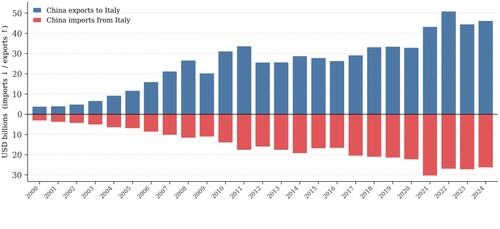
As noted above, the expectations at both national and local level regarding Chinese investments were to increase Italy-China trade ties and to significantly boost Vado’s role in wider trade networks. In this section, we assess whether any of these claims materialised, starting from trade patterns. Figure 1 illustrates the evolution of Italy’s trade with China highlighting the persistent and widening trade deficit.
Figure 1. Italy–China trade flows and balance, 2000–2024 (US$ billions).
Source: UN Comtrade, total goods (HS), reporter = China.
Display full size
At the national level, Italy's exports to China remained broadly flat between 2017 and 2020 (in the US$20–22 billion range), surged to a peak of US$30.3 billion in 2021, and have since settled at around US$26–27 billion, with US$26.4 billion recorded in 2024. Italy's imports from China, by contrast, show a sustained upward trend over the same period, rising from US$29.2 billion in 2017 to a peak of US$50.9 billion in 2022, before easing to US$44.5 billion in 2023 and recovering to US$46.2 billion in 2024. As a result, the bilateral balance has been consistently and increasingly negative for Italy: the deficit widened from US$8.7 billion in 2017 to US$12.1 billion in 2019 and reached a peak of US$23.9 billion in 2022, before narrowing slightly to US$19.8 billion in 2024 a pattern common to all major EU economies. Italian imports from China expanded most rapidly in electrical machinery and organic chemicals, underlining Italy's growing reliance on China for components and materials critical to its industrial supply chains.
Within the Savona–Vado port system (Autorità di Sistema Portuale del Mar Ligure Occidentale), total throughput amounted to 15.2 million metric tons in 2023, a 2.5% decline year-on-year. Of this, about 7.2 million tons were general cargo, including 3.0 million tons of containerised traffic equal to 346,000 TEU, alongside 1.6 million tons of dry bulk and roughly 6.3 million tons of liquid petroleum products, with an additional 110,000 tons of liquid foodstuffs (Vado Port Authority, 2025). Despite the slight contraction at system level, a closer look at traffic between 2021 and 2023 reveals a different dynamic: inbound volumes rose 5.4%, from 27.9–29.4 million tons, while exports stagnated at an annual average of around 8.1 million tons.
This skew toward imports was most evident in liquid bulk, which saw a 35% increase between 2021 and 2023 reaching 16.1 million tons inbound. Growth was fuelled by crude oil imports, which rose 13% over the period, while refined petroleum products increased by 31.7% between 2021 and 2022 before a modest 3.6% decline in 2023; refined exports fell by 16.8%. The expansion of liquid bulk flows reflects both the long-standing oil-handling capacity at Savona–Vado and the commissioning of additional berth and tank infrastructure in recent years, which lowered turnaround times and boosted effective throughput. A similarly sharp growth trajectory was recorded for chemicals, which surged by 248% between 2022 and 2023, a development that coincided with new tank capacity and pipeline connections completed in 2022–2023 and mirrored the parallel rise of Chinese chemical exports to Italy. Metallurgical products, by contrast, contracted sharply, with inbound volumes falling 28.6% and exports plunging by 60.2% over the same period, a decline that can be attributed both to weaker European demand and to the reallocation of berth space toward containers and liquid cargo after the commissioning of the new terminal.
General cargo remained comparatively stable, fluctuating between 8.1 and 8.6 million tons annually, but vessel calls declined slightly from 4317 to 4281, indicating larger call sizes. Taken together, these cargo-type shifts point at how COSCO targeted investments in container and liquid bulk infrastructure have influenced Vado’s transformation into an import-oriented hub for Europe, while sectors without comparable investment, such as metallurgical products, have declined in relative importance.
Our analysis of port traffic confirms two trends: first, the Chinese preference for using Vado as a hub to ship goods to Western and Central Europe; second, and relatedly, Vado Ligure’s centrality as Italy’s import, rather than export, hub.
4.3.3. Spatial impact
A key feature in how COSCO and, more broadly, China engaged with Italy lies in the context of infrastructure development. Differently from what we will see in the Gwadar case, COSCO entered the Italian market within already well-established local dynamics and planning. Since 1999, several master plans and projects have been initiated to develop port areas. For instance, the 2002 master plan for Vado anticipated much of the developments taking place in the areas and it was managed at the municipal level, with the ‘Piano Regolatore Portuale Savona-Vado Ligure’ coming into force in 2005 to guide development. As such, there is no evident Chinese influence on this aspect, as these developments well predate the advent of Chinese investors.
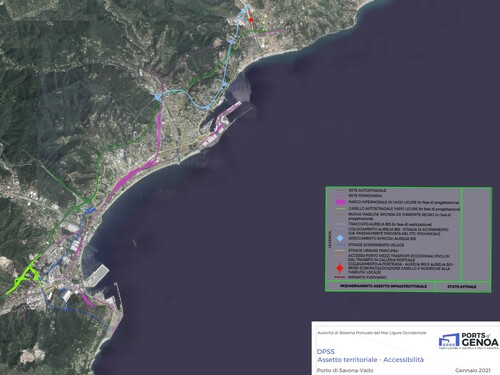
A second interesting feature from a spatial standpoint is that COSCO (or other Chinese actors for that matter) are not investing in infrastructure developments in the area. The 2001 ‘Relazione Generale al Piano Regolatore’ highlighted the priority of developing infrastructure alongside the terminal to support increased capacity. Neither China nor COSCO played any role in developing the infrastructure necessary for the port’s success. Figure 2 illustrates the new infrastructures planned and being built connecting the Vado Terminal including: the Bossarino Casello, designed to provide direct access to the port area; the New Vado Ligure Breakwater, aimed at enhancing maritime protection and improving accessibility for larger vessels; the expansion of the rail terminal to optimise freight movements and intermodal transport efficiency; and the restructuring of breakwaters to increase resilience against adverse sea conditions and support port operations.
Figure 2. Planned infrastructure developments in the Savona–Vado port system.
Source: Autorità di Sistema Portuale del Mar Ligure Occidentale, DPSS (January 2021).
Display full size
These projects are driven by local and national actors, with no direct Chinese involvement. COSCO’s role has been strictly limited to specific and remunerated activities within the port, including transportation, logistics and the adjudication of tenders, such as managing the electrical tower. Unlike in other locations where China integrates deeply into territorial development, COSCO’s engagement in Vado does not extend to territorial control or reconfiguration. China operates within existing infrastructure without leaving any visible footprint in the area. There is a clear absence of territorial presence or marks in Vado, unlike in Gwadar. China remains invisible not only in the initial phases of infrastructure development but also within the surrounding areas. According to ISTAT (2022), there are no well-established Chinese communities or residents in Vado. A striking example of this detachment was evident during our visit to Vado, where no COSCO-branded containers were visible and no symbolic or territorial markers were present.Footnote2 This is in stark contrast to the other ports, including Gwadar and Piraeus, where Chinese investments often come with celebratory territorial markers like flags, poster visuals. Vado Port functions as a node within a broader logistics network rather than a fixed territorial extension of Chinese influence. It operates through flows and connectivity rather than through direct, physical markers of China’s presence.
4.4. Gwadar
In this section we turn to our second case study, namely the port of Gwadar. The original construction of Gwadar Port was led by the China Harbour Construction Company (CHCC), a fully owned subsidiary of the better-known China Communications Construction Company (CCCC). Commissioned in 2002, Phase 1 of the project involved dredging the port to a depth of 14.5 metres to accommodate vessels of up to 50,000 DWT. The majority of funding came from China Eximbank and grants from China's Ministry of Commerce. Importantly, the project was initiated and proposed by Pakistani elites who have long sought to build infrastructure in Gwadar. Beijing was sceptical of then President Musharraf’s proposal, since Gwadar was located in a remote area and was disconnected from the major transport routes that have been China’s focus. Phase 1 was completed in 2006, and following an international tender, operations were awarded to the Singapore Port Authority (PSA) which however failed to develop the port any further. On 16 May 2013, the port was handed over to China Overseas Port Holding Company (COPHC) for a 40-year period.
4.5. Preference setting
Pakistan’s priorities with regards to Gwadar were two-fold: first, developing the port into a commercial hub linking to the central Asian markets. As then Pakistani President General Pervez Musharraf noted at the Pakistan–China business forum in 2006: ‘Look at China’s access to South Asia and to the Indian markets, to the Gulf, to Africa, to Europe and see where Pakistan stands and see the access which Pakistan gives to China to all these regions’ (Musharraf, 2006). Second, the aim was to develop the area around Gwadar and the Balochistan province more broadly. In 2012, Nawaz Sharif – three times Pakistani PM – highlighted the port’s importance, stating: ‘I want to grant Gwadar a Hong Kong-like status of international acclaim […] to enable it to play an efficient role in the development of not only Balochistan but the whole country’ (Farooq, 2012). From a local perspective, Chinese investment represented an opportunity to develop basic infrastructure in one of the poorest areas of Pakistan. Former Chief Minister of Balochistan, Mir Abdul Quddus Bizenjo, pointed out that ‘providing basic services to the people at their doorstep is the main objective of our development policy, besides ensuring the rights of fishermen and their welfare’ (Shahid, 2022).
With regards to China, its engagement in Gwadar was guided by two core priorities: 1) the port’s geographical location; and 2) addressing Pakistan’s development demands in order to ensure stability on its Western periphery. In terms of the geographical location, the port of Gwadar lies 400 km east of the Strait of Hormuz, which connects the Persian Gulf to global markets, and through which over 40% of China’s imported oil transits. Pakistan, alongside Myanmar, is one of the few states friendly to China with both access to the Indian Ocean and a land border with the PRC. As such, in case of disruptions to maritime transportations, having an alternative trade and energy route via Gwadar was seen as beneficial (Boni, 2019; Kardon et al., 2020). With regards to the second strategic driver behind developing Gwadar, China’s aim was to shore up Pakistan’s economy both through boosting trade at Gwadar and through the infrastructure investment in CPEC in order to stabilise the country, which shares a border with Xinjiang, China’s westernmost province and a constant source of concerns for policymakers in Beijing in relation to the Muslim Uyghur minority. In addition, by linking Gwadar with Kashgar, the economies of those regions could become interdependent and generate economic growth (Khetran, 2015).
4.6. Outcomes
Here, we turn to analyse the outcomes of our multi-scalar and multi-dimensional analysis. From a political perspective, our analysis indicates a notable alignment with China at national level. However, this contrasts sharply with the situation at the local level, particularly in Balochistan, where there is significant resistance. Economically, the port’s performance has fallen short of expectations. Despite grand narratives of regional connectivity and economic transformation, the port has remained largely dormant, with minimal commercial activity taking place. From a spatial standpoint, significant reconfigurations are indeed occurring, but they are unfolding in a manner characterised by heightened securitisation. Over the period examined in the article (2013–2024), these dynamics have evolved: initial post-handover optimism gave way to rising contestation in the late 2010s, and from 2020 onward the pandemic compounded existing structural weaknesses, delaying commercial consolidation.
4.6.1. Political alignment
At the national level, we observed two trends: the strengthening of military ties; and Pakistan’s silence on key issues related to China, including the treatment of Uyghurs. Military ties represent the historical backbone of the China–Pakistan strategic partnership (Boni, 2019), and at times of crisis the military has often been Beijing’s preferred interlocutor to deal with issues related to CPEC and to look after its interests in Pakistan more generally. According to a study by the United States Institute for Peace, China’s military diplomacy with Pakistan over the past 20 years is second only to its military diplomacy with Russia (Lalwani, 2022). In terms of arms transfers, between 2013 and 2023 China was by far Pakistan’s major arms supplier with US$8.6 billion, followed by the United States (US$532 million), Italy (US$389 million) and Russia (US$384 million) (SIPRI, 2024). The other significant development is Pakistan’s public silence on sensitive issues. China’s treatment of the Uyghur minority in Xinjiang is a case in point. During celebrations in Islamabad in 2021 for the centenary of the Chinese Communist Party, then Prime Minister Imran Khan told reporters that ‘because we have a very strong relationship with China, and because we have a relationship based on trust, so we actually accept the Chinese version’ (i.e., that there is no such thing as human rights violations) (Westfall, 2021). Khan’s stance on the Uyghurs stands out amid his advocacy against Islamophobia, which was clearly visible in a letter he wrote in 2020 to the leaders of Muslim countries, urging them to ‘end cycles of violence bred of ignorance and hate’ (Khan, 2023). While nationally, we observed an overall alignment, locally the development of Gwadar has faced strong resistance. Initially, local communities welcomed the project with a mix of hope and excitement, but the promised development never materialised (Jamali, 2014). In a 2023 interview, Maulana Hidayat Rahman Baloch, a local politician, noted that ‘there is a unanimous agreement […] on the demand for a regional and provincial share of the revenue’ (Anees, 2024). As Karrar (2025, p. 249) describes, the approach to Gwadar’s development ‘rests on the development of heavy infrastructure, securitization, and extraction’.
4.6.2. Economic engagement
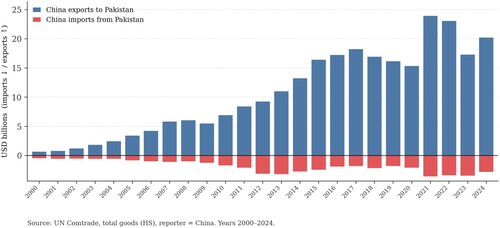
At the national level, since the launch of CPEC in 2015, Pakistan’s imports from China have skyrocketed and mostly concentrated in machinery, energy equipment – especially solar – and construction materials. In contrast, Pakistan’s exports to China have remained stagnant and narrowly concentrated. They consist primarily of low-value raw materials such as cotton yarn, rice, copper and leather, along with a smaller share of textiles produced mainly in Punjab. Very few of these export sectors have any logistical or production link to Gwadar or Balochistan, which shows how the port has done little to expand Pakistan’s export base. CPEC has reinforced Pakistan’s dependency on Chinese imports, but has so far failed to generate new export-oriented industries or value chains around key nodes like Gwadar. Instead of rebalancing trade geography as promised, CPEC has deepened Pakistan’s role as an import-dependent consumer market for Chinese goods, while its export capacity remains tied to older industrial centres far from Gwadar.
Since 2017, Pakistan's imports from China have remained the dominant flow in the bilateral relationship, rising from US$18.3 billion in 2017 to a peak of US$23.9 billion in 2021, then easing to US$17.3 billion in 2023 before recovering to US$20.2 billion in 2024. Pakistan's exports to China, in contrast, have stayed structurally narrow – between US$1.8 billion and US$3.6 billion across the entire 2017–2024 period – and consist primarily of low value-added raw materials such as cotton yarn, copper, leather and rice, with a smaller share of textiles produced largely in Punjab. Very few of these export sectors have any logistical or production link to Gwadar or Balochistan, illustrating how the port has done little to expand Pakistan's export base. As a result, the bilateral trade is among the most lopsided of China's major partnerships: in 2023 the trade-imbalance ratio (the bilateral deficit divided by total bilateral trade) stood at 66.7%, widening further to 75.5% in 2024, when China's exports of US$20.2 billion dwarfed imports of US$2.8 billion. China remains Pakistan's largest source of imports, even as the United States remains Pakistan's top export destination. CPEC has thus reinforced Pakistan's dependency on Chinese imports rather than generating new export-oriented industries or value chains around key nodes like Gwadar; instead of rebalancing trade geography as initially promised, it has deepened Pakistan's role as an import-dependent consumer market for Chinese goods, while its export capacity remains tied to older industrial centres far from Gwadar (Figure 3).
Figure 3. Pakistan–China trade flows and balance, 2000–2024 (US$ billions).
Source: UN Comtrade, total goods (HS), reporter = China.
Display full size
At the port level, the disconnect between investment and outcomes is stark. Unlike Vado, where targeted container and liquid-bulk assets map cleanly onto observed cargo trends, Gwadar exhibits a marked decoupling between investment and throughput. Phase 1 construction in the early 2000s (dredging to 14.5 metres to accommodate up to 50,000 DWT) and the 2013 handover to COPHC were followed by a decade of additional CPEC spending on core and connective assets, most notably port maintenance dredging, the Gwadar Eastbay Expressway, the new international airport and security infrastructure. Although the COVID-19 pandemic between 2020 and 2022 disrupted infrastructure development and global shipping patterns, Gwadar’s underperformance cannot be reduced to COVID alone. Even by 2024, commercial activity at Gwadar remained virtually non-existent and hugely dependent on state-directed cargo. The contrast with neighbouring facilities is also striking. Chabahar, just 173 kilometres away in Iran, handled more than 8.5 million tons of cargo in 2023, marking a 30% year-on-year increase (Maritime Gateway, 2025). Karachi, 481 kilometres to the east, processed over 65 million tons of cargo in 2023–2024, a 24.4% rise compared with the previous year (Karachi Port Trust, 2024). Gwadar, by comparison, handled just 17 ships and 506,800 tons of bulk cargo. Nine of these vessels carried wheat from Russia due to a domestic wheat shortage and all of these imports were decided and organised by the federal government in Islamabad (Pakistan Today, 2023). Due to the underutilisation of the port, the government intervened, and in January 2025, authorities pushed for rerouting 60% of public-sector imports (wheat, fertiliser and sugar) through Gwadar (Kiani, 2025a). Importantly, this shift means that 91% of the port’s revenue will go to China,Footnote3 whereas in Karachi port revenues would remain under local authorities (Kiani, 2025b).
From a cargo-type perspective, the traffic mix remains thin. Bulk inflows are episodic and policy-driven responding to federal government necessity rather than to trade patterns and dynamics. No general cargo and containers have established regular, commercially viable rotations comparable to Karachi or Port Qasim, and Gwadar has not built a metals, chemicals or petroleum profile that would indicate maturing commodity corridors.
Finally, an important difference with the case of Vado Ligure lies in the number of state and non-state actors involved in Gwadar's developments. The involvement of Chinese companies in Gwadar has led to large-scale territorial reconfigurations and increased militarisation, whereas in Vado, China’s presence is more discreet and primarily focused on business returns. Many Chinese firms have been involved in developing the Gwadar port and surrounding areas. Examples include China Airport Construction Group Corporation (CACC) that was the main contractor for Gwadar Airport, CHEC which is back in Gwadar after winning the contract for maintenance dredging of the port (Khan, 2023). Others are also involved in other CPEC developments like China Communications Construction Company (CCCC), main contractor for the coal power plant and the Gwadar Expressway as well as Gansu Provincial Construction Investment Group, responsible for the Pak-China Friendship Hospital. Chinese development organisations and banks have also played a crucial role in financing infrastructure projects in Gwadar. The Exim Bank provided most of the funding for social infrastructure, along with ChinaAid, which supports a vast network of Chinese enterprises engaged in ancillary business activities related to the port and being directly involved in the Gwadar master plan. The involvement of Chinese actors in Gwadar on a large scale has not only transformed the physical landscape but also increased militarisation to protect Chinese workers, in stark contrast to Vado, where Chinese engagement remains commercially driven and less visible.
4.6.3. Spatial impact
As Zhang Baozhong remarked, ‘Gwadar Port is like a blank sheet of paper’ (Global Times, 2023). A significant spatial reconfiguration happening in Gwadar, directly tied to Chinese investments, is a focus on social infrastructure, largely a response to protests and unrest over Gwadar’s developments not benefitting the local population. While up until 2022, most of the investment went into hardcore infrastructure (roads, energy plants, industrial parks), from 2022 onward, partly as a way to address local concerns, social infrastructure has been built through ChinaAid and EXIM Bank financing. As of 2025, over $230 million in grant-funded projects have been assigned to Gwadar, covering areas like education, healthcare and water supply. One of the flagship projects is the Pak-China Technical and Vocational Institute, built to train locals in port operations and industrial trades. Another example is the 300-bed Pak-China Friendship Hospital, as well as smaller clinics meant to expand healthcare. Then there’s the five million gallons per day (MGD) desalination plant, which was supposed to fix Gwadar’s perennial water crisis but has yet to do so. During one of the authors’ fieldworks, these facilities were largely inaccessible to local residents as checkpoints and militarised perimeters surrounded them and restricted access. Although authorities presented these projects as addressing local needs, not a single investment in social infrastructure has gone to the old city where most of Gwadar’s population lives. All the projects stand in securitised enclaves far from where most people actually reside, and local residents face growing obstacles to entering these sites.
The federal government and the military–industrial complex involved in real estate development have actively reclaimed specific areas within Gwadar, prioritising those they consider profitable. One such area is the Hammerhead of Gwadar, where they erected a massive national flag urging unity. Another example is the cricket stadium on the city’s outskirts, with its carefully maintained green grass but eerie emptiness.Footnote4 Most residents play football on the beach, while this monumental stadium rarely hosts matches and symbolises development aimed at external spectators rather than local life. All of this shows how development in Gwadar reflects geopolitical rationales more than local priorities. Authorities deploy ‘showcase’ projects as gifts to enhance China’s image and display federal control. As Prime Minister Shehbaz Sharif noted at the inauguration of the Gwadar International Airport, ‘This gift is another feather in CPEC’s (China Pakistan Economic Corridor) cap’, framing the new airport first and foremost as a symbolic gift from Beijing and not as a locally-driven development initiative (Dawn, 2024).
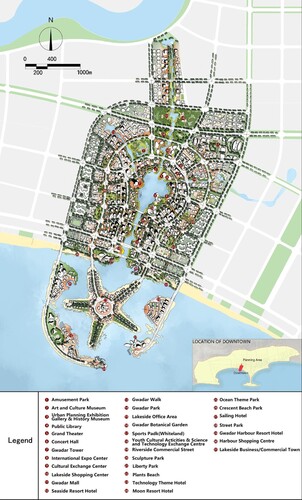
A second spatial reconfiguration is also in the making. As Karrar rightly puts it, Balochistan and Gwadar remain ‘mired in a peripheralized past despite the miraculous futures that have been imagined for it’ (Karrar, 2025, p. 250). This imagined future is well illustrated when looking at the kind of urban vision planned for Gwadar. The 2050 Master Plan presents a city of 1.4 million people, making it Pakistan’s third-largest by economic output, with a projected GDP per capita of $15,000 – over 1000% of Pakistan’s current average. The plan envisions 1.2 million new jobs and over 250,000 households. Even more telling is how the Integrated Gwadar Smart Port City Master Plan Report, prepared by CCCC and ChinaAid, frames the existing city. No major interventions are planned for Gwadar’s old city – all developments are happening outside where people actually live right now. The new downtown (shown in Figure 4), instead of organically expanding from the old city, is envisioned to be built far away on what looks like an artificial island, inspired by Gulf-style projects.
Figure 4. Gwadar Smart Port City Master Plan (2017–2050): urban design of the new downtown.
Source: Integrated Gwadar Smart Port City Master Plan Report (CCCC/ChinaAid).
Display full size
Gwadar well illustrates how Chinese influence materialises through spatial reconfigurations that respond to and are shaped by local dynamics. In this context, it is Chinese state actors such as ChinaAid and SOEs, rather than private enterprises, that intervene in ways that lead to territorial reconfigurations. These interventions intensified following large-scale protests in Balochistan. The construction of social infrastructure by Chinese state actors represents a strategic adaptation aimed at diffusing protest, stabilising the region, and ultimately creating more favourable conditions for COPHC – a private enterprise operating the port. Rather than a coherent or top-down projection of power, Chinese influence in Gwadar emerges through uneven, negotiated responses to local resistance, highlighting its contingent, reactive and relational character.
5. Discussion and implications
Table 1 below summarises the findings of our multi-scalar analysis across the two cases. Our comparative study highlights four key implications related to China’s influence. First, the temporality of Chinese investments reflects a long-term strategic vision. Second, the relational dynamics between China and host nations show how influence is co-constituted through political, economic and institutional ties. Third, Chinese actors’ adaptive capacity demonstrates a flexible approach tailored according to the context they operate in. Finally, the geostrategic positioning of the ports, located near critical resource zones and export markets, amplifies China’s leverage in regional and global trade networks.
With regards to temporality, despite transitioning from a strategy of ‘hide and bide’ to one centred on striving for achievement, China continues to present itself as an integral part of the Global South. While this self-narrative certainly carries a strong rhetorical dimension, it also reflects a distinctive approach to time horizons that sets China apart from other rising or major powers. As David Edelstein (2020, p. 390) notes, time horizons ‘describe the degree to which states value the future versus the present’. China’s insistence on identifying as a developing nation serves an important strategic function. As Edelstein argues, ‘rising great powers whose brightest days lie ahead are likely to have longer time horizons’ (Edelstein, 2020, p. 391). By positioning itself as a state whose peak is still in the future, China signals a long-term perspective that informs both its domestic policies and its international engagements. China’s emphasis on long time horizons is evident not only in its diplomatic rhetoric but also in the operation of both SOEs – COSCO – and private companies, as demonstrated in our case studies of Vado and Gwadar. Even as political and economic conditions in host countries continuously shift, shaped by changing priorities, interests and contestations at both national and local levels, Chinese companies have maintained their presence and continued their operations. This suggests that China is not exclusively focused on short-term economic profit but instead aims to build long-term relationships with host countries, enduring temporary setbacks in pursuit of long-term strategic and economic gains.
Second, our analysis revealed how Chinese state and state-affiliated actors often respond proactively to local interests, rather than simply imposing their will. In the case of Gwadar, following local resistance to the project, China opted to invest in building social infrastructure. For Vado, Chinese media actively promoted local perspectives favourable to COSCO’s investment specifically and to China more broadly. In this sense, our study concurs with Evelyn Goh’s assessment of China’s influence as often being a ‘preference multiplier’ as Beijing’s investments often adapt and adjust to local priorities.
Third, China tailors its strategies towards the contexts it operates in. Our analysis demonstrated how the diverse characteristics of partner countries, including variations in geography, political systems, material resources, economic structures and institutional frameworks, significantly shape the nature and extent of China’s approach and influence within each host nation. In mature democracies like Italy with robust institutional and regulatory frameworks and relatively stable economic environments, China's approach may prioritise slow and gradual entries and investment in high-value sectors. Conversely, in countries like Pakistan with weaker governance structures and economic volatility, infrastructure development functions both as a vehicle for economic engagement and as a strategic instrument through which China secures long-term access to critical geographies.
Fourth, China’s approach to port investments aligns with the strategic geographical logic highlighted by Kardon and Leutert (2022). The locations of these investments reflect an attempt at enhancing China’s global connectivity and economic security. In the case of Gwadar, its proximity to the Strait of Hormuz, one of the world’s most critical chokepoints for energy transit, makes it a highly strategic investment. In contrast, China’s investment in Vado is primarily driven by economic considerations, particularly in terms of securing access to the European market. Unlike Gwadar, where the focus is on energy security, the Italian port serves as a logistical hub which facilitates China’s commercial expansion into one of the world’s largest consumer markets.
6. Conclusions
The aim of this study was to examine whether and how China’s influence materialises through port infrastructure investments, contributing to the broader debate on the infrastructure–influence nexus. Employing a mixed-methods approach and disaggregating influence across political, economic and spatial dimensions – at both national and local scales – we show that Chinese engagement in Gwadar and Vado Ligure is neither uniform nor unidirectional. Instead of reflecting a singular or predetermined strategy, China’s influence unfolds through a contingent process of negotiation, adaptation and response to host-country contexts. Our comparative analysis revealed four key patterns. First, these investments tend to operate on a medium-term time horizon, suggesting a more patient and embedded form of influence than is often assumed. Second, China often acts as a ‘preference multiplier’ of national and local priorities in host countries. Third, Chinese investments exhibit a high degree of adaptability to the political economies of host countries. Fourth, they consistently target geographically strategic locations, highlighting the spatial logic of China’s global infrastructure strategy. By foregrounding the relational and context-dependent nature of Chinese influence, this study contributes to Global China scholarship by proposing a framework tracing how influence unfolds across three dimensions – political, economic and spatial – and at multiple scales. We highlight the importance of examining how global actors interact with local structures, and how influence is co-produced through these interactions. Our findings also call for more comparative, multi-sited research especially across the Global North and South to capture the varied forms and logics of influence emerging in practice. As China continues to expand its global infrastructure footprint, understanding these complex and evolving dynamics will be essential for scholars, policymakers and stakeholders seeking to assess the long-term implications of Beijing’s internationalisation.
Supplemental material
China’s port investments and influence abroad: a comparative analysis of Italy and Pakistan
79views
0shares
21downloads
Skip to figshare navigation
Appendix A. Research Design, Site Visits, and Spatial Data Construction (Gwadar and Vado
Ligure)
Research site
We identified two port sites in which to examine the materialization of China’s maritime
engagement. One site is located in the Global South, the port of Gwadar in Pakistan; the other is
located in the Global North, the port of Vado Ligure in Italy. These sites were selected because
they are both linked to China’s overseas port expansion through state-owned or state-affiliated
enterprises, yet they sit within different political economies and governance regimes.
Gwadar is located in Balochistan province along Pakistan’s Makran coastal belt, close to the
Pakistan–Iran border and approximately 400 km east of the Strait of Hormuz. The port is widely
framed by Pakistani and Chinese authorities as a strategic gateway connecting western China to
the Arabian Sea. Our research site includes the port and the immediate urban area, the Gwadar
Free Zone / Special Economic Zone, and the key connective and enabling infrastructures
associated with port development, as envisioned in the master planning documents and
implemented through CPEC-linked projects.
Vado Ligure is located on the Ligurian coast in north-western Italy, within the wider Savona–Vado
port system. It is embedded in a mature European port governance environment characterized by
dense regulatory oversight, established municipal and regional planning traditions, and integration
into EU-level trade and security frameworks. Chinese involvement in Vado is primarily tied to
COSCO Shipping Ports’ equity participation in the Vado Gateway container terminal and its
operational integration into wider shipping and logistics networks. Here too, the research includes
the container terminal and adjacent port facilities, the immediate land-side logistics and the
surrounding area where port expansion and planning intersect.
Open source data analysis and construction of the case-based geospatial database
The initial step of the research consisted in building a case-based geospatial database for both sites
and using open-source data to examine the temporal dynamics and spatial characteristics of
Chinese-linked port development and associated infrastructures. The goal was to compare (1) what
was envisioned (master plans and official development narratives), (2) what was financed and
implemented (project-level evidence), and (3) what materially exists on the ground (validated
through site visits).
For project-level data on Chinese development finance, we relied on China's Global Loans and
Grants Dataset. This dataset provides information on Chinese-financed projects including sector
classification, implementing and financing actors, project status and timelines, and where available
geographic coordinates. For Gwadar, project-level information was triangulated and expanded
using additional public sources because many port-adjacent developments are recorded across
multiple repositories with inconsistent naming conventions and incomplete geocoding. In practice,
this involved reconstructing a “Gwadar portfolio” by cross-checking project lists and descriptions
across (1) AidData entries, (2) publicly available government releases and media reporting, (3)
port and planning documents, and (4) CPEC-related public documentation including the official
CPEC website for district-level and Gwadar-specific projects since the formalization of CPEC.
For Vado, the database was constructed by combining open planning documentation and port
authority materials with public reporting and port development documents that identify the major
infrastructural works associated with the container platform and the wider Savona–Vado system.
Planning materials were used as spatial references that define the intended territorial logic of port
expansion and logistical integration.
In both cases, spatial layers were created to support two types of comparison. First, the database
locates Chinese-linked projects and associated infrastructures relative to the port. Second, it
enables comparison between “envisioned” versus “implemented” development by mapping
master-plan representations against existing infrastructure footprints. Geographic features for
contextual layers were retrieved from OpenStreetMap.
Fieldwork and site visits
Field observations were conducted through site visits of one of the authors to Gwadar between
April 24, 2023 and May 1, 2023 and to Vado Ligure between July 1 and 7 2024. These visits
served two purposes. First, they were used to validate and contextualize the spatial database by
verifying the physical presence and the infrastructure footprint and to provide information on
access.
The Gwadar visit took place during a broader research period in Pakistan from 13 February to 4
May 2023. This fieldwork period was facilitated by one of the authors’ appointment as
[anonymised].
Access conditions differed substantially across the two sites and are analytically significant for the
research design. In Gwadar, to access the research site, we obtained non-objection certificates from
two separate Pakistani state departments and travelled with a licensed local guide. These access
conditions also constrained data collection: the authorization framework did not permit
engagement with local residents for interview purposes. For this reason, fieldwork in Gwadar was
limited to direct observation, structured field notes, and site-based validation of infrastructure
locations and accessibility (ground-truthing), rather than interviews with local communities.
In Vado Ligure, by contrast, we conducted site visits to the port area and surrounding connective
infrastructures without access constraints. However, to maintain methodological comparability
across cases and to avoid introducing asymmetry in the evidentiary base we adopted the same
fieldwork strategy used in Gwadar. We therefore limited the Vado field component to ground-
truthing and systematic observational documentation and no interviews with local actors.
ShareDownload
Supplemental Material
Acknowledgements
The authors would like to thank the three reviewers and editors for their very constructive feedback. We are also grateful to Giles Mohan and Ceren Ergenc for inviting us to contribute to the special issue this article is part of. All errors are our own.
Disclosure statement
No potential conflict of interest was reported by the author(s).
Data availability statement
The data supporting the findings of this study are derived from publicly available sources. Trade data were obtained from the World Integrated Trade Solution (WITS); port traffic data were collected from the Autorità di Sistema Portuale del Mar Ligure Occidentale and project-level financing data were drawn from AidData’s Global Chinese Development Finance Dataset (version 1.0). Geospatial base layers were retrieved from OpenStreetMap. All data underlying this study are openly available for download here: https://drive.google.com/drive/folders/1KrUBVa96_HMUGR7BJDJCrtha4TvgGC7x?usp=sharing.
Supplemental Material
Supplemental data for this article can be accessed online at https://doi.org/10.1080/21622671.2026.2684486
Correction Statement
This article has been corrected with minor changes. These changes do not impact the academic content of the article.
Notes
1 Qingdao International has sold its 9.9% share to APM Terminals in 2023.
2 Fieldwork observation by one of the authors, July 2024.
3 COPHC secured a controversial agreement granting it 91% of revenue generated by Gwadar Port, while the Gwadar Port Authority receives only 9% for the duration of the 40-year lease
4 Fieldwork observation by one of the authors, April 2024.
Previous articleView latest articlesNext article
References
- Abb, P., Boni, F., & Karrar, H. H. (2024). China, Pakistan and the Belt and Road Initiative: The experience of an early adopter state. Rethinking Asia and international relations. Routledge.
(Open in a new window)Google Scholar
- Adeney, K., & Boni, F. (2021). How China and Pakistan Negotiate. Carnegie Endowment for International Peace.
(Open in a new window)Google Scholar
- Adeney, K., & Boni, F. (2024). Global China and Pakistan’s federal politics: 10 years of the China–Pakistan Economic Corridor. Commonwealth & Comparative Politics, 62(3), 275–295. https://doi.org/10.1080/14662043.2024.2354568

(Open in a new window)Web of Science ®(Open in a new window)Google Scholar
- Andrijauskas, K., & Boruta, R. (2025). China’s economic pressure campaign against Lithuania: The novelties and limits of Chinese economic statecraft and coercion. The International Spectator, 60(2), 38–55. https://doi.org/10.1080/03932729.2024.2444289
(Open in a new window)Web of Science ®(Open in a new window)Google Scholar
- Anees, M. S. (2024). “From activism to provincial assembly: A conversation with Gwadar’s Maulana Hidayat ur Rehman”, The Diplomat, 17 July 2024, https://thediplomat.com/2024/07/from-activism-to-provincial-assembly-a-conversation-with-gwadars-maulana-hidayat-ur-rehman/(open in a new window)
(Open in a new window)Google Scholar
- ANSA. (2023). ‘Italia e Cina partner naturali, i fatti vincono sulla retorica’, 14 February 2023, https://www.ansa.it/sito/notizie/mondo/2023/02/11/italia-e-cina-partner-naturali-i-fatti-vincono-sulla-retorica_85711042-4709-436c-bd62-69bd6d801edc.html(open in a new window)
(Open in a new window)Google Scholar
- Banach, C., & Gunter, J. (2023). How the BRI is shaping global trade and what to expect from the initiative in its second decade. Mercator Institute for China Studies. https://merics.org/en/tracker/how-bri-shaping-global-trade-and-what-expect-initiative-its-second-decade(open in a new window)
(Open in a new window)Google Scholar
- Blanchard, J.-M. F. (Ed.). (2024). Chinese overseas ports in southeast and south Asia: Cutting through the froth (1st ed.). Routledge. https://doi.org/10.4324/9781003495567.
(Open in a new window)Google Scholar
- Boni, F. (2019). Sino-Pakistani relations. Politics, military and regional dynamics. Routledge.
(Open in a new window)Google Scholar
- Boni, F. (2023). “What Wang Yi’s European tour told us about China-EU relations”, EUROPP – European Politics and Policy, 22 February 2023, https://blogs.lse.ac.uk/europpblog/2023/02/22/what-wang-yis-european-tour-told-us-about-china-eu-relations/(open in a new window)
(Open in a new window)Google Scholar
- Boni, F. (2023). Strategic partnerships and China’s diplomacy in Europe: Insights from Italy. The British Journal of Politics and International Relations, 25(4), 740–757. https://doi.org/10.1177/13691481221127571

(Open in a new window)Web of Science ®(Open in a new window)Google Scholar
- Breslin, S., & Nesadurai, H. E. S. (2023). Economic statecraft, geoeconomics and regional political economies. The Pacific Review, 36(5), 927–948. https://doi.org/10.1080/09512748.2023.2200030

(Open in a new window)Web of Science ®(Open in a new window)Google Scholar
- Chen, J., Fei, Y., Lee, P. T.-W., & Tao, X. (2019). Overseas port investment policy for China’s central and local overnments in the belt and road initiative. Journal of Contemporary China, 28(116), 196–215.
(Open in a new window)Web of Science ®(Open in a new window)Google Scholar
- Dawn. (2024). “PM Shehbaz inaugurates Gwadar International Airport on Chinese Premier Li Qiang’s visit”, October 14, 2024, https://www.dawn.com/news/1865145(open in a new window)
(Open in a new window)Google Scholar
- Edelstein, D. M. (2020). Time and the rise of China. The Chinese Journal of International Politics, 13(3), 387–417. https://doi.org/10.1093/cjip/poaa010
(Open in a new window)Web of Science ®(Open in a new window)Google Scholar
- European Commission. (2019). EU-China – a strategic outlook, 12 March. https://commission.europa.eu/system/files/2019-03/communication-eu-china-a-strategic-outlook.pdf(open in a new window)
(Open in a new window)Google Scholar
- Farooq, F. (2012). “People of Balochistan have foremost right over Gwadar port: Nawaz Sharif”, News Pakistan, https://www.newspakistan.pk/2012/07/03/people-balochistan-foremost-gwadar-port-nawaz-sharif/(open in a new window)
- Farrell, H., & Newman, A. L. (2019). Weaponized interdependence: How global economic networks shape statecoercion. International Security, 44(1), 42–79. https://doi.org/10.1162/isec_a_00351
- Fasulo, F. (2024). Italy and China: Back to normality?, ISPI, https://www.ispionline.it/en/publication/italy-and-china-back-to-normality-175798(open in a new window)
- Ferchen, M., & Mattlin, M. (2023). Five modes of China’s economic influence: Rethinking Chinese economic statecraft. The Pacific Review, 36(5), 978–1004. https://doi.org/10.1080/09512748.2023.2200029
- Ghiretti, F., Gökten, M., Gunter, J., Pindyuk, O., Sebastian, G., Tonchev, P., & Zavarská, Z. (2023). Research for TRAN committee – Chinese investments in European maritime infrastructure. European Parliament, Policy Department for Structural and Cohesion Policies.
- Global Times. (2019). “How an Italian port illustrates the future of China-Europe ties”, 30 August 2019, https://www.globaltimes.cn/content/1163136.shtml(open in a new window)
- Global Times. (2023). “Gwadar being transformed into modern hub via BRI.”, July 5, 2023. https://www.globaltimes.cn/page/202307/1295398.shtml(open in a new window)
- Goh, E. (2014). The modes of China’s influence: Cases from Southeast Asia. Asian Survey, 54(5), 825–848. https://doi.org/10.1525/as.2014.54.5.825
- Governo Italiano. (2024). Piano di Azione Italia Cina 2024-2027, https://www.governo.it/sites/governo.it/files/Piano_Azione_Italia-Cina_2024-2027.pdf
- Gu, B. (2024). Black gold and green BRI–A grounded analysis of Chinese investment in coal-fired power plants in Indonesia. The Extractive Industries and Society, 17, 1–13. doi:10.1016/j.exis.2024.101411
- Guide, J. (2023). “Italy and China should initiate a full relaunch of all-sector exchanges and cooperation and take action ASAP to make up for the time lost due to the pandemic. As said by Director Wang Yi”, X, 16 February 2023, https://x.com/AmbJiaGuide/status/1626361694837415936(open in a new window)
- Gurol, J., & Rodríguez, F. (2022). “Contingent power extension” and regional (dis)integration: China’s Belt and Road Initiative and its consequences for the EU. Asia Europe Journal, 20(4), 441–456. https://doi.org/10.1007/s10308-022-00651-9
- Hillman, J. E. (2021). The digital silk road: China's quest to wire the world and win the future. Profile Books.
- Hu, Z.-H., Liu, C.-J., & Lee, P. T.-W. (2021). China’s global investment and maritime flows in the context of the belt and road initiative. Journal of Contemporary China, 30(129), 465–480. https://doi.org/10.1080/10670564.2020.1827357
- I. Conceptual Language: The Problem with ‘Chinese Influence’. (2021). Whitehall Papers, 98(1), 14–28.
- Iftikhar, M. (2025). Regional security structure and domestic political economy interests: Comparative analysis of Belt and Road Initiative investments in the Philippines and Malaysia. Asia and the Global Economy, 5(2), 100128. doi:10.1016/j.aglobe.2025.100128
- Jakimów, M., Boni, F., & Turcsányi, R. (2025). Does populism matter in EU–China relations? The cases of Italy and Czechia. JCMS: Journal of Common Market Studies, 63(1), 89–107. https://doi.org/10.1111/jcms.13621
- Jamali, H. A. (2014). A harbor in the tempest: Megaprojects, identity, and the politics of place in Gwadar, Pakistan (Doctoral dissertation).
- Jones, L., & Hameiri, S. (2021). Fractured China. In Fractured China: How state transformation is shaping China’s rise. Cambridge University Press.
- Jones, L., & Zeng, J. (2019). Understanding China’s ‘Belt and Road Initiative’: beyond ‘grand strategy’ to a state transformation analysis. Third World Quarterly, 40(8), 1415–1439. https://doi.org/10.1080/01436597.2018.1559046
- Kao, P. S. (2021). The political economy of China’s strategic layout in Europe: A case study of the Belt and Road Initiative. The Chinese Economy, 55(4), 303–316. https://doi.org/10.1080/10971475.2021.1972549
- Karachi Port Trust. (2024). A massive increase of 24.43% in cargo handling at Karachi port at the end of F.Y 2023–24, https://kpt.gov.pk/news/149/a-massive-increase-of-24.43-percent-in-cargo-handling-at-karachi-port-at-the-end-of-f.y-2023-24(open in a new window)
- Kardon, I. B., Kennedy, C. M., & Dutton, P. A. (2020). “China maritime report no. 7: Gwadar: China’s Potential Strategic Strongpoint in Pakistan” https://x.com/ImranKhanPTI/status/1321401079947558915(open in a new window)
- Kardon, I. B., & Leutert, W. (2022). Pier competitor: China’s power position in global ports. International Security, 46(4), 9–47. https://doi.org/10.1162/isec_a_00433
- Karrar, H. (2025). A Dubai and a Shenzhen in Gwadar? Development models on Pakistan’s securitized coastline at the turn of the century. Radical History Review, 2025(151), 241–252. https://doi.org/10.1215/01636545-11506784
- Khan, Y. H. (2023). CHEC to start de-silting operation in Gwadar Port, 12 February, https://www.gwadarpro.pk/1624364267779649538/chec-to-start-de-silting-operation-in-gwadar-port(open in a new window)
- Khetran, M. S. (2015). The potential and prospects of Gwadar Port. Strategic Studies, 34(4), 70–89.
- Kiani, K. (2025a). After a decade, govt wakes up to market Gwadar port, Dawn, 9 January 2025, https://www.dawn.com/news/1883968(open in a new window)
- Kiani, K. (2025b). Private firms urged to use Gwadar port, Dawn, 15 January 2025, https://www.dawn.com/news/1885214(open in a new window)
- Lalwani, S. P. (2022). A threshold alliance: The China-Pakistan military relationship. US Institute of Peace.
- Lamperti, L. (2019). “Vado Ligure, apre il Terminal Gateway. “Ma in Italia sulle infrastrutture si deve fare di più”, Affari Italiani, 10th December 2019, https://www.affaritaliani.it/cronache/vado-ligure-apm-terminals-apertura-intervista-infrastrutture.html(open in a new window)
- La Repubblica. (2019). “Via della Seta: Toti “Genova non farà la fine del Pireo”, 20 Marzo 2019, https://genova.repubblica.it/cronaca/2019/03/20/news/via_della_seta_toti_genova_non_fara_la_fine_del_pireo_−222089511(open in a new window)
- La Stampa. (2016). “Ma adesso serve lavoro per i vadesi”, 19 October 2016, https://www.lastampa.it/savona/2016/10/19/news/ma-adesso-servelavoro-per-i-vadesi-1.34790588/(open in a new window)
- Lee, P. T.-W., Zhang, Q., Suthiwartnarueput, K., Zhang, D., & Yang, Z. (2020). Research trends in Belt and Road Initiative studies on logistics, supply chains, and transportation sector. International Journal of Logistics: Research and Applications, 23(6), 525–543.
- Liu, Z., Dunford, M., & Liu, W. (2021). Coupling national geo-political economic strategies and the belt and road initiative: The China-Belarus great stone industrial park. Political Geography, 84, 102296. https://doi.org/10.1016/j.polgeo.2020.102296
- Loughlin, N., & Milne, S. (2025). Speculative land grabs and Chinese investment: Cambodia’s evolving regime of dispossession. Globalizations, 22(8), 1396–1414. https://doi.org/10.1080/14747731.2024.2320494
- Maritime Gateway. (2025). “Volume of goods loaded and unloaded at Chabahar port increased by 30%”, 13 February 2025, https://www.maritimegateway.com/volume-of-goods-loaded-and-unloaded-at-chabahar-port-increased-by-30/(open in a new window)
- Massaro, F. (2021). “Draghi ferma i cinesi con il ‘golden power’: cosa è e perchè l’italiana lpe è stata protetta”, Corriere della Sera, 21 April 2021, https://www.corriere.it/economia/aziende/21_aprile_09/draghi-ferma-cinesi-il-golden-power-cos-e-perche-l-italiana-lpe-stata-protetta-ec7b7088-98fa-11eb-9898-68a50e5b3d06.shtml(open in a new window)
- Mohan, G., Boni, F., Rogers, S., Schaefer, F., & Wang, Y. (2024). De-risking, re-balancing and recentralising: Intra-state relations in Chinese-backed transport infrastructure projects in Europe. Political Geography, 113, 103152. doi:10.1016/j.polgeo.2024.103152
- Musharraf, P. (2006, February 23). ‘President at Pak-China business forum’: https://presidentmusharraf.wordpress.com/2006/09/24/musharraf-china-business-form/(open in a new window).
- Pakistan Today. (2023). Gwadar port proves international worth, handles all 9 wheat ships, 4th May 2023, https://www.pakistantoday.com.pk/2023/05/04/gwadar-port-proves-international-worth-handles-all-9-wheat-ships/(open in a new window)
- People.cn. (2019, March 22). China contributes to Italian port construction for win-win results 2019. https://en.people.cn/n3/2019/0322/c90000-9559340.html. (accessed 15/06/2026)
- Reilly, J. (2017). China’s economic statecraft in Europe. Asia Europe Journal, 15(2), 173–185. https://doi.org/10.1007/s10308-017-0473-6
- Rolland, N. (2017). China's Eurasian century?: Political and strategic implications of the belt and road initiative. National Bureau of Asian Research.
- Roy, I., Eckhardt, J., Stroikos, D., & Davidescu, S. (Eds.). (2024). Rising power, limited influence: The politics of Chinese investments in Europe and the liberal international order. Oxford University Press.
- Ryuichi, S., Tanabe, S., Kato, H., & Lee T.-W. P. (2019). Could Gwadar Port in Pakistan be a new gateway? A network simulation approach in the context of the belt and road initiative. Sustainability, MDPI, 11(20), 1–28.
- Safdar, M. T. (2025). The BRI in Pakistan’s power sector: From initial success to structural challenges. World Development, 190, 106929.
- Seawright, J., & Gerring, J. (2008). Case selection techniques in case study research: A menu of qualitative and quantitative options. Political Research Quarterly, 61(2), 294–308.
- Select Committee on the CCP. (2024). https://selectcommitteeontheccp.house.gov/media/press-releases/investigation-select-committee-ccp-house-homeland-finds-potential-threats-us(open in a new window)
- Shahid, S. (2022). “Development of Gwadar top priority, says Balochistan CM Bizenjo”, Dawn, 9 May 2022, https://www.dawn.com/news/1688735(open in a new window)
- SIPRI. (2024). “Arms Transfer Database”, data generated on 15 January 2025, https://armstransfers.sipri.org/ArmsTransfer/CSVResult(open in a new window)
- Spigarelli, F., & Lepore, D. (2023). China’s Italian ports in the spotlight: Economic, social, and geopolitical aspects. In J. M. Blanchard (Ed.), Chinese overseas ports in Europe and the Americas: Understanding smooth and turbulent waters (pp. 93–109). Routledge.
- Strange, A. (2023). Chinese global infrastructure. Cambridge University Press.
- Wang, Z., & Fu, Y. (2022). Local politics and fluctuating engagement with China: Analysing the Belt and Road Initiative in maritime Southeast Asia. The Chinese Journal of International Politics, 15(2), 163–182. https://doi.org/10.1093/cjip/poac006
- Westfall, S. (2021). “Pakistan’s prime minister embraces China’s policy toward Uyghurs in remarks on Communist Party centenary”, The Washington Post, 2 July 2021, https://www.washingtonpost.com/world/2021/07/02/pakistan-prime-minister-backs-china-on-uyghurs/(open in a new window)
- Zoppolato, D. G., & Boni, F. (2025). Symbolic power and the reception of Chinese narratives on the China–Pakistan economic corridor: adaptation and contestation. Eurasian Geography and Economics, 1–23. https://doi.org/10.1080/15387216.2025.2597822
- Zoppolato, D. G., & Culcasi, K. (2026). Social media geopolitics: The “unofficial geopolitics” of Chinese vloggers in Pakistan. Geopolitics, 31(1), 313–333. https://doi.org/10.1080/14650045.2025.2499133
More Research
1/2